Casey Paquola, Margaret Garber, Stefan Frässle, Jessica Royer, Yigu Zhou, Shahin Tavakol, Raul Rodriguez-Cruces, Donna Gift Cabalo, Sofie Valk, Simon B. Eickhoff, Daniel S. Margulies, Alan Evans, Katrin Amunts, Elizabeth Jefferies, Jonathan Smallwood, Boris C. Bernhardt
{"title":"The architecture of the human default mode network explored through cytoarchitecture, wiring and signal flow","authors":"Casey Paquola, Margaret Garber, Stefan Frässle, Jessica Royer, Yigu Zhou, Shahin Tavakol, Raul Rodriguez-Cruces, Donna Gift Cabalo, Sofie Valk, Simon B. Eickhoff, Daniel S. Margulies, Alan Evans, Katrin Amunts, Elizabeth Jefferies, Jonathan Smallwood, Boris C. Bernhardt","doi":"10.1038/s41593-024-01868-0","DOIUrl":null,"url":null,"abstract":"The default mode network (DMN) is implicated in many aspects of complex thought and behavior. Here, we leverage postmortem histology and in vivo neuroimaging to characterize the anatomy of the DMN to better understand its role in information processing and cortical communication. Our results show that the DMN is cytoarchitecturally heterogenous, containing cytoarchitectural types that are variably specialized for unimodal, heteromodal and memory-related processing. Studying diffusion-based structural connectivity in combination with cytoarchitecture, we found the DMN contains regions receptive to input from sensory cortex and a core that is relatively insulated from environmental input. Finally, analysis of signal flow with effective connectivity models showed that the DMN is unique amongst cortical networks in balancing its output across the levels of sensory hierarchies. Together, our study establishes an anatomical foundation from which accounts of the broad role the DMN plays in human brain function and cognition can be developed. The default mode network (DMN) is implicated in cognition and behavior. Here, the authors show that the DMN is cytoarchitecturally heterogeneous, it contains regions receptive to input from the sensory cortex and a core relatively insulated from environmental input, and it uniquely balances its output across sensory hierarchies.","PeriodicalId":19076,"journal":{"name":"Nature neuroscience","volume":"28 3","pages":"654-664"},"PeriodicalIF":20.0000,"publicationDate":"2025-01-28","publicationTypes":"Journal Article","fieldsOfStudy":null,"isOpenAccess":false,"openAccessPdf":"https://www.nature.com/articles/s41593-024-01868-0.pdf","citationCount":"0","resultStr":null,"platform":"Semanticscholar","paperid":null,"PeriodicalName":"Nature neuroscience","FirstCategoryId":"3","ListUrlMain":"https://www.nature.com/articles/s41593-024-01868-0","RegionNum":1,"RegionCategory":"医学","ArticlePicture":[],"TitleCN":null,"AbstractTextCN":null,"PMCID":null,"EPubDate":"","PubModel":"","JCR":"Q1","JCRName":"NEUROSCIENCES","Score":null,"Total":0}
引用次数: 0
Abstract
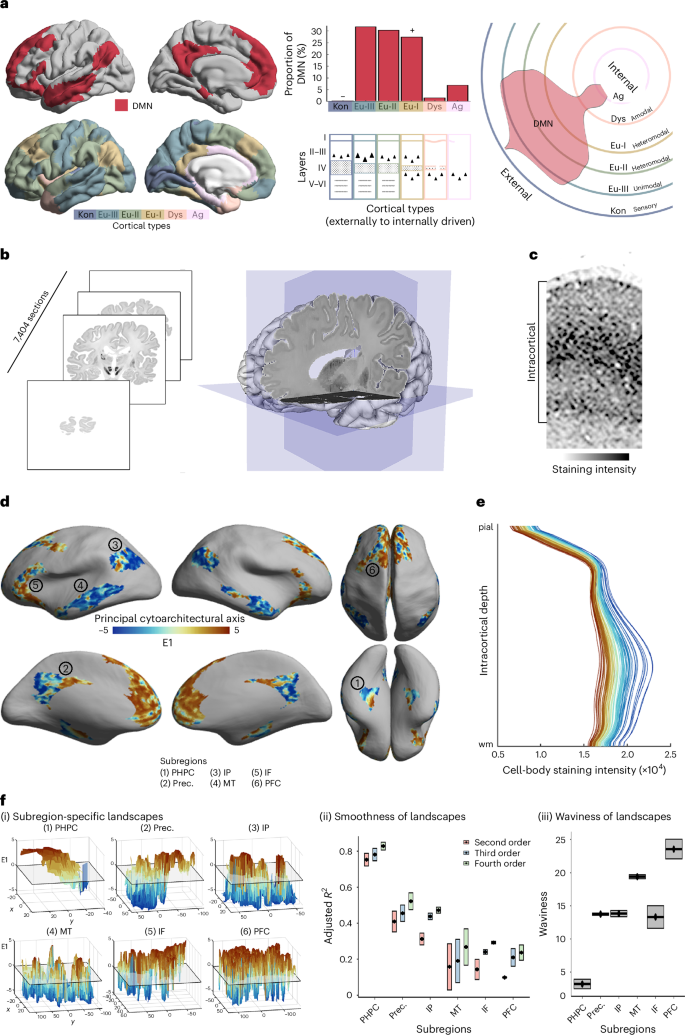
The default mode network (DMN) is implicated in many aspects of complex thought and behavior. Here, we leverage postmortem histology and in vivo neuroimaging to characterize the anatomy of the DMN to better understand its role in information processing and cortical communication. Our results show that the DMN is cytoarchitecturally heterogenous, containing cytoarchitectural types that are variably specialized for unimodal, heteromodal and memory-related processing. Studying diffusion-based structural connectivity in combination with cytoarchitecture, we found the DMN contains regions receptive to input from sensory cortex and a core that is relatively insulated from environmental input. Finally, analysis of signal flow with effective connectivity models showed that the DMN is unique amongst cortical networks in balancing its output across the levels of sensory hierarchies. Together, our study establishes an anatomical foundation from which accounts of the broad role the DMN plays in human brain function and cognition can be developed. The default mode network (DMN) is implicated in cognition and behavior. Here, the authors show that the DMN is cytoarchitecturally heterogeneous, it contains regions receptive to input from the sensory cortex and a core relatively insulated from environmental input, and it uniquely balances its output across sensory hierarchies.
期刊介绍:
Nature Neuroscience, a multidisciplinary journal, publishes papers of the utmost quality and significance across all realms of neuroscience. The editors welcome contributions spanning molecular, cellular, systems, and cognitive neuroscience, along with psychophysics, computational modeling, and nervous system disorders. While no area is off-limits, studies offering fundamental insights into nervous system function receive priority.
The journal offers high visibility to both readers and authors, fostering interdisciplinary communication and accessibility to a broad audience. It maintains high standards of copy editing and production, rigorous peer review, rapid publication, and operates independently from academic societies and other vested interests.
In addition to primary research, Nature Neuroscience features news and views, reviews, editorials, commentaries, perspectives, book reviews, and correspondence, aiming to serve as the voice of the global neuroscience community.




 京公网安备 11010802042870号
京ICP备2023020795号-1
京公网安备 11010802042870号
京ICP备2023020795号-1

 分享
分享
 求助内容:
求助内容: 应助结果提醒方式:
 扫码关注我们
