Tzu-Hsuen Yuan , Chun-Ju Tai , Cheng-Hsien Tsai , Jien-Wen Chien , Akifumi Eguchi , Chih-Yun Li , Ching-Wen Lin , Chisato Mori , Chang-Chuan Chan
{"title":"Exploring the influence of PCB exposure on neonatal birth outcomes and neurobehavioral development after 15 years of prohibition","authors":"Tzu-Hsuen Yuan , Chun-Ju Tai , Cheng-Hsien Tsai , Jien-Wen Chien , Akifumi Eguchi , Chih-Yun Li , Ching-Wen Lin , Chisato Mori , Chang-Chuan Chan","doi":"10.1016/j.envpol.2025.125761","DOIUrl":null,"url":null,"abstract":"<div><div>Despite polychlorinated biphenyls (PCBs) have been banned in Taiwan for fifteen years, epidemiological studies indicated that prenatal PCB exposure may still affect newborns and their birth outcomes. The study aimed to investigate the association between PCB concentrations in umbilical cord blood and infants' birth outcomes and neurodevelopment. We recruited 100 pairs of mothers and infants, residing in Changhua and Yunlin countries in Taiwan from 2014 to 2016. Maternal questionnaire surveys conducted to collect demographic data, and the Chinese version of the Neonatal Neurobehavioral Assessment Scale was used to assess the development of their neurological behavior in newborns within one to two weeks after birth. Additionally, the Infant Temperament Questionnaire was used to evaluate newborns’ responses to stimuli. The measured levels of 23 PCB congeners were analyzed using gas chromatography-electron capture negative ionization quadrupole mass spectrometry (GC-NICI-qMS). Multiple regression explored correlations between prenatal PCB exposure and neonatal birth outcomes, neurobehavioral, and temperament. Additionally, we used the Weighted Quantile Sum (WQS) regression model analysis to identify the major contributing congener. The results revealed that 9 PCB congeners were commonly found in the study participants, specifically PCB138, PCB153, PCB180, PCB156, PCB170, PCB177, PCB187, PCB194, and PCB201. The top three PCBs congeners by levels were PCB138, PCB153, and PCB180 (17.28 ± 16.84, 11.50 ± 15.12, 8.09 ± 14.10 pg/g wet weight, respectively). The decrease in birth weight and head circumference in newborns were each associated with 7 different PCB congeners, with 6 of them being correlated with both, including PCB153, PCB156, PCB177, PCB180, PCB187, and PCB194. Specifically, PCB153 was associated with delayed neurobehavioral development in newborns. Exposure to PCB153, PCB177, and PCB180 influenced the temperament development of newborns. The WQS results indicated that PCB156 and PCB177 were the major contributors to decreased birth weight and head circumference. In conclusion, despite the prohibition of PCB usage, prenatal exposure to PCBs may still affect neonatal health. It is recommended that Taiwan should monitor local newborns' long-term PCB exposure and track potential adverse health effects in their future development.</div></div>","PeriodicalId":311,"journal":{"name":"Environmental Pollution","volume":"368 ","pages":"Article 125761"},"PeriodicalIF":7.3000,"publicationDate":"2025-03-01","publicationTypes":"Journal Article","fieldsOfStudy":null,"isOpenAccess":false,"openAccessPdf":"","citationCount":"0","resultStr":null,"platform":"Semanticscholar","paperid":null,"PeriodicalName":"Environmental Pollution","FirstCategoryId":"93","ListUrlMain":"https://www.sciencedirect.com/science/article/pii/S0269749125001344","RegionNum":2,"RegionCategory":"环境科学与生态学","ArticlePicture":[],"TitleCN":null,"AbstractTextCN":null,"PMCID":null,"EPubDate":"2025/1/28 0:00:00","PubModel":"Epub","JCR":"Q1","JCRName":"ENVIRONMENTAL SCIENCES","Score":null,"Total":0}
引用次数: 0
Abstract
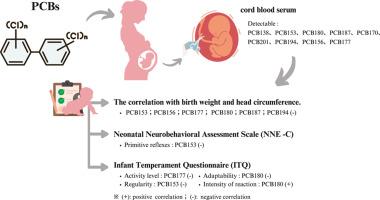
Despite polychlorinated biphenyls (PCBs) have been banned in Taiwan for fifteen years, epidemiological studies indicated that prenatal PCB exposure may still affect newborns and their birth outcomes. The study aimed to investigate the association between PCB concentrations in umbilical cord blood and infants' birth outcomes and neurodevelopment. We recruited 100 pairs of mothers and infants, residing in Changhua and Yunlin countries in Taiwan from 2014 to 2016. Maternal questionnaire surveys conducted to collect demographic data, and the Chinese version of the Neonatal Neurobehavioral Assessment Scale was used to assess the development of their neurological behavior in newborns within one to two weeks after birth. Additionally, the Infant Temperament Questionnaire was used to evaluate newborns’ responses to stimuli. The measured levels of 23 PCB congeners were analyzed using gas chromatography-electron capture negative ionization quadrupole mass spectrometry (GC-NICI-qMS). Multiple regression explored correlations between prenatal PCB exposure and neonatal birth outcomes, neurobehavioral, and temperament. Additionally, we used the Weighted Quantile Sum (WQS) regression model analysis to identify the major contributing congener. The results revealed that 9 PCB congeners were commonly found in the study participants, specifically PCB138, PCB153, PCB180, PCB156, PCB170, PCB177, PCB187, PCB194, and PCB201. The top three PCBs congeners by levels were PCB138, PCB153, and PCB180 (17.28 ± 16.84, 11.50 ± 15.12, 8.09 ± 14.10 pg/g wet weight, respectively). The decrease in birth weight and head circumference in newborns were each associated with 7 different PCB congeners, with 6 of them being correlated with both, including PCB153, PCB156, PCB177, PCB180, PCB187, and PCB194. Specifically, PCB153 was associated with delayed neurobehavioral development in newborns. Exposure to PCB153, PCB177, and PCB180 influenced the temperament development of newborns. The WQS results indicated that PCB156 and PCB177 were the major contributors to decreased birth weight and head circumference. In conclusion, despite the prohibition of PCB usage, prenatal exposure to PCBs may still affect neonatal health. It is recommended that Taiwan should monitor local newborns' long-term PCB exposure and track potential adverse health effects in their future development.
期刊介绍:
Environmental Pollution is an international peer-reviewed journal that publishes high-quality research papers and review articles covering all aspects of environmental pollution and its impacts on ecosystems and human health.
Subject areas include, but are not limited to:
• Sources and occurrences of pollutants that are clearly defined and measured in environmental compartments, food and food-related items, and human bodies;
• Interlinks between contaminant exposure and biological, ecological, and human health effects, including those of climate change;
• Contaminants of emerging concerns (including but not limited to antibiotic resistant microorganisms or genes, microplastics/nanoplastics, electronic wastes, light, and noise) and/or their biological, ecological, or human health effects;
• Laboratory and field studies on the remediation/mitigation of environmental pollution via new techniques and with clear links to biological, ecological, or human health effects;
• Modeling of pollution processes, patterns, or trends that is of clear environmental and/or human health interest;
• New techniques that measure and examine environmental occurrences, transport, behavior, and effects of pollutants within the environment or the laboratory, provided that they can be clearly used to address problems within regional or global environmental compartments.




 京公网安备 11010802042870号
京ICP备2023020795号-1
京公网安备 11010802042870号
京ICP备2023020795号-1

 分享
分享
 求助内容:
求助内容: 应助结果提醒方式:
 扫码关注我们
