{"title":"Uncertainty in the Carbon Footprint accounting and evaluation of textile and apparel products: A systematic review","authors":"Qing He , Xiongying Wu , Xuemei Ding","doi":"10.1016/j.jclepro.2025.144885","DOIUrl":null,"url":null,"abstract":"<div><div>The textile and apparel industry is pivotal in the global economy but faces significant environmental challenges, particularly regarding Greenhouse Gas (GHG) emissions reduction. Carbon Footprint of a Product (CFP) serves as an effective measure of carbon emissions and has garnered widespread attention within the industry. However, there is a lack of comprehensive accounting and analysis of its uncertainties, especially in the textile and apparel sector. This study analyzes the main factors influencing uncertainties in CFP and categorizes them based on the accounting process and life cycle characteristics of textile and apparel products. It identifies the primary factors affecting uncertainty as the definition of system boundaries, the quality of activity data and emission factor data, the selection of allocation methods, and the setting of scenarios. Methodological uncertainty, in addition to parameter, scenario, and model uncertainties, should also be considered. A review of 1072 CFP related publications on textile and apparel products from 2000 to 2023 revealed that 38 mentioned uncertainties, with only 10 providing qualitative or quantitative assessments, primarily focusing on parameter uncertainty. The main techniques identified for summarizing uncertainty analysis methods are Monte Carlo simulation (MCS), pedigree matrix and Data Quality Indicator (DQI) methods, or a combination of both (DQI + MCS), and sensitivity analysis (SA). Future work should focus on enhancing attention to model, scenario, and methodological uncertainty to establish a more systematic and comprehensive evaluation framework. Digital acquisition technology, blockchain technology, modular theory and fuzzy methods should be used to improve data collection methods and optimize the selection and verification of data sources, thereby reducing uncertainties at the source.</div></div>","PeriodicalId":349,"journal":{"name":"Journal of Cleaner Production","volume":"492 ","pages":"Article 144885"},"PeriodicalIF":10.0000,"publicationDate":"2025-02-10","publicationTypes":"Journal Article","fieldsOfStudy":null,"isOpenAccess":false,"openAccessPdf":"","citationCount":"0","resultStr":null,"platform":"Semanticscholar","paperid":null,"PeriodicalName":"Journal of Cleaner Production","FirstCategoryId":"93","ListUrlMain":"https://www.sciencedirect.com/science/article/pii/S0959652625002355","RegionNum":1,"RegionCategory":"环境科学与生态学","ArticlePicture":[],"TitleCN":null,"AbstractTextCN":null,"PMCID":null,"EPubDate":"2025/1/28 0:00:00","PubModel":"Epub","JCR":"Q1","JCRName":"ENGINEERING, ENVIRONMENTAL","Score":null,"Total":0}
引用次数: 0
Abstract
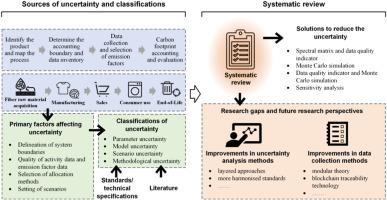
The textile and apparel industry is pivotal in the global economy but faces significant environmental challenges, particularly regarding Greenhouse Gas (GHG) emissions reduction. Carbon Footprint of a Product (CFP) serves as an effective measure of carbon emissions and has garnered widespread attention within the industry. However, there is a lack of comprehensive accounting and analysis of its uncertainties, especially in the textile and apparel sector. This study analyzes the main factors influencing uncertainties in CFP and categorizes them based on the accounting process and life cycle characteristics of textile and apparel products. It identifies the primary factors affecting uncertainty as the definition of system boundaries, the quality of activity data and emission factor data, the selection of allocation methods, and the setting of scenarios. Methodological uncertainty, in addition to parameter, scenario, and model uncertainties, should also be considered. A review of 1072 CFP related publications on textile and apparel products from 2000 to 2023 revealed that 38 mentioned uncertainties, with only 10 providing qualitative or quantitative assessments, primarily focusing on parameter uncertainty. The main techniques identified for summarizing uncertainty analysis methods are Monte Carlo simulation (MCS), pedigree matrix and Data Quality Indicator (DQI) methods, or a combination of both (DQI + MCS), and sensitivity analysis (SA). Future work should focus on enhancing attention to model, scenario, and methodological uncertainty to establish a more systematic and comprehensive evaluation framework. Digital acquisition technology, blockchain technology, modular theory and fuzzy methods should be used to improve data collection methods and optimize the selection and verification of data sources, thereby reducing uncertainties at the source.
期刊介绍:
The Journal of Cleaner Production is an international, transdisciplinary journal that addresses and discusses theoretical and practical Cleaner Production, Environmental, and Sustainability issues. It aims to help societies become more sustainable by focusing on the concept of 'Cleaner Production', which aims at preventing waste production and increasing efficiencies in energy, water, resources, and human capital use. The journal serves as a platform for corporations, governments, education institutions, regions, and societies to engage in discussions and research related to Cleaner Production, environmental, and sustainability practices.





 京公网安备 11010802042870号
京ICP备2023020795号-1
京公网安备 11010802042870号
京ICP备2023020795号-1

 分享
分享
 求助内容:
求助内容: 应助结果提醒方式:
 扫码关注我们
