Wei Yang, Wenqing Wang, Shidi Huang, Mengluan Gao, Fuming Weng and Rujia Zou
{"title":"Three-dimensional hollow ZnS/MXene heterostructures with stable Ti–O–Zn bonding for enhanced lithium-ion storage†","authors":"Wei Yang, Wenqing Wang, Shidi Huang, Mengluan Gao, Fuming Weng and Rujia Zou","doi":"10.1039/D4DT03381G","DOIUrl":null,"url":null,"abstract":"<p >An effective way to improve the cycling performance of metal sulfide materials is to blend them with conductive materials. In this paper, three-dimensional (3D) hollow MXene/ZnS heterostructures (ZnSMX) were prepared <em>via</em> a two-step process involving hydrothermal and template methodologies. The formation of Ti–O–Zn bonds enables the firm bonding between ZnS nanoparticles and the MXene substrate at heterogeneous interfaces, which can act as “electron bridges” to facilitate electron and charge transfer. Additionally, 3D hollow ZnSMX not only enhances the conductivity of ZnS, enabling rapid charge transfer, but also effectively show restacking of MXene nanosheets to maintain structural stability during the charge/discharge process. More importantly, the 3D porous structure provides ultrafast interfacial ion transport pathways and extra surficial and interfacial storage sites, thus boosting excellent storage performances in lithium-ion battery applications. The 3D ZnSMX exhibited a high capacity of 782.1 mA h g<small><sup>−1</sup></small> at 1 A g<small><sup>−1</sup></small> current, excellent cycling stability (providing a high capacity of 1027.8 mA h g<small><sup>−1</sup></small> after 350 cycles at 2 A g<small><sup>−1</sup></small>), and excellent rate performance. This indicates that 3D ZnS/MXene heterostructures can potentially be highly promising anode materials for high-multiplication lithium-ion batteries.</p>","PeriodicalId":71,"journal":{"name":"Dalton Transactions","volume":" 10","pages":" 4039-4048"},"PeriodicalIF":3.3000,"publicationDate":"2025-01-28","publicationTypes":"Journal Article","fieldsOfStudy":null,"isOpenAccess":false,"openAccessPdf":"","citationCount":"0","resultStr":null,"platform":"Semanticscholar","paperid":null,"PeriodicalName":"Dalton Transactions","FirstCategoryId":"92","ListUrlMain":"https://pubs.rsc.org/en/content/articlelanding/2025/dt/d4dt03381g","RegionNum":3,"RegionCategory":"化学","ArticlePicture":[],"TitleCN":null,"AbstractTextCN":null,"PMCID":null,"EPubDate":"","PubModel":"","JCR":"Q2","JCRName":"CHEMISTRY, INORGANIC & NUCLEAR","Score":null,"Total":0}
引用次数: 0
Abstract
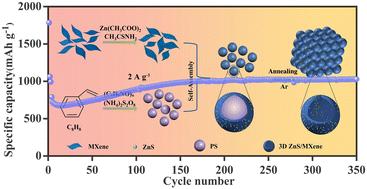
An effective way to improve the cycling performance of metal sulfide materials is to blend them with conductive materials. In this paper, three-dimensional (3D) hollow MXene/ZnS heterostructures (ZnSMX) were prepared via a two-step process involving hydrothermal and template methodologies. The formation of Ti–O–Zn bonds enables the firm bonding between ZnS nanoparticles and the MXene substrate at heterogeneous interfaces, which can act as “electron bridges” to facilitate electron and charge transfer. Additionally, 3D hollow ZnSMX not only enhances the conductivity of ZnS, enabling rapid charge transfer, but also effectively show restacking of MXene nanosheets to maintain structural stability during the charge/discharge process. More importantly, the 3D porous structure provides ultrafast interfacial ion transport pathways and extra surficial and interfacial storage sites, thus boosting excellent storage performances in lithium-ion battery applications. The 3D ZnSMX exhibited a high capacity of 782.1 mA h g−1 at 1 A g−1 current, excellent cycling stability (providing a high capacity of 1027.8 mA h g−1 after 350 cycles at 2 A g−1), and excellent rate performance. This indicates that 3D ZnS/MXene heterostructures can potentially be highly promising anode materials for high-multiplication lithium-ion batteries.
提高金属硫化材料循环性能的有效途径是与导电材料共混。本文采用水热法和模板法制备了三维中空MXene/ZnS异质结构(ZnSMX)。Ti-O-Zn键的形成使ZnS纳米颗粒与MXene衬底在非均相界面上形成牢固的键合,起到“电子桥”的作用,促进电子和电荷的转移。最重要的是,3D中空ZnSMX不仅增强了ZnS的导电性,实现了快速的电荷转移,而且有效地重新堆积了MXene纳米片,在充放电过程中保持了结构的稳定性。更重要的是,三维大孔结构提供了超快的界面离子传输途径和额外的表面和界面存储位点,从而提高了锂离子电池应用中的优异存储性能。3D ZnSMX在1 a g-1电流下具有782.1 mAh g-1的高容量,出色的循环稳定性(在2 a g-1下循环350次后提供1027.8 mAh g-1的高容量),以及出色的倍率性能。这表明3D ZnS/MXene异质结构具有成为高倍率锂离子电池极有前景的负极材料的潜力。
期刊介绍:
Dalton Transactions is a journal for all areas of inorganic chemistry, which encompasses the organometallic, bioinorganic and materials chemistry of the elements, with applications including synthesis, catalysis, energy conversion/storage, electrical devices and medicine. Dalton Transactions welcomes high-quality, original submissions in all of these areas and more, where the advancement of knowledge in inorganic chemistry is significant.



 京公网安备 11010802042870号
京ICP备2023020795号-1
京公网安备 11010802042870号
京ICP备2023020795号-1

 分享
分享
 求助内容:
求助内容: 应助结果提醒方式:
 扫码关注我们
