Ru Jia, Xiaoxue Zhang, Li Gan, Muhammad Tahir, Zhen-Feng Huang, Lun Pan, Ruijie Gao, Chengxiang Shi, Xiangwen Zhang, Guidong Yang and Ji-Jun Zou
{"title":"Boosting electrocatalytic nitrate reduction to ammonia with a Cu/Ag-Ru tandem catalyst at industrial-scale current density†","authors":"Ru Jia, Xiaoxue Zhang, Li Gan, Muhammad Tahir, Zhen-Feng Huang, Lun Pan, Ruijie Gao, Chengxiang Shi, Xiangwen Zhang, Guidong Yang and Ji-Jun Zou","doi":"10.1039/D4TA08066A","DOIUrl":null,"url":null,"abstract":"<p >The nitrate reduction reaction (NO<small><sub>3</sub></small>RR) represents a promising route for water treatment and NH<small><sub>3</sub></small> generation. This process involves the deoxygenation of NO<small><sub>3</sub></small><small><sup>−</sup></small> to form nitrite (NO<small><sub>2</sub></small><small><sup>−</sup></small>), followed by its subsequent hydrogenation. However, discrepancies in the rates of these two steps result in a decrease in faradaic efficiency (FE) and NH<small><sub>3</sub></small> yield rate. Herein, we demonstrated a tandem catalyst of (Cu<small><sub>7</sub></small>/Ag<small><sub>3</sub></small>)<small><sub>7</sub></small>-Ru<small><sub>3</sub></small>/C achieving a high NH<small><sub>3</sub></small> yield rate of 3.45 mmol h<small><sup>−1</sup></small> cm<small><sup>−2</sup></small> (2.30 mol g<small><sub>cat</sub></small><small><sup>−1</sup></small> h<small><sup>−1</sup></small>) and a FE of 93.48% at −0.9 V <em>vs.</em> the reversible hydrogen electrode. The Cu/Ag heterostructure greatly enhanced the conversion of NO<small><sub>3</sub></small><small><sup>−</sup></small> to NO<small><sub>2</sub></small><small><sup>−</sup></small> over a wide potential window due to the synergistic effect, while Ru, selectively adsorbing NO<small><sub>2</sub></small><small><sup>−</sup></small>, provided active hydrogen derived from water hydrolysis to facilitate NH<small><sub>3</sub></small> synthesis. Furthermore, (Cu<small><sub>7</sub></small>/Ag<small><sub>3</sub></small>)<small><sub>7</sub></small>-Ru<small><sub>3</sub></small>/C exhibited stable performance in a membrane electrode assembly over 60 hours, achieving an average NH<small><sub>3</sub></small> yield rate of 6.90 mmol h<small><sup>−1</sup></small>. The ammonium chloride solid product was successfully obtained using an air stripping methodology. <em>In situ</em> characterization revealed that the surface microenvironment of Ru influenced the adsorption configuration of *NO and on-top adsorbed NO was more favorable for ammonia synthesis compared to bridge-adsorbed NO. The overall reaction pathway involved stepwise deoxygenation to form *N and subsequent gradual hydrogenation.</p>","PeriodicalId":82,"journal":{"name":"Journal of Materials Chemistry A","volume":" 8","pages":" 5732-5743"},"PeriodicalIF":9.5000,"publicationDate":"2025-01-28","publicationTypes":"Journal Article","fieldsOfStudy":null,"isOpenAccess":false,"openAccessPdf":"","citationCount":"0","resultStr":null,"platform":"Semanticscholar","paperid":null,"PeriodicalName":"Journal of Materials Chemistry A","FirstCategoryId":"88","ListUrlMain":"https://pubs.rsc.org/en/content/articlelanding/2025/ta/d4ta08066a","RegionNum":2,"RegionCategory":"材料科学","ArticlePicture":[],"TitleCN":null,"AbstractTextCN":null,"PMCID":null,"EPubDate":"","PubModel":"","JCR":"Q1","JCRName":"CHEMISTRY, PHYSICAL","Score":null,"Total":0}
引用次数: 0
Abstract
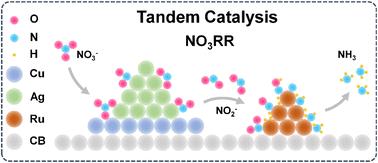
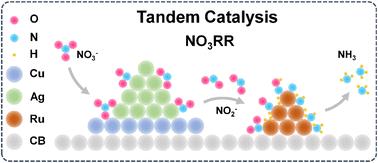
The nitrate reduction reaction (NO3RR) represents a promising route for water treatment and NH3 generation. This process involves the deoxygenation of NO3− to form nitrite (NO2−), followed by its subsequent hydrogenation. However, discrepancies in the rates of these two steps result in a decrease in faradaic efficiency (FE) and NH3 yield rate. Herein, we demonstrated a tandem catalyst of (Cu7/Ag3)7-Ru3/C achieving a high NH3 yield rate of 3.45 mmol h−1 cm−2 (2.30 mol gcat−1 h−1) and a FE of 93.48% at −0.9 V vs. the reversible hydrogen electrode. The Cu/Ag heterostructure greatly enhanced the conversion of NO3− to NO2− over a wide potential window due to the synergistic effect, while Ru, selectively adsorbing NO2−, provided active hydrogen derived from water hydrolysis to facilitate NH3 synthesis. Furthermore, (Cu7/Ag3)7-Ru3/C exhibited stable performance in a membrane electrode assembly over 60 hours, achieving an average NH3 yield rate of 6.90 mmol h−1. The ammonium chloride solid product was successfully obtained using an air stripping methodology. In situ characterization revealed that the surface microenvironment of Ru influenced the adsorption configuration of *NO and on-top adsorbed NO was more favorable for ammonia synthesis compared to bridge-adsorbed NO. The overall reaction pathway involved stepwise deoxygenation to form *N and subsequent gradual hydrogenation.
期刊介绍:
The Journal of Materials Chemistry A, B & C covers a wide range of high-quality studies in the field of materials chemistry, with each section focusing on specific applications of the materials studied. Journal of Materials Chemistry A emphasizes applications in energy and sustainability, including topics such as artificial photosynthesis, batteries, and fuel cells. Journal of Materials Chemistry B focuses on applications in biology and medicine, while Journal of Materials Chemistry C covers applications in optical, magnetic, and electronic devices. Example topic areas within the scope of Journal of Materials Chemistry A include catalysis, green/sustainable materials, sensors, and water treatment, among others.



 京公网安备 11010802042870号
京ICP备2023020795号-1
京公网安备 11010802042870号
京ICP备2023020795号-1

 分享
分享
 求助内容:
求助内容: 应助结果提醒方式:
 扫码关注我们
