{"title":"Blistering of hafnia/hafnon composites exposed to molten silicate deposits","authors":"P.Y. Kumbhar , S.S. Shishvan , A.R. Ericks , C.G. Levi , F.W. Zok , V.S. Deshpande","doi":"10.1016/j.actamat.2025.120782","DOIUrl":null,"url":null,"abstract":"<div><div>Environmental barrier coatings (EBCs) are critical for protecting ceramic matrix composites in gas turbine engines. However, their effectiveness can be compromised by blistering when exposed to molten silicate deposits. This study investigates the mechanisms driving blistering in hafnia/hafnon EBCs through numerical modelling. Two potential mechanisms are explored: one driven by partial dissolution of the parent phases into the melt followed by crystallization into the other phase (hafnia to hafnon or vice-versa) and another driven by partial dissolution and reprecipitation into the same phase via Ostwald ripening. Models for both mechanisms make use of the observations that melt ingress and macroscopic blistering are decoupled in time, with melt ingress occurring relatively rapidly along grain triple junctions and blistering occurring later through a slower process of melt spreading, dissolution and crystallization or reprecipitation. A finite element model incorporating randomly shaped grains and cohesive grain boundaries is developed to simulate these two mechanisms. Phase transformation-driven cracking is found to produce minimal damage and negligible changes in pellet thickness, inconsistent with experimental observations. In contrast, the Ostwald ripening mechanism generates damage patterns and pellet thickness increases closely resembling experimental blistering observations, even though the ripening process produces only modest stresses. Combined effects of phase transformation and Ostwald ripening show no significant synergy. These findings suggest Ostwald ripening as the dominant mechanism responsible for blistering in hafnia/hafnon EBCs exposed to molten silicate deposits. The study provides valuable insights into EBC failure modes and offers a framework for investigations of similar phenomena in other coating systems.</div></div>","PeriodicalId":238,"journal":{"name":"Acta Materialia","volume":"287 ","pages":"Article 120782"},"PeriodicalIF":9.3000,"publicationDate":"2025-04-01","publicationTypes":"Journal Article","fieldsOfStudy":null,"isOpenAccess":false,"openAccessPdf":"","citationCount":"0","resultStr":null,"platform":"Semanticscholar","paperid":null,"PeriodicalName":"Acta Materialia","FirstCategoryId":"88","ListUrlMain":"https://www.sciencedirect.com/science/article/pii/S1359645425000746","RegionNum":1,"RegionCategory":"材料科学","ArticlePicture":[],"TitleCN":null,"AbstractTextCN":null,"PMCID":null,"EPubDate":"2025/1/28 0:00:00","PubModel":"Epub","JCR":"Q1","JCRName":"MATERIALS SCIENCE, MULTIDISCIPLINARY","Score":null,"Total":0}
引用次数: 0
Abstract
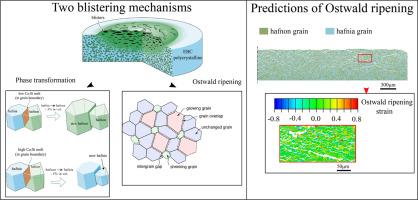
Environmental barrier coatings (EBCs) are critical for protecting ceramic matrix composites in gas turbine engines. However, their effectiveness can be compromised by blistering when exposed to molten silicate deposits. This study investigates the mechanisms driving blistering in hafnia/hafnon EBCs through numerical modelling. Two potential mechanisms are explored: one driven by partial dissolution of the parent phases into the melt followed by crystallization into the other phase (hafnia to hafnon or vice-versa) and another driven by partial dissolution and reprecipitation into the same phase via Ostwald ripening. Models for both mechanisms make use of the observations that melt ingress and macroscopic blistering are decoupled in time, with melt ingress occurring relatively rapidly along grain triple junctions and blistering occurring later through a slower process of melt spreading, dissolution and crystallization or reprecipitation. A finite element model incorporating randomly shaped grains and cohesive grain boundaries is developed to simulate these two mechanisms. Phase transformation-driven cracking is found to produce minimal damage and negligible changes in pellet thickness, inconsistent with experimental observations. In contrast, the Ostwald ripening mechanism generates damage patterns and pellet thickness increases closely resembling experimental blistering observations, even though the ripening process produces only modest stresses. Combined effects of phase transformation and Ostwald ripening show no significant synergy. These findings suggest Ostwald ripening as the dominant mechanism responsible for blistering in hafnia/hafnon EBCs exposed to molten silicate deposits. The study provides valuable insights into EBC failure modes and offers a framework for investigations of similar phenomena in other coating systems.
期刊介绍:
Acta Materialia serves as a platform for publishing full-length, original papers and commissioned overviews that contribute to a profound understanding of the correlation between the processing, structure, and properties of inorganic materials. The journal seeks papers with high impact potential or those that significantly propel the field forward. The scope includes the atomic and molecular arrangements, chemical and electronic structures, and microstructure of materials, focusing on their mechanical or functional behavior across all length scales, including nanostructures.





 京公网安备 11010802042870号
京ICP备2023020795号-1
京公网安备 11010802042870号
京ICP备2023020795号-1

 分享
分享
 求助内容:
求助内容: 应助结果提醒方式:
 扫码关注我们
