Jian-Biao Liu , Yan Wang , Hai-Yan Wang , Xiao-Jun Liu
{"title":"Understanding the influence of metal centers on the mechanism and chemoselectivity of transition-metal-catalyzed cyclizations of dienyl aldehydes†","authors":"Jian-Biao Liu , Yan Wang , Hai-Yan Wang , Xiao-Jun Liu","doi":"10.1039/d4qo02342k","DOIUrl":null,"url":null,"abstract":"<div><div>Hydroacylation of alkenes represents a pivotal synthetic method for the atom-economical construction of valuable ketones, with current research focusing on using 3d transition metals and improving reaction selectivity. This study presents a computational investigation into transition-metal-catalyzed divergent cyclizations of dienyl aldehydes, emphasizing the influence of metal centers on the mechanism and chemoselectivity. For both Co(<span>i</span>) and Rh(<span>i</span>) catalysts, the reaction pathway involves oxidative addition and alkene insertion, resulting in the formation of five-membered metallacycle intermediates. Our calculations reveal that the stability and reactivity of the metallacycle intermediates play crucial roles in regulating the chemoselectivity. The Co(<span>i</span>) catalysts promote the preferential formation of strained cyclobutanones with high enantioselectivity due to the relatively lower activation barrier for reductive elimination from the corresponding cobaltacycle intermediate. Conversely, for Rh(<span>i</span>) catalysts, endocyclic β-hydride elimination and migratory insertion occur more favorably owing to the stability of rhodacycle intermediates, leading to the formation of cyclopentanones. Energy decomposition analysis indicates that electrostatic and orbital interactions are dominant factors influencing the relative stability of these metallacycle intermediates. This work elucidates the contrasting effects of cobalt and rhodium on reaction mechanisms and chemoselectivity, offering valuable insights into designing catalytic systems for efficient and selective hydroacylation reactions.</div></div>","PeriodicalId":94379,"journal":{"name":"Organic chemistry frontiers : an international journal of organic chemistry","volume":"12 7","pages":"Pages 2194-2204"},"PeriodicalIF":0.0000,"publicationDate":"2025-02-12","publicationTypes":"Journal Article","fieldsOfStudy":null,"isOpenAccess":false,"openAccessPdf":"","citationCount":"0","resultStr":null,"platform":"Semanticscholar","paperid":null,"PeriodicalName":"Organic chemistry frontiers : an international journal of organic chemistry","FirstCategoryId":"1085","ListUrlMain":"https://www.sciencedirect.com/org/science/article/pii/S205241292500083X","RegionNum":0,"RegionCategory":null,"ArticlePicture":[],"TitleCN":null,"AbstractTextCN":null,"PMCID":null,"EPubDate":"2025/1/28 0:00:00","PubModel":"Epub","JCR":"","JCRName":"","Score":null,"Total":0}
引用次数: 0
Abstract
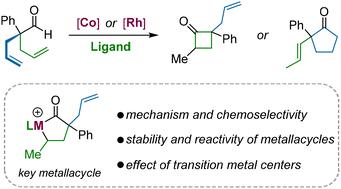
Hydroacylation of alkenes represents a pivotal synthetic method for the atom-economical construction of valuable ketones, with current research focusing on using 3d transition metals and improving reaction selectivity. This study presents a computational investigation into transition-metal-catalyzed divergent cyclizations of dienyl aldehydes, emphasizing the influence of metal centers on the mechanism and chemoselectivity. For both Co(i) and Rh(i) catalysts, the reaction pathway involves oxidative addition and alkene insertion, resulting in the formation of five-membered metallacycle intermediates. Our calculations reveal that the stability and reactivity of the metallacycle intermediates play crucial roles in regulating the chemoselectivity. The Co(i) catalysts promote the preferential formation of strained cyclobutanones with high enantioselectivity due to the relatively lower activation barrier for reductive elimination from the corresponding cobaltacycle intermediate. Conversely, for Rh(i) catalysts, endocyclic β-hydride elimination and migratory insertion occur more favorably owing to the stability of rhodacycle intermediates, leading to the formation of cyclopentanones. Energy decomposition analysis indicates that electrostatic and orbital interactions are dominant factors influencing the relative stability of these metallacycle intermediates. This work elucidates the contrasting effects of cobalt and rhodium on reaction mechanisms and chemoselectivity, offering valuable insights into designing catalytic systems for efficient and selective hydroacylation reactions.




 京公网安备 11010802042870号
京ICP备2023020795号-1
京公网安备 11010802042870号
京ICP备2023020795号-1

 分享
分享

 求助内容:
求助内容: 应助结果提醒方式:
 扫码关注我们
