Advanced low-temperature self-healable bio-polyurethanes with double-alkane-tailed ringing units for applications in self-powered flexible control panels
Hong Wang, Mingjie Gao, Linman Zhang, Ziyue Su, Chaoyu Chen, Weijun Yang, Pengwu Xu, Deyu Niu, Pibo Ma, Piming Ma
{"title":"Advanced low-temperature self-healable bio-polyurethanes with double-alkane-tailed ringing units for applications in self-powered flexible control panels","authors":"Hong Wang, Mingjie Gao, Linman Zhang, Ziyue Su, Chaoyu Chen, Weijun Yang, Pengwu Xu, Deyu Niu, Pibo Ma, Piming Ma","doi":"10.1016/j.cej.2025.160019","DOIUrl":null,"url":null,"abstract":"Elastomers with dynamic covalent bonds are typically used to develop self-healing flexible control panels, however, their self-healing efficiency is low at low temperatures which hampers the stable operation and durability of the control panels. This work used a new strategy to achieve low-temperature self-healing in bio-based polyurethane elastomers (PDLBE) by designing a dynamic van der Waals force network. The elastomers are synthesized by using biobased monomers containing a double-alkane-tailed ringing unit and show self-healing efficiencies close to 90 % even under low temperature (−20 °C), supercooled brine (30 % NaCl @ −20 °C), and alkali (pH = 14) conditions. In addition, the PDLBE exhibits rapid self-healing capability, superior elongation rate (12,000 %), and reprocessability. Both experimental and molecular simulation results indicate that the low-temperature self-healing properties are mainly attributed to the abundant vdW forces and self-plasticization generated by the double-alkane-tailed ringing unit. Subsequently, low-temperature triboelectric nanogenerator (LT-TENG) and LT-TENG-based flexible control panels are successfully made from the elastomers, showing a recovery of 97 % at − 20 ℃ and a stable output (∼13 mW/m<sup>2</sup>) at − 30 ℃ after damage and even after 1200 cycles. This study presents a novel route for the preparation of low-temperature self-healable bio-elastomers and may expand their application in TENGs and flexible control panels in harsh environments.","PeriodicalId":270,"journal":{"name":"Chemical Engineering Journal","volume":"40 1","pages":""},"PeriodicalIF":13.2000,"publicationDate":"2025-01-28","publicationTypes":"Journal Article","fieldsOfStudy":null,"isOpenAccess":false,"openAccessPdf":"","citationCount":"0","resultStr":null,"platform":"Semanticscholar","paperid":null,"PeriodicalName":"Chemical Engineering Journal","FirstCategoryId":"5","ListUrlMain":"https://doi.org/10.1016/j.cej.2025.160019","RegionNum":1,"RegionCategory":"工程技术","ArticlePicture":[],"TitleCN":null,"AbstractTextCN":null,"PMCID":null,"EPubDate":"","PubModel":"","JCR":"Q1","JCRName":"ENGINEERING, CHEMICAL","Score":null,"Total":0}
引用次数: 0
Abstract
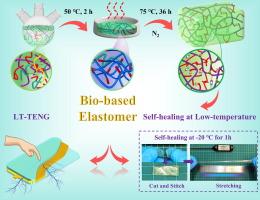
Elastomers with dynamic covalent bonds are typically used to develop self-healing flexible control panels, however, their self-healing efficiency is low at low temperatures which hampers the stable operation and durability of the control panels. This work used a new strategy to achieve low-temperature self-healing in bio-based polyurethane elastomers (PDLBE) by designing a dynamic van der Waals force network. The elastomers are synthesized by using biobased monomers containing a double-alkane-tailed ringing unit and show self-healing efficiencies close to 90 % even under low temperature (−20 °C), supercooled brine (30 % NaCl @ −20 °C), and alkali (pH = 14) conditions. In addition, the PDLBE exhibits rapid self-healing capability, superior elongation rate (12,000 %), and reprocessability. Both experimental and molecular simulation results indicate that the low-temperature self-healing properties are mainly attributed to the abundant vdW forces and self-plasticization generated by the double-alkane-tailed ringing unit. Subsequently, low-temperature triboelectric nanogenerator (LT-TENG) and LT-TENG-based flexible control panels are successfully made from the elastomers, showing a recovery of 97 % at − 20 ℃ and a stable output (∼13 mW/m2) at − 30 ℃ after damage and even after 1200 cycles. This study presents a novel route for the preparation of low-temperature self-healable bio-elastomers and may expand their application in TENGs and flexible control panels in harsh environments.
期刊介绍:
The Chemical Engineering Journal is an international research journal that invites contributions of original and novel fundamental research. It aims to provide an international platform for presenting original fundamental research, interpretative reviews, and discussions on new developments in chemical engineering. The journal welcomes papers that describe novel theory and its practical application, as well as those that demonstrate the transfer of techniques from other disciplines. It also welcomes reports on carefully conducted experimental work that is soundly interpreted. The main focus of the journal is on original and rigorous research results that have broad significance. The Catalysis section within the Chemical Engineering Journal focuses specifically on Experimental and Theoretical studies in the fields of heterogeneous catalysis, molecular catalysis, and biocatalysis. These studies have industrial impact on various sectors such as chemicals, energy, materials, foods, healthcare, and environmental protection.



 京公网安备 11010802042870号
京ICP备2023020795号-1
京公网安备 11010802042870号
京ICP备2023020795号-1

 分享
分享
 求助内容:
求助内容: 应助结果提醒方式:
 扫码关注我们
