Bashdar Abuzed Sadee, Salih M. S. Zebari, Yaseen Galali and Mahmood Fadhil Saleem
{"title":"A review on arsenic contamination in drinking water: sources, health impacts, and remediation approaches","authors":"Bashdar Abuzed Sadee, Salih M. S. Zebari, Yaseen Galali and Mahmood Fadhil Saleem","doi":"10.1039/D4RA08867K","DOIUrl":null,"url":null,"abstract":"<p >Arsenic (As) contamination in groundwater has become a global concern, and it poses a serious threat to the health of millions of people. Groundwater with high As concentrations has been reported worldwide. It is widely recognized that the toxicity of As largely depends on its chemical forms, making As speciation a critical issue. Numerous studies on As speciation have been conducted, extending beyond the general knowledge on As to the toxicity and health issues caused by exposure to various As species in water. This article reviews various As species, their sources and health effects, and treatment methods for the removal of As from contaminated water. Additionally, various established and emerging technologies for the removal of As contaminants from the environment, including adsorption (using rocks, soils, minerals, industrial by-products, biosorbents, biochars, and microalgal and fungal biomass), ion exchange, phytoremediation, chemical precipitation, electrocoagulation, and membrane technologies, are discussed. Treating As-contaminated drinking water is considered the most effective approach to minimize the associated health risks. Finally, the advantages and disadvantages of various remediation and removal methods are outlined, along with their key advantages. Among these techniques, the simplicity, low cost, and ease of operation make adsorption techniques desirable, particularly with the use of novel functional materials like graphite oxides, metal–organic frameworks, carbon nanotubes, and other emerging functional materials, which are promising future alternatives for As removal.</p>","PeriodicalId":102,"journal":{"name":"RSC Advances","volume":" 4","pages":" 2684-2703"},"PeriodicalIF":4.6000,"publicationDate":"2025-01-27","publicationTypes":"Journal Article","fieldsOfStudy":null,"isOpenAccess":false,"openAccessPdf":"https://www.ncbi.nlm.nih.gov/pmc/articles/PMC11770421/pdf/","citationCount":"0","resultStr":null,"platform":"Semanticscholar","paperid":null,"PeriodicalName":"RSC Advances","FirstCategoryId":"92","ListUrlMain":"https://pubs.rsc.org/en/content/articlelanding/2025/ra/d4ra08867k","RegionNum":3,"RegionCategory":"化学","ArticlePicture":[],"TitleCN":null,"AbstractTextCN":null,"PMCID":null,"EPubDate":"","PubModel":"","JCR":"Q2","JCRName":"CHEMISTRY, MULTIDISCIPLINARY","Score":null,"Total":0}
引用次数: 0
Abstract
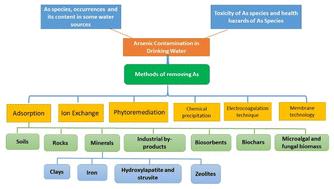
Arsenic (As) contamination in groundwater has become a global concern, and it poses a serious threat to the health of millions of people. Groundwater with high As concentrations has been reported worldwide. It is widely recognized that the toxicity of As largely depends on its chemical forms, making As speciation a critical issue. Numerous studies on As speciation have been conducted, extending beyond the general knowledge on As to the toxicity and health issues caused by exposure to various As species in water. This article reviews various As species, their sources and health effects, and treatment methods for the removal of As from contaminated water. Additionally, various established and emerging technologies for the removal of As contaminants from the environment, including adsorption (using rocks, soils, minerals, industrial by-products, biosorbents, biochars, and microalgal and fungal biomass), ion exchange, phytoremediation, chemical precipitation, electrocoagulation, and membrane technologies, are discussed. Treating As-contaminated drinking water is considered the most effective approach to minimize the associated health risks. Finally, the advantages and disadvantages of various remediation and removal methods are outlined, along with their key advantages. Among these techniques, the simplicity, low cost, and ease of operation make adsorption techniques desirable, particularly with the use of novel functional materials like graphite oxides, metal–organic frameworks, carbon nanotubes, and other emerging functional materials, which are promising future alternatives for As removal.
期刊介绍:
An international, peer-reviewed journal covering all of the chemical sciences, including multidisciplinary and emerging areas. RSC Advances is a gold open access journal allowing researchers free access to research articles, and offering an affordable open access publishing option for authors around the world.




 京公网安备 11010802042870号
京ICP备2023020795号-1
京公网安备 11010802042870号
京ICP备2023020795号-1

 分享
分享
 求助内容:
求助内容: 应助结果提醒方式:
 扫码关注我们
