Investigating the longitudinal bi-directional relationship between self-reported restrictive eating behaviours and sleep in UK adolescents within the Millennium Cohort Study.
Marie-Christine Opitz, Giulia Gaggioni, Nora Trompeter, Francisco Diego Rabelo-da-Ponte, Sylvane Desrivières, Nadia Micali, Ulrike Schmidt, Helen Sharpe
{"title":"Investigating the longitudinal bi-directional relationship between self-reported restrictive eating behaviours and sleep in UK adolescents within the Millennium Cohort Study.","authors":"Marie-Christine Opitz, Giulia Gaggioni, Nora Trompeter, Francisco Diego Rabelo-da-Ponte, Sylvane Desrivières, Nadia Micali, Ulrike Schmidt, Helen Sharpe","doi":"10.1007/s00787-025-02641-9","DOIUrl":null,"url":null,"abstract":"<p><strong>Objective: </strong>This study aimed to investigate the longitudinal bi-directional relationship between self-reported restrictive eating behaviours and sleep characteristics within a sample of UK adolescents from the Millennium Cohort Study (MCS).</p><p><strong>Method: </strong>Using a Structural Equation Modelling approach, the present study investigated the prospective associations between individual sleep behaviours (e.g., sleep timing, sleep onset latency, social jetlag) at age 14 and restrictive eating behaviours at age 17. Moreover, the association between restrictive eating behaviours (age 14) and self-reported sleep quality (age 17) was tested. A mediation analysis was conducted to explore the role of depressive symptoms in these relationships. In total, N = 6,041 young people provided self-report data at both timepoints (sweep 6 & 7) and a subsample of N = 2,164 additionally provided diary data on their sleep behaviours over two separate 24 h periods.</p><p><strong>Results: </strong>Sleep indicators at age 14 did not significantly predict changes in restrictive eating behaviours across time. However, engagement in restrictive eating behaviours at age 14 significantly predicted poorer self-perceived sleep quality three years later (β = 0.06, SE = 0.01, p <.01). Depressive symptoms fully mediated this relationship (indirect effect: β = 0.05, SE = 0.04, p <.001).</p><p><strong>Discussion: </strong>The present study provides evidence for a prospective positive association between restrictive eating behaviours and subsequent poorer sleep quality in a large, general population sample. Findings of the mediation analysis suggest mood as a potential target for tertiary prevention when addressing restrictive eating behaviours as an eating disorder risk factor in adolescents.</p>","PeriodicalId":11856,"journal":{"name":"European Child & Adolescent Psychiatry","volume":" ","pages":"2405-2416"},"PeriodicalIF":4.9000,"publicationDate":"2025-08-01","publicationTypes":"Journal Article","fieldsOfStudy":null,"isOpenAccess":false,"openAccessPdf":"https://www.ncbi.nlm.nih.gov/pmc/articles/PMC12397170/pdf/","citationCount":"0","resultStr":null,"platform":"Semanticscholar","paperid":null,"PeriodicalName":"European Child & Adolescent Psychiatry","FirstCategoryId":"3","ListUrlMain":"https://doi.org/10.1007/s00787-025-02641-9","RegionNum":2,"RegionCategory":"医学","ArticlePicture":[],"TitleCN":null,"AbstractTextCN":null,"PMCID":null,"EPubDate":"2025/1/28 0:00:00","PubModel":"Epub","JCR":"Q1","JCRName":"PEDIATRICS","Score":null,"Total":0}
引用次数: 0
Abstract
Objective: This study aimed to investigate the longitudinal bi-directional relationship between self-reported restrictive eating behaviours and sleep characteristics within a sample of UK adolescents from the Millennium Cohort Study (MCS).
Method: Using a Structural Equation Modelling approach, the present study investigated the prospective associations between individual sleep behaviours (e.g., sleep timing, sleep onset latency, social jetlag) at age 14 and restrictive eating behaviours at age 17. Moreover, the association between restrictive eating behaviours (age 14) and self-reported sleep quality (age 17) was tested. A mediation analysis was conducted to explore the role of depressive symptoms in these relationships. In total, N = 6,041 young people provided self-report data at both timepoints (sweep 6 & 7) and a subsample of N = 2,164 additionally provided diary data on their sleep behaviours over two separate 24 h periods.
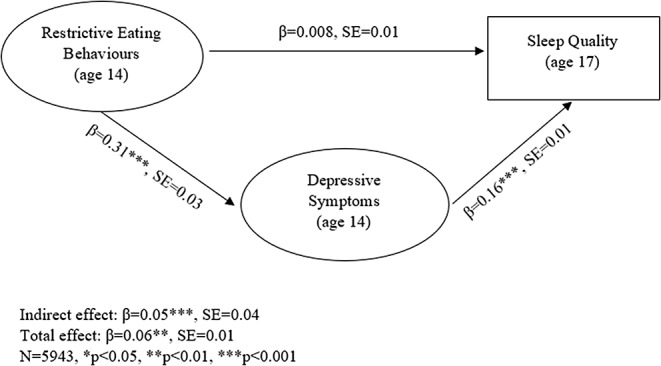
Results: Sleep indicators at age 14 did not significantly predict changes in restrictive eating behaviours across time. However, engagement in restrictive eating behaviours at age 14 significantly predicted poorer self-perceived sleep quality three years later (β = 0.06, SE = 0.01, p <.01). Depressive symptoms fully mediated this relationship (indirect effect: β = 0.05, SE = 0.04, p <.001).
Discussion: The present study provides evidence for a prospective positive association between restrictive eating behaviours and subsequent poorer sleep quality in a large, general population sample. Findings of the mediation analysis suggest mood as a potential target for tertiary prevention when addressing restrictive eating behaviours as an eating disorder risk factor in adolescents.
期刊介绍:
European Child and Adolescent Psychiatry is Europe''s only peer-reviewed journal entirely devoted to child and adolescent psychiatry. It aims to further a broad understanding of psychopathology in children and adolescents. Empirical research is its foundation, and clinical relevance is its hallmark.
European Child and Adolescent Psychiatry welcomes in particular papers covering neuropsychiatry, cognitive neuroscience, genetics, neuroimaging, pharmacology, and related fields of interest. Contributions are encouraged from all around the world.



 京公网安备 11010802042870号
京ICP备2023020795号-1
京公网安备 11010802042870号
京ICP备2023020795号-1

 分享
分享
 求助内容:
求助内容: 应助结果提醒方式:
 扫码关注我们
