{"title":"Samarium as a Catalytic Electron-Transfer Mediator in Electrocatalytic Nitrogen Reduction to Ammonia","authors":"Emily A. Boyd, Hoimin Jung, Jonas C. Peters","doi":"10.1021/jacs.4c14845","DOIUrl":null,"url":null,"abstract":"Samarium diiodide (SmI<sub>2</sub>) exhibits high selectivity for N<sub>2</sub>R catalyzed by molybdenum complexes; however, it has so far been employed only as a stoichiometric reagent (0.3 equiv of NH<sub>3</sub> per Sm) combined with coordinating proton sources (e.g., H<sub>2</sub>O, ROH). The latter inhibit catalytic turnover of Sm<sup>III</sup> owing to buildup of stable hydroxide/alkoxide sinks. Here, we report a tandem Sm/Mo-catalyzed <i>e</i>N<sub>2</sub>R system that achieves the lowest overpotential and highest Faradaic efficiency (82%) reported to date for nonaqueous <i>e</i>N<sub>2</sub>R at ambient pressure. Up to 8.4 equiv of NH<sub>3</sub> is produced per Sm, representing a 25-fold increase over N<sub>2</sub>R with stoichiometric SmI<sub>2</sub>. A noncoordinating proton source enables electrochemical SmI<sub>3</sub>/SmI<sub>2</sub> cycling at the applied potential of −1.45 V vs Fc<sup>+/0</sup>.","PeriodicalId":49,"journal":{"name":"Journal of the American Chemical Society","volume":"4 1","pages":""},"PeriodicalIF":15.6000,"publicationDate":"2025-01-29","publicationTypes":"Journal Article","fieldsOfStudy":null,"isOpenAccess":false,"openAccessPdf":"","citationCount":"0","resultStr":null,"platform":"Semanticscholar","paperid":null,"PeriodicalName":"Journal of the American Chemical Society","FirstCategoryId":"92","ListUrlMain":"https://doi.org/10.1021/jacs.4c14845","RegionNum":1,"RegionCategory":"化学","ArticlePicture":[],"TitleCN":null,"AbstractTextCN":null,"PMCID":null,"EPubDate":"","PubModel":"","JCR":"Q1","JCRName":"CHEMISTRY, MULTIDISCIPLINARY","Score":null,"Total":0}
引用次数: 0
Abstract
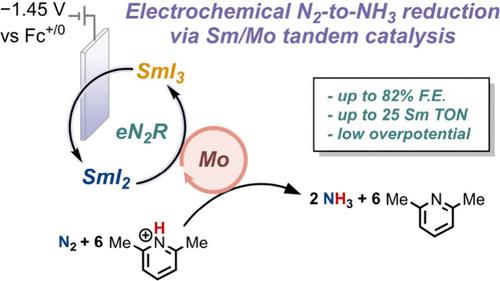
Samarium diiodide (SmI2) exhibits high selectivity for N2R catalyzed by molybdenum complexes; however, it has so far been employed only as a stoichiometric reagent (0.3 equiv of NH3 per Sm) combined with coordinating proton sources (e.g., H2O, ROH). The latter inhibit catalytic turnover of SmIII owing to buildup of stable hydroxide/alkoxide sinks. Here, we report a tandem Sm/Mo-catalyzed eN2R system that achieves the lowest overpotential and highest Faradaic efficiency (82%) reported to date for nonaqueous eN2R at ambient pressure. Up to 8.4 equiv of NH3 is produced per Sm, representing a 25-fold increase over N2R with stoichiometric SmI2. A noncoordinating proton source enables electrochemical SmI3/SmI2 cycling at the applied potential of −1.45 V vs Fc+/0.
钼配合物催化的二碘化钐(SmI2)对N2R具有高选择性;然而,到目前为止,它仅被用作化学计量试剂(每Sm相当于0.3 NH3)与配位质子源(例如H2O, ROH)结合使用。后者由于形成稳定的氢氧化物/醇氧化物汇而抑制SmIII的催化周转。在这里,我们报道了一个串联Sm/ mo催化的eN2R体系,该体系在环境压力下实现了迄今为止报道的最低过电位和最高法拉第效率(82%)。每Sm可产生8.4等量的NH3,与化学计量学SmI2的N2R相比增加了25倍。非配位质子源使电化学SmI3/SmI2在−1.45 V vs Fc+/0电位下循环。
期刊介绍:
The flagship journal of the American Chemical Society, known as the Journal of the American Chemical Society (JACS), has been a prestigious publication since its establishment in 1879. It holds a preeminent position in the field of chemistry and related interdisciplinary sciences. JACS is committed to disseminating cutting-edge research papers, covering a wide range of topics, and encompasses approximately 19,000 pages of Articles, Communications, and Perspectives annually. With a weekly publication frequency, JACS plays a vital role in advancing the field of chemistry by providing essential research.



 京公网安备 11010802042870号
京ICP备2023020795号-1
京公网安备 11010802042870号
京ICP备2023020795号-1

 分享
分享
 求助内容:
求助内容: 应助结果提醒方式:
 扫码关注我们
