Jason D. Boettger, Nicole M. DeLuca, Michael A. Zurek-Ost, Kelsey E. Miller, Christopher Fuller, Karen D. Bradham, Peter Ashley, Warren Friedman, Eugene A. Pinzer, David C. Cox, Gary Dewalt, Kristin K. Isaacs, Elaine A. Cohen Hubal, James P. McCord
{"title":"Emerging Per- and Polyfluoroalkyl Substances in Tap Water from the American Healthy Homes Survey II","authors":"Jason D. Boettger, Nicole M. DeLuca, Michael A. Zurek-Ost, Kelsey E. Miller, Christopher Fuller, Karen D. Bradham, Peter Ashley, Warren Friedman, Eugene A. Pinzer, David C. Cox, Gary Dewalt, Kristin K. Isaacs, Elaine A. Cohen Hubal, James P. McCord","doi":"10.1021/acs.est.4c08037","DOIUrl":null,"url":null,"abstract":"Humans experience widespread exposure to anthropogenic per- and polyfluoroalkyl substances (PFAS) through various media, which can lead to a wide range of negative health impacts. Tap water is an important source of exposure in communities with any degree of contamination but routine or large-scale PFAS monitoring often depends on targeted analytical methods limited to measuring specific PFAS. We analyzed 680 tap water samples from the American Healthy Homes Survey II for PFAS using non-targeted analysis (NTA) to expand the range of detectable PFAS. Based on detection frequency and relative abundance, about half of the identified PFAS were found only by NTA. We identified (with varying degrees of confidence) 75 distinct PFAS, including 57 exclusively detected by NTA. The identified PFAS are members of seven structural subclasses differentiated by their head groups and degree of fluorination. Clustering analysis categorized the PFAS into four coabundance groups dominated by specific PFAS subclasses. One group uniquely identified by NTA contains zwitterionic PFAS and other PFAS transformation products which are likely associated with aqueous firefighting foam contaminants in a small number of spatially correlated samples. These results help further characterize the scope of exposure to emerging PFAS experienced by the U.S. population via tap water and augment nationwide targeted-PFAS monitoring programs.","PeriodicalId":36,"journal":{"name":"环境科学与技术","volume":"78 1","pages":""},"PeriodicalIF":11.3000,"publicationDate":"2025-01-29","publicationTypes":"Journal Article","fieldsOfStudy":null,"isOpenAccess":false,"openAccessPdf":"","citationCount":"0","resultStr":null,"platform":"Semanticscholar","paperid":null,"PeriodicalName":"环境科学与技术","FirstCategoryId":"1","ListUrlMain":"https://doi.org/10.1021/acs.est.4c08037","RegionNum":1,"RegionCategory":"环境科学与生态学","ArticlePicture":[],"TitleCN":null,"AbstractTextCN":null,"PMCID":null,"EPubDate":"","PubModel":"","JCR":"Q1","JCRName":"ENGINEERING, ENVIRONMENTAL","Score":null,"Total":0}
引用次数: 0
Abstract
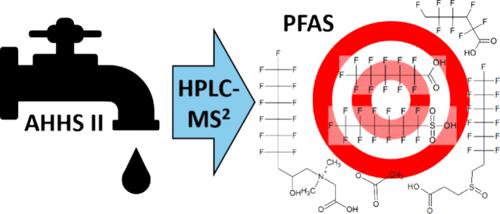
Humans experience widespread exposure to anthropogenic per- and polyfluoroalkyl substances (PFAS) through various media, which can lead to a wide range of negative health impacts. Tap water is an important source of exposure in communities with any degree of contamination but routine or large-scale PFAS monitoring often depends on targeted analytical methods limited to measuring specific PFAS. We analyzed 680 tap water samples from the American Healthy Homes Survey II for PFAS using non-targeted analysis (NTA) to expand the range of detectable PFAS. Based on detection frequency and relative abundance, about half of the identified PFAS were found only by NTA. We identified (with varying degrees of confidence) 75 distinct PFAS, including 57 exclusively detected by NTA. The identified PFAS are members of seven structural subclasses differentiated by their head groups and degree of fluorination. Clustering analysis categorized the PFAS into four coabundance groups dominated by specific PFAS subclasses. One group uniquely identified by NTA contains zwitterionic PFAS and other PFAS transformation products which are likely associated with aqueous firefighting foam contaminants in a small number of spatially correlated samples. These results help further characterize the scope of exposure to emerging PFAS experienced by the U.S. population via tap water and augment nationwide targeted-PFAS monitoring programs.
期刊介绍:
Environmental Science & Technology (ES&T) is a co-sponsored academic and technical magazine by the Hubei Provincial Environmental Protection Bureau and the Hubei Provincial Academy of Environmental Sciences.
Environmental Science & Technology (ES&T) holds the status of Chinese core journals, scientific papers source journals of China, Chinese Science Citation Database source journals, and Chinese Academic Journal Comprehensive Evaluation Database source journals. This publication focuses on the academic field of environmental protection, featuring articles related to environmental protection and technical advancements.



 京公网安备 11010802042870号
京ICP备2023020795号-1
京公网安备 11010802042870号
京ICP备2023020795号-1

 分享
分享
 求助内容:
求助内容: 应助结果提醒方式:
 扫码关注我们
