Sanghun Han, Woo Hyeon Jeong, Gayoung Seo, Seongmin Choi, Dong Gyu Lee, Weon-Sik Chae, Hyungju Ahn, Tae Kyung Lee, Hyosung Choi, Jongmin Choi, Bo Ram Lee, Younghoon Kim
{"title":"Synergistic Hybrid-Ligand Passivation of Perovskite Quantum Dots: Suppressing Reduced-Dimensionality and Enhancing Optoelectronic Performance","authors":"Sanghun Han, Woo Hyeon Jeong, Gayoung Seo, Seongmin Choi, Dong Gyu Lee, Weon-Sik Chae, Hyungju Ahn, Tae Kyung Lee, Hyosung Choi, Jongmin Choi, Bo Ram Lee, Younghoon Kim","doi":"10.1002/adma.202410128","DOIUrl":null,"url":null,"abstract":"<p>In terms of surface passivation for realizing efficient CsPbI<sub>3</sub>-perovskite quantum dot (CsPbI<sub>3</sub>-PQD)-based optoelectronic devices, phenethylammonium iodide (PEAI) is widely used during the ligand exchange. However, the PEA cation, due to its large ionic radius incompatible with the 3D perovskite framework, acts as an organic spacer within polycrystalline perovskites, leading to the formation of reduced dimensional perovskites (RDPs). Despite sharing the identical 3D perovskite framework, the influence of PEAI on the structure of CsPbI<sub>3</sub>-PQDs remains unexplored. Here, it is revealed that PEAI can induce the formation of high-n RDPs (<i>n</i> > 2) within the CsPbI<sub>3</sub>-PQD solids, but these high-n RDPs undergo an undesirable phase transition to low-n RDPs, leading to the structural and optical degradation of CsPbI<sub>3</sub>-PQDs. To address the PEAI-induced issue, we employ triphenylphosphine oxide (TPPO) as an ancillary ligand during the ligand exchange process. The incorporation of TPPO prevents H<sub>2</sub>O penetration and regulates the rapid diffusion of PEAI, suppressing the formation of low-n RDPs. Moreover, TPPO can passivate the uncoordinated Pb<sup>2+</sup> sites, reducing the nonradiative recombination. This hybrid-ligand exchange strategy using both PEAI and TPPO enables realizing efficient and stable CsPbI<sub>3</sub>-PQD-based light-emitting diode (external quantum efficiency of 21.8%) and solar cell (power conversion efficiency of 15.3%) devices.</p>","PeriodicalId":114,"journal":{"name":"Advanced Materials","volume":"37 25","pages":""},"PeriodicalIF":26.8000,"publicationDate":"2025-01-29","publicationTypes":"Journal Article","fieldsOfStudy":null,"isOpenAccess":false,"openAccessPdf":"","citationCount":"0","resultStr":null,"platform":"Semanticscholar","paperid":null,"PeriodicalName":"Advanced Materials","FirstCategoryId":"88","ListUrlMain":"https://advanced.onlinelibrary.wiley.com/doi/10.1002/adma.202410128","RegionNum":1,"RegionCategory":"材料科学","ArticlePicture":[],"TitleCN":null,"AbstractTextCN":null,"PMCID":null,"EPubDate":"","PubModel":"","JCR":"Q1","JCRName":"CHEMISTRY, MULTIDISCIPLINARY","Score":null,"Total":0}
引用次数: 0
Abstract
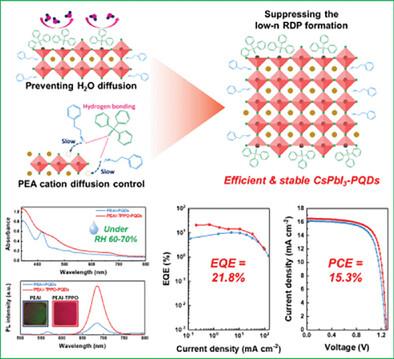
In terms of surface passivation for realizing efficient CsPbI3-perovskite quantum dot (CsPbI3-PQD)-based optoelectronic devices, phenethylammonium iodide (PEAI) is widely used during the ligand exchange. However, the PEA cation, due to its large ionic radius incompatible with the 3D perovskite framework, acts as an organic spacer within polycrystalline perovskites, leading to the formation of reduced dimensional perovskites (RDPs). Despite sharing the identical 3D perovskite framework, the influence of PEAI on the structure of CsPbI3-PQDs remains unexplored. Here, it is revealed that PEAI can induce the formation of high-n RDPs (n > 2) within the CsPbI3-PQD solids, but these high-n RDPs undergo an undesirable phase transition to low-n RDPs, leading to the structural and optical degradation of CsPbI3-PQDs. To address the PEAI-induced issue, we employ triphenylphosphine oxide (TPPO) as an ancillary ligand during the ligand exchange process. The incorporation of TPPO prevents H2O penetration and regulates the rapid diffusion of PEAI, suppressing the formation of low-n RDPs. Moreover, TPPO can passivate the uncoordinated Pb2+ sites, reducing the nonradiative recombination. This hybrid-ligand exchange strategy using both PEAI and TPPO enables realizing efficient and stable CsPbI3-PQD-based light-emitting diode (external quantum efficiency of 21.8%) and solar cell (power conversion efficiency of 15.3%) devices.
期刊介绍:
Advanced Materials, one of the world's most prestigious journals and the foundation of the Advanced portfolio, is the home of choice for best-in-class materials science for more than 30 years. Following this fast-growing and interdisciplinary field, we are considering and publishing the most important discoveries on any and all materials from materials scientists, chemists, physicists, engineers as well as health and life scientists and bringing you the latest results and trends in modern materials-related research every week.






 京公网安备 11010802042870号
京ICP备2023020795号-1
京公网安备 11010802042870号
京ICP备2023020795号-1

 分享
分享
 求助内容:
求助内容: 应助结果提醒方式:
 扫码关注我们
