An Wang , Shaozhen Huang , Zhangdi Xie , Jiahua Liao , Wenhao Li , Yuejiao Chen , Huimiao Li , Zhe Wang , Zhibin Wu , Libao Chen
{"title":"In3Li13(311)/Li(110) coherent heterogeneous induced uniform epitaxial electrodeposition enabling the stable ultrathin lithium metal anode","authors":"An Wang , Shaozhen Huang , Zhangdi Xie , Jiahua Liao , Wenhao Li , Yuejiao Chen , Huimiao Li , Zhe Wang , Zhibin Wu , Libao Chen","doi":"10.1016/j.actamat.2025.120780","DOIUrl":null,"url":null,"abstract":"<div><div>A growing need for high-energy-density lithium metal batteries appeal for utilize ultrathin (≤50 μm) free-standing Li metal anodes. However, challenges such as the formation of an unstable solid electrolyte interphase and the lithium dendrites growth have led to poor cycling performance and safety concerns, limiting the commercial viability of thin lithium metal anodes. This work introduces a facile approach by designing and fabricating an ultrathin Li-In alloy anode through in-situ vacuum melting and codirectional continuous rolling. The rolled ultrathin Li-In anode achieves the induction of uniform epitaxial electrodeposition of Li(110), which is attributed to the lithiophility of the densely distributed In₃Li₁₃ alloy phase and the coherent heterogeneous relationship between textured In₃Li₁₃(311) and Li(110).The symmetrical cell assembled by 50 μm Li-In alloy anode exhibits a prolonged lifespan for 1800 h under the conditions of 1 mA cm<sup>-2</sup> and 3 mAh cm<sup>-2</sup>. Meanwhile, the LiFePO<sub>4</sub>||Li-In (50 μm) full cell achieves sTable 450 cycles with a retention of 90.3 % at 2 C (1 C = 170 mA g<sup>-1</sup>). This work paves the path for the practical ultrathin Li anode for commercializing the lithium metal batteries.</div></div>","PeriodicalId":238,"journal":{"name":"Acta Materialia","volume":"287 ","pages":"Article 120780"},"PeriodicalIF":9.3000,"publicationDate":"2025-04-01","publicationTypes":"Journal Article","fieldsOfStudy":null,"isOpenAccess":false,"openAccessPdf":"","citationCount":"0","resultStr":null,"platform":"Semanticscholar","paperid":null,"PeriodicalName":"Acta Materialia","FirstCategoryId":"88","ListUrlMain":"https://www.sciencedirect.com/science/article/pii/S1359645425000722","RegionNum":1,"RegionCategory":"材料科学","ArticlePicture":[],"TitleCN":null,"AbstractTextCN":null,"PMCID":null,"EPubDate":"2025/1/30 0:00:00","PubModel":"Epub","JCR":"Q1","JCRName":"MATERIALS SCIENCE, MULTIDISCIPLINARY","Score":null,"Total":0}
引用次数: 0
Abstract
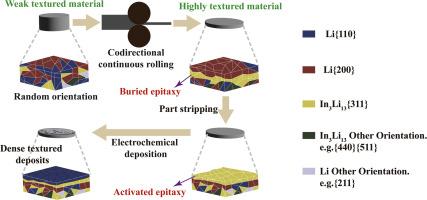
A growing need for high-energy-density lithium metal batteries appeal for utilize ultrathin (≤50 μm) free-standing Li metal anodes. However, challenges such as the formation of an unstable solid electrolyte interphase and the lithium dendrites growth have led to poor cycling performance and safety concerns, limiting the commercial viability of thin lithium metal anodes. This work introduces a facile approach by designing and fabricating an ultrathin Li-In alloy anode through in-situ vacuum melting and codirectional continuous rolling. The rolled ultrathin Li-In anode achieves the induction of uniform epitaxial electrodeposition of Li(110), which is attributed to the lithiophility of the densely distributed In₃Li₁₃ alloy phase and the coherent heterogeneous relationship between textured In₃Li₁₃(311) and Li(110).The symmetrical cell assembled by 50 μm Li-In alloy anode exhibits a prolonged lifespan for 1800 h under the conditions of 1 mA cm-2 and 3 mAh cm-2. Meanwhile, the LiFePO4||Li-In (50 μm) full cell achieves sTable 450 cycles with a retention of 90.3 % at 2 C (1 C = 170 mA g-1). This work paves the path for the practical ultrathin Li anode for commercializing the lithium metal batteries.
对高能量密度锂金属电池日益增长的需求要求使用超薄(≤50 μm)独立锂金属阳极。然而,诸如不稳定的固体电解质界面的形成和锂枝晶的生长等挑战导致了较差的循环性能和安全问题,限制了薄锂金属阳极的商业可行性。本文介绍了一种采用原位真空熔炼和同向连续轧制的方法设计和制造超薄锂合金阳极的简便方法。轧制的超薄Li-In阳极实现了Li(110)均匀外延电沉积的诱导,这归功于密集分布的In₃Li₁₃合金相的亲石性以及织构的In₃Li₁₃(311)与Li(110)之间的相干非均质关系。采用50 μm Li-In合金阳极组装的对称电池在1 mA cm-2和3 mAh cm-2条件下寿命可延长1800 h。同时,LiFePO4||Li-In (50 μm)全电池在2℃(1℃ = 170 mA g-1)下实现了450次稳定循环,保留率为90.3%。本研究为超薄锂阳极的实用化和锂金属电池的商业化铺平了道路。
期刊介绍:
Acta Materialia serves as a platform for publishing full-length, original papers and commissioned overviews that contribute to a profound understanding of the correlation between the processing, structure, and properties of inorganic materials. The journal seeks papers with high impact potential or those that significantly propel the field forward. The scope includes the atomic and molecular arrangements, chemical and electronic structures, and microstructure of materials, focusing on their mechanical or functional behavior across all length scales, including nanostructures.





 京公网安备 11010802042870号
京ICP备2023020795号-1
京公网安备 11010802042870号
京ICP备2023020795号-1

 分享
分享
 求助内容:
求助内容: 应助结果提醒方式:
 扫码关注我们
