Jihyun Baek, Yue Jiang, Dongwon Ka, Yuzhe Li, Yifan Wang, Sungsoon Kim, Adam Wallace Potter, Zengqing Zhuo, Jinghua Guo, Xiaolin Zheng
{"title":"Ultrafast Photoflash Synthesis of High-Entropy Oxide Nanoparticles","authors":"Jihyun Baek, Yue Jiang, Dongwon Ka, Yuzhe Li, Yifan Wang, Sungsoon Kim, Adam Wallace Potter, Zengqing Zhuo, Jinghua Guo, Xiaolin Zheng","doi":"10.1021/acsnano.4c18277","DOIUrl":null,"url":null,"abstract":"High-entropy metal oxides (HEOs) have recently received growing attention for broad energy conversion and storage applications due to their tunable properties. HEOs typically involve the combination of multiple metal cations in a single oxide lattice, thus bringing distinctive structures, controllable elemental composition, and tunable functional properties. Many synthesis methods for HEOs have been reported, such as solid-state reactions and carbon thermal shock methods. These methods frequently are energy-intensive or require relatively expensive heating equipment. In this work, we report an ultrafast photoflash synthesis method for HEO nanoparticles on diverse substrates. The energy input is provided by a commercial Xe photoflash unit, which triggers exothermic reactions to convert metal salt precursors to HEO nanoparticles within tens of milliseconds. The formation of HEO nanoparticles is attributed to the ultrafast heating (∼10<sup>6</sup> K/s) and cooling (∼10<sup>5</sup> K/s) rates of the photoflash and overall high temperature (>1000 K) during the ultrafast synthesis process. When the synthesized CoNiFeCrMn oxide (HEO) is tested as an oxygen evolution reaction electrocatalyst, it shows similar activity to similar materials prepared by other methods. We believe this photoflash synthesis provides a simple method for many others to synthesize diverse HEOs and explore their properties and potential applications.","PeriodicalId":21,"journal":{"name":"ACS Nano","volume":"11 1","pages":""},"PeriodicalIF":16.0000,"publicationDate":"2025-01-30","publicationTypes":"Journal Article","fieldsOfStudy":null,"isOpenAccess":false,"openAccessPdf":"","citationCount":"0","resultStr":null,"platform":"Semanticscholar","paperid":null,"PeriodicalName":"ACS Nano","FirstCategoryId":"88","ListUrlMain":"https://doi.org/10.1021/acsnano.4c18277","RegionNum":1,"RegionCategory":"材料科学","ArticlePicture":[],"TitleCN":null,"AbstractTextCN":null,"PMCID":null,"EPubDate":"","PubModel":"","JCR":"Q1","JCRName":"CHEMISTRY, MULTIDISCIPLINARY","Score":null,"Total":0}
引用次数: 0
Abstract
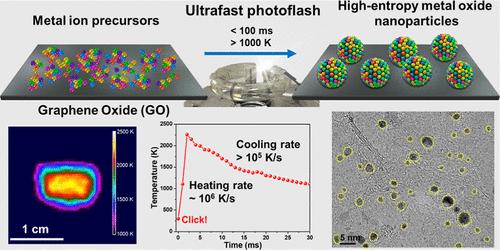
High-entropy metal oxides (HEOs) have recently received growing attention for broad energy conversion and storage applications due to their tunable properties. HEOs typically involve the combination of multiple metal cations in a single oxide lattice, thus bringing distinctive structures, controllable elemental composition, and tunable functional properties. Many synthesis methods for HEOs have been reported, such as solid-state reactions and carbon thermal shock methods. These methods frequently are energy-intensive or require relatively expensive heating equipment. In this work, we report an ultrafast photoflash synthesis method for HEO nanoparticles on diverse substrates. The energy input is provided by a commercial Xe photoflash unit, which triggers exothermic reactions to convert metal salt precursors to HEO nanoparticles within tens of milliseconds. The formation of HEO nanoparticles is attributed to the ultrafast heating (∼106 K/s) and cooling (∼105 K/s) rates of the photoflash and overall high temperature (>1000 K) during the ultrafast synthesis process. When the synthesized CoNiFeCrMn oxide (HEO) is tested as an oxygen evolution reaction electrocatalyst, it shows similar activity to similar materials prepared by other methods. We believe this photoflash synthesis provides a simple method for many others to synthesize diverse HEOs and explore their properties and potential applications.
期刊介绍:
ACS Nano, published monthly, serves as an international forum for comprehensive articles on nanoscience and nanotechnology research at the intersections of chemistry, biology, materials science, physics, and engineering. The journal fosters communication among scientists in these communities, facilitating collaboration, new research opportunities, and advancements through discoveries. ACS Nano covers synthesis, assembly, characterization, theory, and simulation of nanostructures, nanobiotechnology, nanofabrication, methods and tools for nanoscience and nanotechnology, and self- and directed-assembly. Alongside original research articles, it offers thorough reviews, perspectives on cutting-edge research, and discussions envisioning the future of nanoscience and nanotechnology.




 京公网安备 11010802042870号
京ICP备2023020795号-1
京公网安备 11010802042870号
京ICP备2023020795号-1

 分享
分享
 求助内容:
求助内容: 应助结果提醒方式:
 扫码关注我们
