Anu Pulparambil, Bitan Ray, Subhajit Chakraborty and Sebastian C. Peter
{"title":"Exploration of halogen-free sustainable superhydrophobic materials for surface protection from multi-contaminants in all weather conditions†","authors":"Anu Pulparambil, Bitan Ray, Subhajit Chakraborty and Sebastian C. Peter","doi":"10.1039/D4MH01304B","DOIUrl":null,"url":null,"abstract":"<p >The complex synthetic approach and utilization of toxic chemicals restrain the commercialization of numerous existing superhydrophobic materials. This article focuses on the development of a halogen-free superhydrophobic material for self-cleaning applications. HMDS-modified MCM-41 is employed as the base material. Silanization within the silica-framework is strategically improved by introducing the concept of surface-acidity enhancement by suitable heteroatom (Al, Ti and Zr) incorporation. The role of heteroatoms in defining the surface acidity of MCM-41 is analyzed in terms of solubility limit, ionic radii and electronegativity of the heteroatoms. Additionally, this work exclusively discusses the solvent selection criteria for the synthesis of hydrophobic materials and their role in enhancing hydrophobicity, evaluated <em>via</em> UV-visible turbidity measurements. Based on extensive studies, silane modified 25% Al-MCM-41 dispersed in acetonitrile exhibits exceptional water repellence with a water contact angle of 172.4 ± 0.7°. Higher electropositivity and the trivalent bonding nature of Al facilitate efficient silane modification and reduced surface OH concentration, leading to improved material hydrophobicity. Remarkable self-cleaning capability combined with durability and resilience towards diverse harsh conditions strengthen the practical viability of the designed material. Life cycle assessment (LCA) suggested that the material exhibits a smaller environmental footprint in terms of 18 selected midpoint indicators compared to the state-of-the-art materials.</p>","PeriodicalId":87,"journal":{"name":"Materials Horizons","volume":" 9","pages":" 3062-3072"},"PeriodicalIF":10.7000,"publicationDate":"2025-01-14","publicationTypes":"Journal Article","fieldsOfStudy":null,"isOpenAccess":false,"openAccessPdf":"","citationCount":"0","resultStr":null,"platform":"Semanticscholar","paperid":null,"PeriodicalName":"Materials Horizons","FirstCategoryId":"88","ListUrlMain":"https://pubs.rsc.org/en/content/articlelanding/2025/mh/d4mh01304b","RegionNum":2,"RegionCategory":"材料科学","ArticlePicture":[],"TitleCN":null,"AbstractTextCN":null,"PMCID":null,"EPubDate":"","PubModel":"","JCR":"Q1","JCRName":"CHEMISTRY, MULTIDISCIPLINARY","Score":null,"Total":0}
引用次数: 0
Abstract
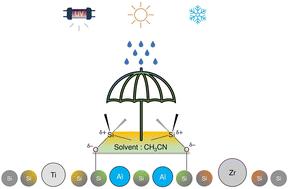
The complex synthetic approach and utilization of toxic chemicals restrain the commercialization of numerous existing superhydrophobic materials. This article focuses on the development of a halogen-free superhydrophobic material for self-cleaning applications. HMDS-modified MCM-41 is employed as the base material. Silanization within the silica-framework is strategically improved by introducing the concept of surface-acidity enhancement by suitable heteroatom (Al, Ti and Zr) incorporation. The role of heteroatoms in defining the surface acidity of MCM-41 is analyzed in terms of solubility limit, ionic radii and electronegativity of the heteroatoms. Additionally, this work exclusively discusses the solvent selection criteria for the synthesis of hydrophobic materials and their role in enhancing hydrophobicity, evaluated via UV-visible turbidity measurements. Based on extensive studies, silane modified 25% Al-MCM-41 dispersed in acetonitrile exhibits exceptional water repellence with a water contact angle of 172.4 ± 0.7°. Higher electropositivity and the trivalent bonding nature of Al facilitate efficient silane modification and reduced surface OH concentration, leading to improved material hydrophobicity. Remarkable self-cleaning capability combined with durability and resilience towards diverse harsh conditions strengthen the practical viability of the designed material. Life cycle assessment (LCA) suggested that the material exhibits a smaller environmental footprint in terms of 18 selected midpoint indicators compared to the state-of-the-art materials.



 京公网安备 11010802042870号
京ICP备2023020795号-1
京公网安备 11010802042870号
京ICP备2023020795号-1

 分享
分享
 求助内容:
求助内容: 应助结果提醒方式:
 扫码关注我们
