{"title":"Economic loss attributable to premature deaths and morbidity among adolescents in India and its states.","authors":"G Anil Kumar, Anamika Pandey, Rakhi Dandona","doi":"10.1186/s12916-025-03895-5","DOIUrl":null,"url":null,"abstract":"<p><strong>Background: </strong>India's large youth population presents a significant opportunity to harness the demographic dividend. The disease burden in adolescents could be a hindrance for the future economy if not appropriately addressed.</p><p><strong>Methods: </strong>We utilised the data on the number of adolescent deaths and attributable years lived with disability (morbidity) in every state of India as part of the Global Burden of Diseases, Injuries, and Risk Factors Study (GBD) 2021. We estimated the economic impact as the cost of lost output due to premature adolescent deaths and morbidity for every state of India in 2021, using an output-based method. The cost of lost output is reported in US Dollars (USD) and as a percentage of Gross Domestic Product (GDP) for all diseases/conditions together, and separately for communicable diseases (CDs), non-communicable diseases (NCDs), and injuries.</p><p><strong>Results: </strong>The lost output from premature deaths and morbidity attributable to adolescents was USD 9.87 (95% CI 9.04-10.71) and USD 28.13 (95% CI 20.53-37.71) billion respectively, in India in 2021. The total economic loss of USD 38.01 billion (95% CI 29.57-48.41) was 1.30% (1.01-1.65) of India's GDP. The total economic loss as a percentage of the state's GDP varied 3.42 times between the states in 2021, ranging from 2.43% in Bihar to 0.71% in Sikkim. The total economic loss due to CDs, NCDs, and injuries was estimated at 0.45%, 0.69% and 0.16% of India's GDP in 2021, with significant variations across the states.</p><p><strong>Conclusions: </strong>Strengthening the Indian Adolescent Health Strategy to address the diseases/ conditions contributing most to the total economic loss is needed to facilitate substantial avoidance of the high economic losses attributable to adolescent premature deaths and morbidity in India.</p>","PeriodicalId":9188,"journal":{"name":"BMC Medicine","volume":"23 1","pages":"51"},"PeriodicalIF":8.3000,"publicationDate":"2025-01-29","publicationTypes":"Journal Article","fieldsOfStudy":null,"isOpenAccess":false,"openAccessPdf":"https://www.ncbi.nlm.nih.gov/pmc/articles/PMC11776167/pdf/","citationCount":"0","resultStr":null,"platform":"Semanticscholar","paperid":null,"PeriodicalName":"BMC Medicine","FirstCategoryId":"3","ListUrlMain":"https://doi.org/10.1186/s12916-025-03895-5","RegionNum":1,"RegionCategory":"医学","ArticlePicture":[],"TitleCN":null,"AbstractTextCN":null,"PMCID":null,"EPubDate":"","PubModel":"","JCR":"Q1","JCRName":"MEDICINE, GENERAL & INTERNAL","Score":null,"Total":0}
引用次数: 0
Abstract
Background: India's large youth population presents a significant opportunity to harness the demographic dividend. The disease burden in adolescents could be a hindrance for the future economy if not appropriately addressed.
Methods: We utilised the data on the number of adolescent deaths and attributable years lived with disability (morbidity) in every state of India as part of the Global Burden of Diseases, Injuries, and Risk Factors Study (GBD) 2021. We estimated the economic impact as the cost of lost output due to premature adolescent deaths and morbidity for every state of India in 2021, using an output-based method. The cost of lost output is reported in US Dollars (USD) and as a percentage of Gross Domestic Product (GDP) for all diseases/conditions together, and separately for communicable diseases (CDs), non-communicable diseases (NCDs), and injuries.
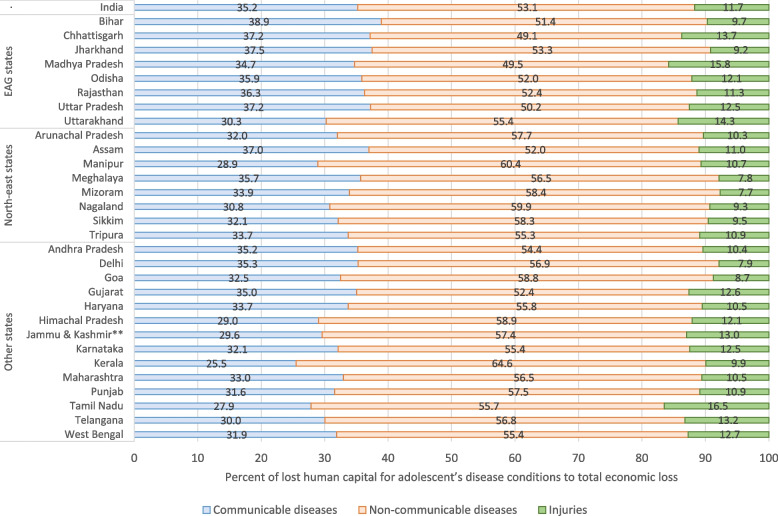
Results: The lost output from premature deaths and morbidity attributable to adolescents was USD 9.87 (95% CI 9.04-10.71) and USD 28.13 (95% CI 20.53-37.71) billion respectively, in India in 2021. The total economic loss of USD 38.01 billion (95% CI 29.57-48.41) was 1.30% (1.01-1.65) of India's GDP. The total economic loss as a percentage of the state's GDP varied 3.42 times between the states in 2021, ranging from 2.43% in Bihar to 0.71% in Sikkim. The total economic loss due to CDs, NCDs, and injuries was estimated at 0.45%, 0.69% and 0.16% of India's GDP in 2021, with significant variations across the states.
Conclusions: Strengthening the Indian Adolescent Health Strategy to address the diseases/ conditions contributing most to the total economic loss is needed to facilitate substantial avoidance of the high economic losses attributable to adolescent premature deaths and morbidity in India.
背景:印度庞大的青年人口为利用人口红利提供了重要机会。青少年的疾病负担如果得不到适当处理,可能成为未来经济的障碍。方法:作为2021年全球疾病、伤害和风险因素负担研究(GBD)的一部分,我们利用了印度每个邦青少年死亡人数和可归因残疾生活年数(发病率)的数据。我们使用基于产出的方法,估计了2021年印度每个邦因青少年过早死亡和发病而造成的产出损失成本的经济影响。所有疾病/病症的产出损失成本以美元(USD)和占国内生产总值(GDP)的百分比报告,传染病(cd)、非传染性疾病(ncd)和伤害的损失成本分别报告。结果:2021年,印度因青少年过早死亡和发病造成的产值损失分别为9.87亿美元(95% CI 9.04-10.71)和28.13亿美元(95% CI 205.3 - 3771)。经济损失总额为380.1亿美元(95% CI 29.57-48.41),占印度GDP的1.30%(1.01-1.65)。2021年,总经济损失占该邦GDP的比例在各邦之间相差3.42倍,从比哈尔邦的2.43%到锡金邦的0.71%不等。2021年,非传染性疾病、非传染性疾病和伤害造成的总经济损失估计分别占印度GDP的0.45%、0.69%和0.16%,各邦差异很大。结论:需要加强印度青少年健康战略,以解决造成经济损失最多的疾病/病症,从而大大避免印度青少年过早死亡和发病造成的高额经济损失。
期刊介绍:
BMC Medicine is an open access, transparent peer-reviewed general medical journal. It is the flagship journal of the BMC series and publishes outstanding and influential research in various areas including clinical practice, translational medicine, medical and health advances, public health, global health, policy, and general topics of interest to the biomedical and sociomedical professional communities. In addition to research articles, the journal also publishes stimulating debates, reviews, unique forum articles, and concise tutorials. All articles published in BMC Medicine are included in various databases such as Biological Abstracts, BIOSIS, CAS, Citebase, Current contents, DOAJ, Embase, MEDLINE, PubMed, Science Citation Index Expanded, OAIster, SCImago, Scopus, SOCOLAR, and Zetoc.




 京公网安备 11010802042870号
京ICP备2023020795号-1
京公网安备 11010802042870号
京ICP备2023020795号-1

 分享
分享
 求助内容:
求助内容: 应助结果提醒方式:
 扫码关注我们
