{"title":"Words of advice for young scientists in developing countries","authors":"Max Chavarría","doi":"10.1111/febs.17425","DOIUrl":null,"url":null,"abstract":"<p>As scientists, change is the only constant in our journey. We often find ourselves in transition from one laboratory to another, and during our training we are fortunate to experience the excitement of pursuing postgraduate studies abroad in well-funded, high-level research centers. However, after completing doctoral or postdoctoral training, we are frequently drawn to return to our home countries, where funding and support for science are significantly more limited. In this brief commentary, first, I would like to highlight the challenges faced by scientists from developing countries who have had the opportunity to train internationally and then choose to return home, driven both by personal motivations (e.g., family) and by the desire to contribute to the scientific advancement of their regions. Second, I would like to share some advice that has been especially useful to me in establishing my laboratory, defining research topics, and maintaining academic productivity. I hope these insights can be useful to colleagues in similar situations across different regions. Although starting a research group in regions with less investment in Research and Development is challenging, it is achievable with perseverance and the implementation of concrete actions.</p>","PeriodicalId":94226,"journal":{"name":"The FEBS journal","volume":"292 13","pages":"3350-3355"},"PeriodicalIF":4.2000,"publicationDate":"2025-01-31","publicationTypes":"Journal Article","fieldsOfStudy":null,"isOpenAccess":false,"openAccessPdf":"https://onlinelibrary.wiley.com/doi/epdf/10.1111/febs.17425","citationCount":"0","resultStr":null,"platform":"Semanticscholar","paperid":null,"PeriodicalName":"The FEBS journal","FirstCategoryId":"1085","ListUrlMain":"https://febs.onlinelibrary.wiley.com/doi/10.1111/febs.17425","RegionNum":0,"RegionCategory":null,"ArticlePicture":[],"TitleCN":null,"AbstractTextCN":null,"PMCID":null,"EPubDate":"","PubModel":"","JCR":"","JCRName":"","Score":null,"Total":0}
引用次数: 0
Abstract
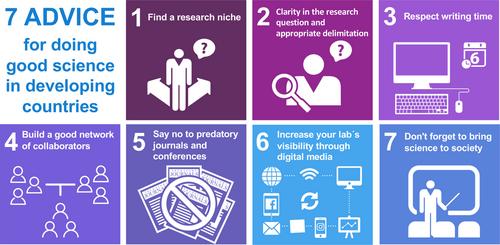
As scientists, change is the only constant in our journey. We often find ourselves in transition from one laboratory to another, and during our training we are fortunate to experience the excitement of pursuing postgraduate studies abroad in well-funded, high-level research centers. However, after completing doctoral or postdoctoral training, we are frequently drawn to return to our home countries, where funding and support for science are significantly more limited. In this brief commentary, first, I would like to highlight the challenges faced by scientists from developing countries who have had the opportunity to train internationally and then choose to return home, driven both by personal motivations (e.g., family) and by the desire to contribute to the scientific advancement of their regions. Second, I would like to share some advice that has been especially useful to me in establishing my laboratory, defining research topics, and maintaining academic productivity. I hope these insights can be useful to colleagues in similar situations across different regions. Although starting a research group in regions with less investment in Research and Development is challenging, it is achievable with perseverance and the implementation of concrete actions.





 京公网安备 11010802042870号
京ICP备2023020795号-1
京公网安备 11010802042870号
京ICP备2023020795号-1

 分享
分享

 求助内容:
求助内容: 应助结果提醒方式:
 扫码关注我们
