Yixi Yang, Shaoqing Wang, Lin Wang, Na Dang, Tao Qin, Heye Zhou and Bin Liu
{"title":"Transition-metal-free tunable regioselective [3+2] cycloaddition of diaryliodonium salts with 1,3-dicarbonyl derivatives†","authors":"Yixi Yang, Shaoqing Wang, Lin Wang, Na Dang, Tao Qin, Heye Zhou and Bin Liu","doi":"10.1039/D4CC06376G","DOIUrl":null,"url":null,"abstract":"<p >A new [3+2] cycloaddition reaction of diaryliodonium salts with 1,3-dicarbonyl compounds for the synthesis of benzofuran derivatives is reported, involving the sequential selective coupling of dual electrophilic and nucleophilic reagents. The key to this reaction is the use of a novel diaryliodonium reagent, which carries both a leaving group and a strong electron-withdrawing group (EWG). Interestingly, the choice of leaving group can dictate the reaction's selectivity. Moreover, the protocol demonstrates significant robustness, flexibility, and compatibility with a broad range of functional groups.</p>","PeriodicalId":67,"journal":{"name":"Chemical Communications","volume":" 17","pages":" 3516-3519"},"PeriodicalIF":4.2000,"publicationDate":"2025-02-01","publicationTypes":"Journal Article","fieldsOfStudy":null,"isOpenAccess":false,"openAccessPdf":"","citationCount":"0","resultStr":null,"platform":"Semanticscholar","paperid":null,"PeriodicalName":"Chemical Communications","FirstCategoryId":"92","ListUrlMain":"https://pubs.rsc.org/en/content/articlelanding/2025/cc/d4cc06376g","RegionNum":2,"RegionCategory":"化学","ArticlePicture":[],"TitleCN":null,"AbstractTextCN":null,"PMCID":null,"EPubDate":"","PubModel":"","JCR":"Q2","JCRName":"CHEMISTRY, MULTIDISCIPLINARY","Score":null,"Total":0}
引用次数: 0
Abstract
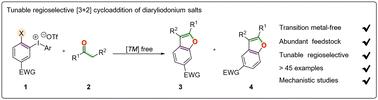
A new [3+2] cycloaddition reaction of diaryliodonium salts with 1,3-dicarbonyl compounds for the synthesis of benzofuran derivatives is reported, involving the sequential selective coupling of dual electrophilic and nucleophilic reagents. The key to this reaction is the use of a novel diaryliodonium reagent, which carries both a leaving group and a strong electron-withdrawing group (EWG). Interestingly, the choice of leaving group can dictate the reaction's selectivity. Moreover, the protocol demonstrates significant robustness, flexibility, and compatibility with a broad range of functional groups.
期刊介绍:
ChemComm (Chemical Communications) is renowned as the fastest publisher of articles providing information on new avenues of research, drawn from all the world''s major areas of chemical research.



 京公网安备 11010802042870号
京ICP备2023020795号-1
京公网安备 11010802042870号
京ICP备2023020795号-1

 分享
分享
 求助内容:
求助内容: 应助结果提醒方式:
 扫码关注我们
