Morten Lindhardt, Søren Tang Knudsen, Thomas Saxild, Morten Charles, Rikke Borg
{"title":"Treating chronic kidney disease in Danish primary care: results from the observational ATLAS study.","authors":"Morten Lindhardt, Søren Tang Knudsen, Thomas Saxild, Morten Charles, Rikke Borg","doi":"10.1186/s12875-025-02721-4","DOIUrl":null,"url":null,"abstract":"<p><strong>Objectives: </strong>To describe the clinical characteristics, comorbidity, and medical treatment in a primary care population with chronic kidney disease (CKD). Additionally, to investigate how primary care physicians (PCPs) diagnose, manage and treat impaired kidney function, including uptake of cardio-renoprotective renin-angiotensin-aldosterone system inhibitors (RAASis) and sodium glucose co-transporter 2 inhibitors (SGLT2is).</p><p><strong>Design: </strong>An observational study of CKD prevalence, treatment patterns and comorbidities in primary care based on patient record data combined with a questionnaire on diagnosis, management and treatment of impaired kidney function in a real-world, primary care setting.</p><p><strong>Setting: </strong>In all 128 primary care clinics in Denmark of 211 randomly invited and a quetionnaire completed by 125/128 participating PCPs.</p><p><strong>Methods: </strong>A computerized selection identified 12 random individuals with CKD per clinic with ≥ 2 measurements of eGFR < 60 mL/min/1.73 m<sup>2</sup> or UACR > 30 mg/g within two years (N = 1 497). Pre-specified data collected from individual electronic health records included demographics, clinical variables, comorbidities, and relevant prescribed medications.</p><p><strong>Results: </strong>Of the CKD study population (N = 1 497), 80% had hypertension, 32% diabetes (DM), 13% heart failure (HF), 59% no DM/HF. ACEis/ARBs were prescribed to 65%, statins to 56%, SGTL2is to 14%, and MRAs to 8% of all individuals. Treatment patterns differed between individuals with varying comorbidities, e.g., ACEis/ARBs usage was higher in DM (76%) or HF (74%) vs. no DM/HF (58%), as was statin usage (76% in DM vs. 45% in no DM/HF). SGTL2i usage in no DM/HF was low. Most PCPs identified CKD using eGFR < 60 mL/min/1.73 m<sup>2</sup> (62%) or UACR > 30 mg/g (58%) and 62% reported initiating treatment to retard kidney function decline.</p><p><strong>Conclusions: </strong>Despite good PCP awareness and wish to use relevant guidelines, a gap exists in implementation of cardio-renoprotective treatment, especially in individuals without DM/HF. This offers an opportunity for clear recommendations to PCPs to optimize early cardio-renal protection in individuals with CKD.</p>","PeriodicalId":72428,"journal":{"name":"BMC primary care","volume":"26 1","pages":"23"},"PeriodicalIF":2.6000,"publicationDate":"2025-02-01","publicationTypes":"Journal Article","fieldsOfStudy":null,"isOpenAccess":false,"openAccessPdf":"https://www.ncbi.nlm.nih.gov/pmc/articles/PMC11786539/pdf/","citationCount":"0","resultStr":null,"platform":"Semanticscholar","paperid":null,"PeriodicalName":"BMC primary care","FirstCategoryId":"1085","ListUrlMain":"https://doi.org/10.1186/s12875-025-02721-4","RegionNum":0,"RegionCategory":null,"ArticlePicture":[],"TitleCN":null,"AbstractTextCN":null,"PMCID":null,"EPubDate":"","PubModel":"","JCR":"Q2","JCRName":"MEDICINE, GENERAL & INTERNAL","Score":null,"Total":0}
引用次数: 0
Abstract
Objectives: To describe the clinical characteristics, comorbidity, and medical treatment in a primary care population with chronic kidney disease (CKD). Additionally, to investigate how primary care physicians (PCPs) diagnose, manage and treat impaired kidney function, including uptake of cardio-renoprotective renin-angiotensin-aldosterone system inhibitors (RAASis) and sodium glucose co-transporter 2 inhibitors (SGLT2is).
Design: An observational study of CKD prevalence, treatment patterns and comorbidities in primary care based on patient record data combined with a questionnaire on diagnosis, management and treatment of impaired kidney function in a real-world, primary care setting.
Setting: In all 128 primary care clinics in Denmark of 211 randomly invited and a quetionnaire completed by 125/128 participating PCPs.
Methods: A computerized selection identified 12 random individuals with CKD per clinic with ≥ 2 measurements of eGFR < 60 mL/min/1.73 m2 or UACR > 30 mg/g within two years (N = 1 497). Pre-specified data collected from individual electronic health records included demographics, clinical variables, comorbidities, and relevant prescribed medications.
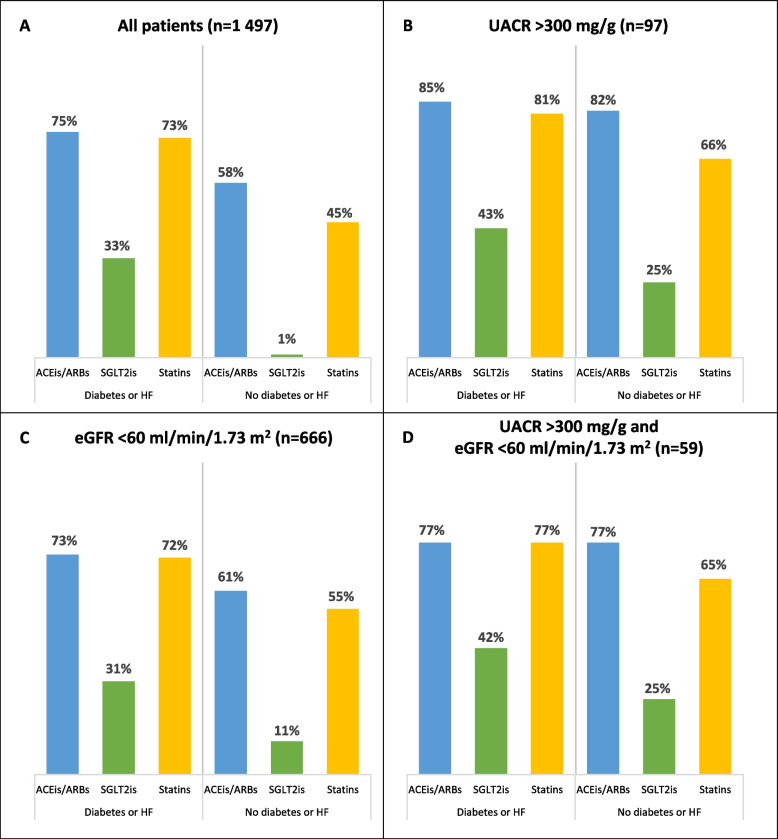
Results: Of the CKD study population (N = 1 497), 80% had hypertension, 32% diabetes (DM), 13% heart failure (HF), 59% no DM/HF. ACEis/ARBs were prescribed to 65%, statins to 56%, SGTL2is to 14%, and MRAs to 8% of all individuals. Treatment patterns differed between individuals with varying comorbidities, e.g., ACEis/ARBs usage was higher in DM (76%) or HF (74%) vs. no DM/HF (58%), as was statin usage (76% in DM vs. 45% in no DM/HF). SGTL2i usage in no DM/HF was low. Most PCPs identified CKD using eGFR < 60 mL/min/1.73 m2 (62%) or UACR > 30 mg/g (58%) and 62% reported initiating treatment to retard kidney function decline.
Conclusions: Despite good PCP awareness and wish to use relevant guidelines, a gap exists in implementation of cardio-renoprotective treatment, especially in individuals without DM/HF. This offers an opportunity for clear recommendations to PCPs to optimize early cardio-renal protection in individuals with CKD.




 京公网安备 11010802042870号
京ICP备2023020795号-1
京公网安备 11010802042870号
京ICP备2023020795号-1

 分享
分享

 求助内容:
求助内容: 应助结果提醒方式:
 扫码关注我们
