Paul J. Weiser , Georg Langs , Wolfgang Bogner , Stanislav Motyka , Bernhard Strasser , Polina Golland , Nalini Singh , Jorg Dietrich , Erik Uhlmann , Tracy Batchelor , Daniel Cahill , Malte Hoffmann , Antoine Klauser , Ovidiu C. Andronesi
{"title":"Deep-ER: Deep Learning ECCENTRIC Reconstruction for fast high-resolution neurometabolic imaging","authors":"Paul J. Weiser , Georg Langs , Wolfgang Bogner , Stanislav Motyka , Bernhard Strasser , Polina Golland , Nalini Singh , Jorg Dietrich , Erik Uhlmann , Tracy Batchelor , Daniel Cahill , Malte Hoffmann , Antoine Klauser , Ovidiu C. Andronesi","doi":"10.1016/j.neuroimage.2025.121045","DOIUrl":null,"url":null,"abstract":"<div><h3>Introduction:</h3><div>Altered neurometabolism is an important pathological mechanism in many neurological diseases and brain cancer, which can be mapped non-invasively by Magnetic Resonance Spectroscopic Imaging (MRSI). Advanced MRSI using non-cartesian compressed-sense acquisition enables fast high-resolution metabolic imaging but has lengthy reconstruction times that limits throughput and needs expert user interaction. Here, we present a robust and efficient Deep Learning reconstruction embedded in a physical model within an end-to-end automated processing pipeline to obtain high-quality metabolic maps.</div></div><div><h3>Methods:</h3><div>Fast high-resolution whole-brain metabolic imaging was performed at 3.4 mm<span><math><msup><mrow></mrow><mrow><mn>3</mn></mrow></msup></math></span> isotropic resolution with acquisition times between 4:11–9:21 min:s using ECCENTRIC pulse sequence on a 7T MRI scanner. Data were acquired in a high-resolution phantom and 27 human participants, including 22 healthy volunteers and 5 glioma patients. A deep neural network using recurring interlaced convolutional layers with joint dual-space feature representation was developed for deep learning ECCENTRIC reconstruction (Deep-ER). 21 subjects were used for training and 6 subjects for testing. Deep-ER performance was compared to iterative compressed sensing Total Generalized Variation reconstruction using image and spectral quality metrics.</div></div><div><h3>Results:</h3><div>Deep-ER demonstrated 600-fold faster reconstruction than conventional methods, providing improved spatial–spectral quality and metabolite quantification with 12%–45% (P<span><math><mo><</mo></math></span>0.05) higher signal-to-noise and 8%–50% (P<span><math><mo><</mo></math></span>0.05) smaller Cramer–Rao lower bounds. Metabolic images clearly visualize glioma tumor heterogeneity and boundary. Deep-ER generalizes reliably to unseen data.</div></div><div><h3>Conclusion:</h3><div>Deep-ER provides efficient and robust reconstruction for sparse-sampled MRSI. The accelerated acquisition-reconstruction MRSI is compatible with high-throughput imaging workflow. It is expected that such improved performance will facilitate basic and clinical MRSI applications for neuroscience and precision medicine.</div></div>","PeriodicalId":19299,"journal":{"name":"NeuroImage","volume":"309 ","pages":"Article 121045"},"PeriodicalIF":4.5000,"publicationDate":"2025-04-01","publicationTypes":"Journal Article","fieldsOfStudy":null,"isOpenAccess":false,"openAccessPdf":"","citationCount":"0","resultStr":null,"platform":"Semanticscholar","paperid":null,"PeriodicalName":"NeuroImage","FirstCategoryId":"3","ListUrlMain":"https://www.sciencedirect.com/science/article/pii/S1053811925000473","RegionNum":2,"RegionCategory":"医学","ArticlePicture":[],"TitleCN":null,"AbstractTextCN":null,"PMCID":null,"EPubDate":"2025/2/1 0:00:00","PubModel":"Epub","JCR":"Q1","JCRName":"NEUROIMAGING","Score":null,"Total":0}
引用次数: 0
Abstract
Introduction:
Altered neurometabolism is an important pathological mechanism in many neurological diseases and brain cancer, which can be mapped non-invasively by Magnetic Resonance Spectroscopic Imaging (MRSI). Advanced MRSI using non-cartesian compressed-sense acquisition enables fast high-resolution metabolic imaging but has lengthy reconstruction times that limits throughput and needs expert user interaction. Here, we present a robust and efficient Deep Learning reconstruction embedded in a physical model within an end-to-end automated processing pipeline to obtain high-quality metabolic maps.
Methods:
Fast high-resolution whole-brain metabolic imaging was performed at 3.4 mm isotropic resolution with acquisition times between 4:11–9:21 min:s using ECCENTRIC pulse sequence on a 7T MRI scanner. Data were acquired in a high-resolution phantom and 27 human participants, including 22 healthy volunteers and 5 glioma patients. A deep neural network using recurring interlaced convolutional layers with joint dual-space feature representation was developed for deep learning ECCENTRIC reconstruction (Deep-ER). 21 subjects were used for training and 6 subjects for testing. Deep-ER performance was compared to iterative compressed sensing Total Generalized Variation reconstruction using image and spectral quality metrics.
Results:
Deep-ER demonstrated 600-fold faster reconstruction than conventional methods, providing improved spatial–spectral quality and metabolite quantification with 12%–45% (P0.05) higher signal-to-noise and 8%–50% (P0.05) smaller Cramer–Rao lower bounds. Metabolic images clearly visualize glioma tumor heterogeneity and boundary. Deep-ER generalizes reliably to unseen data.
Conclusion:
Deep-ER provides efficient and robust reconstruction for sparse-sampled MRSI. The accelerated acquisition-reconstruction MRSI is compatible with high-throughput imaging workflow. It is expected that such improved performance will facilitate basic and clinical MRSI applications for neuroscience and precision medicine.
期刊介绍:
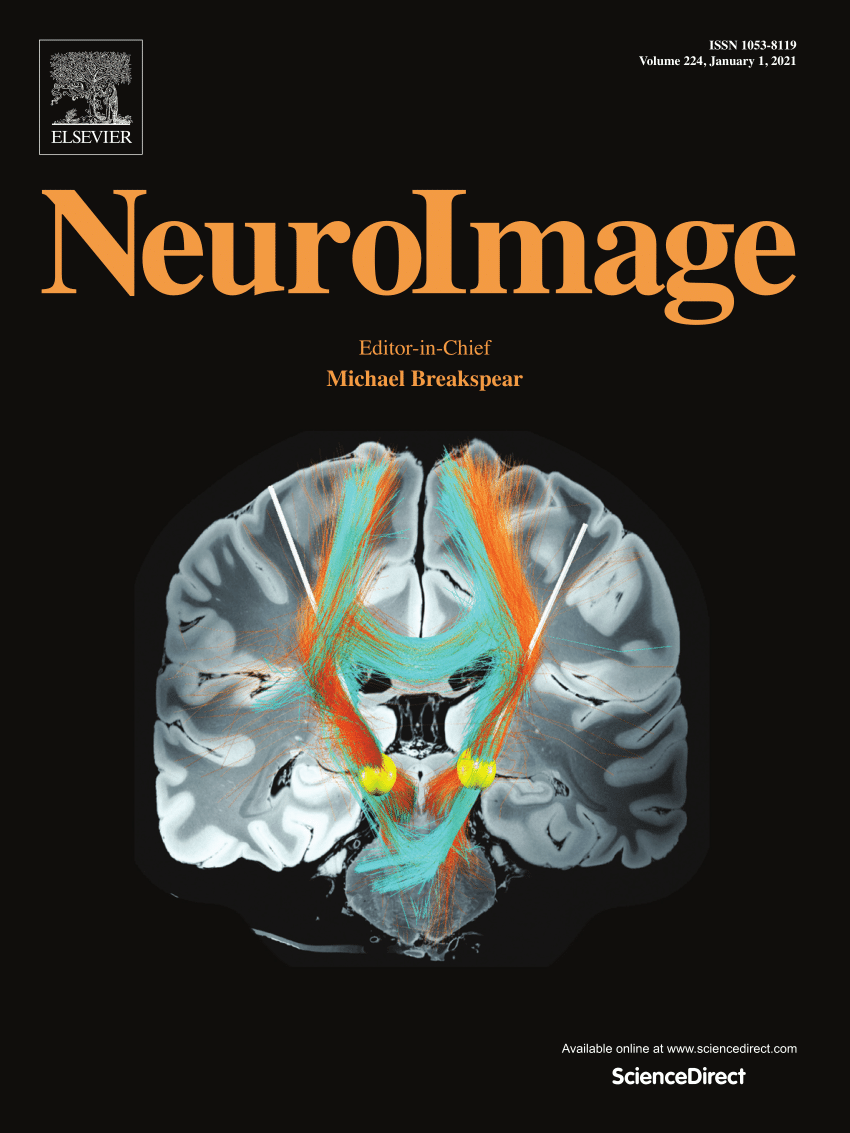
NeuroImage, a Journal of Brain Function provides a vehicle for communicating important advances in acquiring, analyzing, and modelling neuroimaging data and in applying these techniques to the study of structure-function and brain-behavior relationships. Though the emphasis is on the macroscopic level of human brain organization, meso-and microscopic neuroimaging across all species will be considered if informative for understanding the aforementioned relationships.



 京公网安备 11010802042870号
京ICP备2023020795号-1
京公网安备 11010802042870号
京ICP备2023020795号-1

 分享
分享
 求助内容:
求助内容: 应助结果提醒方式:
 扫码关注我们
