J. Gould , R.A. Marshall , D. French , M. Dyer-Heynen , P. Olszynski
{"title":"Comparing sternal versus left-sided chest compressions for thoracoabdonimal injuries and compression biomechanics: A clinical-grade cadaver study","authors":"J. Gould , R.A. Marshall , D. French , M. Dyer-Heynen , P. Olszynski","doi":"10.1016/j.resplu.2025.100865","DOIUrl":null,"url":null,"abstract":"<div><h3>Background</h3><div>The lower half of the sternum is currently recommended as the area of compression (AOC) in CPR. Compressions over this area often result in outflow obstruction and inadequate compression of the left ventricle. Alternative left-sided chest compressions that target the left ventricle may improve cardiac arrest outcomes. However, little is known about the risks of thoracoabdominal injuries or the biomechanics of left-sided compressions.</div></div><div><h3>Methods</h3><div>The objective of this study was to examine the thoracoabdominal injury patterns and compression biomechanics during standard (control) and left-sided (experimental; off sternum, patient left, 6th rib) chest compressions. N = 6 clinical-grade cadavers (control n = 2; experimental n = 4) underwent six 2-minute rounds of chest compressions with intermittent fluoroscopy. Chest compression depth, recoil, and rate were standardized using compression feedback devices. Post-CPR dissection was used to examine for thoracoabdominal injuries.</div></div><div><h3>Results</h3><div>Standard compressions resulted in rib fractures (n = 1 [50%]). Left-sided compressions resulted in rib fractures (n = 4 [100%]), flail chest segments (n = 3 [75%]), and internal thoracic artery injury (n = 1 [25%]). No abdominal organ injuries were identified in either group (N = 6 [0%]). During compression, each condition yielded a different pattern of chest wall deformity (standard − regular trapezoid [midline, comparable left–right sides, flat top, and bottom]; left-sided − irregular trapezium [left-sided, unequal sides, leftward sloped top]).</div></div><div><h3>Conclusion</h3><div>Experimental left-sided compressions consistently produced rib fractures and flail chest segments. Findings should be interpreted with caution due to the limited sample size. Further studies investigating the biomechanics and outcomes of left sided chest compressions are warranted.</div></div>","PeriodicalId":94192,"journal":{"name":"Resuscitation plus","volume":"21 ","pages":"Article 100865"},"PeriodicalIF":2.4000,"publicationDate":"2025-01-01","publicationTypes":"Journal Article","fieldsOfStudy":null,"isOpenAccess":false,"openAccessPdf":"https://www.ncbi.nlm.nih.gov/pmc/articles/PMC11786900/pdf/","citationCount":"0","resultStr":null,"platform":"Semanticscholar","paperid":null,"PeriodicalName":"Resuscitation plus","FirstCategoryId":"1085","ListUrlMain":"https://www.sciencedirect.com/science/article/pii/S2666520425000025","RegionNum":0,"RegionCategory":null,"ArticlePicture":[],"TitleCN":null,"AbstractTextCN":null,"PMCID":null,"EPubDate":"2025/1/4 0:00:00","PubModel":"Epub","JCR":"Q3","JCRName":"CRITICAL CARE MEDICINE","Score":null,"Total":0}
引用次数: 0
Abstract
Background
The lower half of the sternum is currently recommended as the area of compression (AOC) in CPR. Compressions over this area often result in outflow obstruction and inadequate compression of the left ventricle. Alternative left-sided chest compressions that target the left ventricle may improve cardiac arrest outcomes. However, little is known about the risks of thoracoabdominal injuries or the biomechanics of left-sided compressions.
Methods
The objective of this study was to examine the thoracoabdominal injury patterns and compression biomechanics during standard (control) and left-sided (experimental; off sternum, patient left, 6th rib) chest compressions. N = 6 clinical-grade cadavers (control n = 2; experimental n = 4) underwent six 2-minute rounds of chest compressions with intermittent fluoroscopy. Chest compression depth, recoil, and rate were standardized using compression feedback devices. Post-CPR dissection was used to examine for thoracoabdominal injuries.
Results
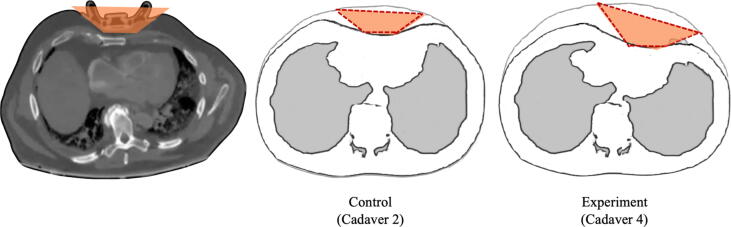
Standard compressions resulted in rib fractures (n = 1 [50%]). Left-sided compressions resulted in rib fractures (n = 4 [100%]), flail chest segments (n = 3 [75%]), and internal thoracic artery injury (n = 1 [25%]). No abdominal organ injuries were identified in either group (N = 6 [0%]). During compression, each condition yielded a different pattern of chest wall deformity (standard − regular trapezoid [midline, comparable left–right sides, flat top, and bottom]; left-sided − irregular trapezium [left-sided, unequal sides, leftward sloped top]).
Conclusion
Experimental left-sided compressions consistently produced rib fractures and flail chest segments. Findings should be interpreted with caution due to the limited sample size. Further studies investigating the biomechanics and outcomes of left sided chest compressions are warranted.






 京公网安备 11010802042870号
京ICP备2023020795号-1
京公网安备 11010802042870号
京ICP备2023020795号-1

 分享
分享
 求助内容:
求助内容: 应助结果提醒方式:
 扫码关注我们
