Munib A. Hasnain, Jaclyn E. Birnbaum, Juan Luis Ugarte Nunez, Emma K. Hartman, Chandramouli Chandrasekaran, Michael N. Economo
{"title":"Separating cognitive and motor processes in the behaving mouse","authors":"Munib A. Hasnain, Jaclyn E. Birnbaum, Juan Luis Ugarte Nunez, Emma K. Hartman, Chandramouli Chandrasekaran, Michael N. Economo","doi":"10.1038/s41593-024-01859-1","DOIUrl":null,"url":null,"abstract":"The cognitive processes supporting complex animal behavior are closely associated with movements responsible for critical processes, such as facial expressions or the active sampling of our environments. These movements are strongly related to neural activity across much of the brain and are often highly correlated with ongoing cognitive processes. A fundamental issue for understanding the neural signatures of cognition and movements is whether cognitive processes are separable from related movements or if they are driven by common neural mechanisms. Here we demonstrate how the separability of cognitive and motor processes can be assessed and, when separable, how the neural dynamics associated with each component can be isolated. We designed a behavioral task in mice that involves multiple cognitive processes, and we show that dynamics commonly taken to support cognitive processes are strongly contaminated by movements. When cognitive and motor components are isolated using a novel approach for subspace decomposition, we find that they exhibit distinct dynamical trajectories and are encoded by largely separate populations of cells. Accurately isolating dynamics associated with particular cognitive and motor processes will be essential for developing conceptual and computational models of neural circuit function. Using a novel method for isolating cognitive and motor neural dynamics, the authors show that dynamics often attributed to cognitive processes were corrupted by movements and that distinct populations of neurons encode cognitive and motor variables.","PeriodicalId":19076,"journal":{"name":"Nature neuroscience","volume":"28 3","pages":"640-653"},"PeriodicalIF":20.0000,"publicationDate":"2025-02-04","publicationTypes":"Journal Article","fieldsOfStudy":null,"isOpenAccess":false,"openAccessPdf":"","citationCount":"0","resultStr":null,"platform":"Semanticscholar","paperid":null,"PeriodicalName":"Nature neuroscience","FirstCategoryId":"3","ListUrlMain":"https://www.nature.com/articles/s41593-024-01859-1","RegionNum":1,"RegionCategory":"医学","ArticlePicture":[],"TitleCN":null,"AbstractTextCN":null,"PMCID":null,"EPubDate":"","PubModel":"","JCR":"Q1","JCRName":"NEUROSCIENCES","Score":null,"Total":0}
引用次数: 0
Abstract
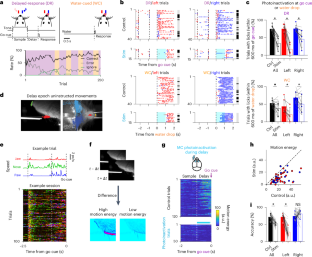
The cognitive processes supporting complex animal behavior are closely associated with movements responsible for critical processes, such as facial expressions or the active sampling of our environments. These movements are strongly related to neural activity across much of the brain and are often highly correlated with ongoing cognitive processes. A fundamental issue for understanding the neural signatures of cognition and movements is whether cognitive processes are separable from related movements or if they are driven by common neural mechanisms. Here we demonstrate how the separability of cognitive and motor processes can be assessed and, when separable, how the neural dynamics associated with each component can be isolated. We designed a behavioral task in mice that involves multiple cognitive processes, and we show that dynamics commonly taken to support cognitive processes are strongly contaminated by movements. When cognitive and motor components are isolated using a novel approach for subspace decomposition, we find that they exhibit distinct dynamical trajectories and are encoded by largely separate populations of cells. Accurately isolating dynamics associated with particular cognitive and motor processes will be essential for developing conceptual and computational models of neural circuit function. Using a novel method for isolating cognitive and motor neural dynamics, the authors show that dynamics often attributed to cognitive processes were corrupted by movements and that distinct populations of neurons encode cognitive and motor variables.
期刊介绍:
Nature Neuroscience, a multidisciplinary journal, publishes papers of the utmost quality and significance across all realms of neuroscience. The editors welcome contributions spanning molecular, cellular, systems, and cognitive neuroscience, along with psychophysics, computational modeling, and nervous system disorders. While no area is off-limits, studies offering fundamental insights into nervous system function receive priority.
The journal offers high visibility to both readers and authors, fostering interdisciplinary communication and accessibility to a broad audience. It maintains high standards of copy editing and production, rigorous peer review, rapid publication, and operates independently from academic societies and other vested interests.
In addition to primary research, Nature Neuroscience features news and views, reviews, editorials, commentaries, perspectives, book reviews, and correspondence, aiming to serve as the voice of the global neuroscience community.




 京公网安备 11010802042870号
京ICP备2023020795号-1
京公网安备 11010802042870号
京ICP备2023020795号-1

 分享
分享
 求助内容:
求助内容: 应助结果提醒方式:
 扫码关注我们
