Siti Amaniah Mohd Chachuli, Noor Athirah Muhammad ‘Azmi, N. H. Shamsudin, Omer Coban, Siti Asma Che Aziz
{"title":"Impact of Chitosan as a Binder in Graphene Gas Sensor for Volatile Organic Compound Detection","authors":"Siti Amaniah Mohd Chachuli, Noor Athirah Muhammad ‘Azmi, N. H. Shamsudin, Omer Coban, Siti Asma Che Aziz","doi":"10.1002/slct.202405111","DOIUrl":null,"url":null,"abstract":"<p>Exposure to high amounts of volatile organic compounds (VOC) in the short term can cause headaches, dizziness, worsening asthma symptoms, vomiting, and eye, nose, and throat irritation. Thus, a gas sensor is needed to detect VOC gases. Chitosan as a nonconducting polymer was used as an alternative binder for thick film gas sensors in this study. Chitosan was dissolved in an acetic acid to produce a polymer solution and mixed with graphene nanoflakes to make a graphene gas sensor. Two chitosan binder recipes were used in this study to investigate their performance in gas sensors for the VOCs acetone and ethanol. A single layer and a double layer of graphene were deposited to study their effects on VOC sensing. Single and double layers of graphene gas sensors had little effect on the sensing response to acetone and ethanol vapor. Results revealed that the gas sensors were prepared by binder B responded better than binder A in sensing response to acetone and ethanol with a response value achieved by T2-2-S1(3) and, T2-2-S1(1) with a response value of 1.0579 and, 1.0532, respectively. In addition, chitosan in graphene gas sensors had outstanding performances, in terms of linearity and repeatability characteristics.</p>","PeriodicalId":146,"journal":{"name":"ChemistrySelect","volume":"10 4","pages":""},"PeriodicalIF":2.0000,"publicationDate":"2025-01-25","publicationTypes":"Journal Article","fieldsOfStudy":null,"isOpenAccess":false,"openAccessPdf":"","citationCount":"0","resultStr":null,"platform":"Semanticscholar","paperid":null,"PeriodicalName":"ChemistrySelect","FirstCategoryId":"92","ListUrlMain":"https://chemistry-europe.onlinelibrary.wiley.com/doi/10.1002/slct.202405111","RegionNum":4,"RegionCategory":"化学","ArticlePicture":[],"TitleCN":null,"AbstractTextCN":null,"PMCID":null,"EPubDate":"","PubModel":"","JCR":"Q3","JCRName":"CHEMISTRY, MULTIDISCIPLINARY","Score":null,"Total":0}
引用次数: 0
Abstract
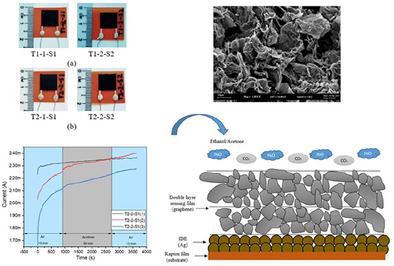
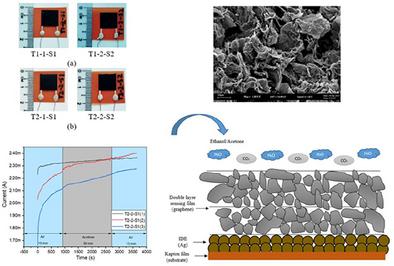
Exposure to high amounts of volatile organic compounds (VOC) in the short term can cause headaches, dizziness, worsening asthma symptoms, vomiting, and eye, nose, and throat irritation. Thus, a gas sensor is needed to detect VOC gases. Chitosan as a nonconducting polymer was used as an alternative binder for thick film gas sensors in this study. Chitosan was dissolved in an acetic acid to produce a polymer solution and mixed with graphene nanoflakes to make a graphene gas sensor. Two chitosan binder recipes were used in this study to investigate their performance in gas sensors for the VOCs acetone and ethanol. A single layer and a double layer of graphene were deposited to study their effects on VOC sensing. Single and double layers of graphene gas sensors had little effect on the sensing response to acetone and ethanol vapor. Results revealed that the gas sensors were prepared by binder B responded better than binder A in sensing response to acetone and ethanol with a response value achieved by T2-2-S1(3) and, T2-2-S1(1) with a response value of 1.0579 and, 1.0532, respectively. In addition, chitosan in graphene gas sensors had outstanding performances, in terms of linearity and repeatability characteristics.
期刊介绍:
ChemistrySelect is the latest journal from ChemPubSoc Europe and Wiley-VCH. It offers researchers a quality society-owned journal in which to publish their work in all areas of chemistry. Manuscripts are evaluated by active researchers to ensure they add meaningfully to the scientific literature, and those accepted are processed quickly to ensure rapid online publication.





 京公网安备 11010802042870号
京ICP备2023020795号-1
京公网安备 11010802042870号
京ICP备2023020795号-1

 分享
分享
 求助内容:
求助内容: 应助结果提醒方式:
 扫码关注我们
