Kristina Allen-Brady , Frederic Clayton , Mark W. Hazel , Jeff Stevens , Ashley L. Pyne , Maria A. Pletneva , Melissa Cessna , Chris Stubben , Jacob Robson , John Fang , Kathryn A. Peterson
{"title":"Overlap of Genomic and Transcriptomic Genes Identified in Familial Eosinophilic Esophagitis","authors":"Kristina Allen-Brady , Frederic Clayton , Mark W. Hazel , Jeff Stevens , Ashley L. Pyne , Maria A. Pletneva , Melissa Cessna , Chris Stubben , Jacob Robson , John Fang , Kathryn A. Peterson","doi":"10.1053/j.gastro.2025.01.235","DOIUrl":null,"url":null,"abstract":"<div><h3>Background & Aims</h3><div>Evidence for a genetic contribution to eosinophilic esophagitis (EoE) exists from family and genome-wide association studies. Extensive investigation into rare variants contributing to EoE has not been performed. The study’s aim was to evaluate families with multiple cases of EoE by genomic and transcriptomic sequencing to identify genes predisposing to EoE.</div></div><div><h3>Methods</h3><div>Distant relative pairs (eg, cousins) in extended EoE families and other affected relatives were whole exome sequenced to identify rare, shared, potentially pathologic variants. <em>RNA</em> sequencing <em>was performed in</em> nuclear families with multiple EoE cases. We compared the overlap of genes from DNA and RNA sequencing for relevance to disease manifestations.</div></div><div><h3>Results</h3><div>Whole exome sequencing was performed in 50 familial cases in 21 EoE extended pedigrees. We observed 189 rare candidate predisposition variants in 181 genes with complete sharing among all affected family members within each pedigree. RNA sequencing was performed for 43 EoE cases in 18 nuclear families, including 6 relatives without EoE. We observed 698 total differentially expressed genes compared with controls. We identified 3 genes (<em>MUC16, ADGRE1</em>, and <em>TENM3</em>) with evidence of rare variant sharing among all affected family members and differential gene expression. We identified 36 other genes with partial sharing of rare variants among some affected family members and with differential gene expression. Several genes identified as prominent in EoE were also differentially expressed in unaffected relatives.</div></div><div><h3>Conclusions</h3><div>Genes related to immune response, barrier dysfunction, and cell adhesion were identified in familial EoE cases and unaffected family members, supporting a genetic familial predisposition and a possible multihit background to disease pathophysiology.</div></div>","PeriodicalId":12590,"journal":{"name":"Gastroenterology","volume":"168 6","pages":"Pages 1101-1113.e18"},"PeriodicalIF":25.1000,"publicationDate":"2025-06-01","publicationTypes":"Journal Article","fieldsOfStudy":null,"isOpenAccess":false,"openAccessPdf":"","citationCount":"0","resultStr":null,"platform":"Semanticscholar","paperid":null,"PeriodicalName":"Gastroenterology","FirstCategoryId":"3","ListUrlMain":"https://www.sciencedirect.com/science/article/pii/S0016508525003427","RegionNum":1,"RegionCategory":"医学","ArticlePicture":[],"TitleCN":null,"AbstractTextCN":null,"PMCID":null,"EPubDate":"2025/2/4 0:00:00","PubModel":"Epub","JCR":"Q1","JCRName":"GASTROENTEROLOGY & HEPATOLOGY","Score":null,"Total":0}
引用次数: 0
Abstract
Background & Aims
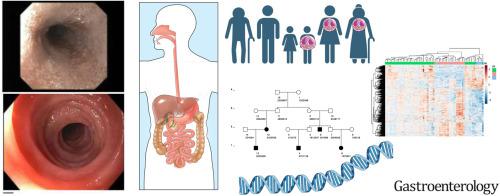
Evidence for a genetic contribution to eosinophilic esophagitis (EoE) exists from family and genome-wide association studies. Extensive investigation into rare variants contributing to EoE has not been performed. The study’s aim was to evaluate families with multiple cases of EoE by genomic and transcriptomic sequencing to identify genes predisposing to EoE.
Methods
Distant relative pairs (eg, cousins) in extended EoE families and other affected relatives were whole exome sequenced to identify rare, shared, potentially pathologic variants. RNA sequencing was performed in nuclear families with multiple EoE cases. We compared the overlap of genes from DNA and RNA sequencing for relevance to disease manifestations.
Results
Whole exome sequencing was performed in 50 familial cases in 21 EoE extended pedigrees. We observed 189 rare candidate predisposition variants in 181 genes with complete sharing among all affected family members within each pedigree. RNA sequencing was performed for 43 EoE cases in 18 nuclear families, including 6 relatives without EoE. We observed 698 total differentially expressed genes compared with controls. We identified 3 genes (MUC16, ADGRE1, and TENM3) with evidence of rare variant sharing among all affected family members and differential gene expression. We identified 36 other genes with partial sharing of rare variants among some affected family members and with differential gene expression. Several genes identified as prominent in EoE were also differentially expressed in unaffected relatives.
Conclusions
Genes related to immune response, barrier dysfunction, and cell adhesion were identified in familial EoE cases and unaffected family members, supporting a genetic familial predisposition and a possible multihit background to disease pathophysiology.
期刊介绍:
Gastroenterology is the most prominent journal in the field of gastrointestinal disease. It is the flagship journal of the American Gastroenterological Association and delivers authoritative coverage of clinical, translational, and basic studies of all aspects of the digestive system, including the liver and pancreas, as well as nutrition.
Some regular features of Gastroenterology include original research studies by leading authorities, comprehensive reviews and perspectives on important topics in adult and pediatric gastroenterology and hepatology. The journal also includes features such as editorials, correspondence, and commentaries, as well as special sections like "Mentoring, Education and Training Corner," "Diversity, Equity and Inclusion in GI," "Gastro Digest," "Gastro Curbside Consult," and "Gastro Grand Rounds."
Gastroenterology also provides digital media materials such as videos and "GI Rapid Reel" animations. It is abstracted and indexed in various databases including Scopus, Biological Abstracts, Current Contents, Embase, Nutrition Abstracts, Chemical Abstracts, Current Awareness in Biological Sciences, PubMed/Medline, and the Science Citation Index.



 京公网安备 11010802042870号
京ICP备2023020795号-1
京公网安备 11010802042870号
京ICP备2023020795号-1

 分享
分享
 求助内容:
求助内容: 应助结果提醒方式:
 扫码关注我们
