Zhubin He , Yi Xu , Bingao Wang , Gaoning Tian , Haimin Zhang
{"title":"Fabrication and mechanical properties of the NiAl sheet with a 3-dimensional network structure prepared by Ni nets and Al foils","authors":"Zhubin He , Yi Xu , Bingao Wang , Gaoning Tian , Haimin Zhang","doi":"10.1016/j.jmatprotec.2024.118680","DOIUrl":null,"url":null,"abstract":"<div><div>Due to the inherent brittleness of lightweight NiAl alloys, conventional manufacturing methods are inadequate for producing large-sized NiAl sheets with excellent mechanical properties. This paper presents an alternative approach, employing Ni nets and Al foils as raw materials to fabricate a NiAl sheet via hot-press sintering in a vacuum furnace. The sheet exhibited a three-dimensional network structure, wherein small-sized grains enveloping larger grains within the net. The network structure is controlled by Ni nets used and the sintering parameters. A nearly fully dense sheet with a density of 99.98 % and a thickness of 1 mm was achieved under sintering conditions of 1400 ℃/20 MPa/0 min. The hardness distribution within the NiAl sheet exhibited a three-dimensional wavy surface profile with distinct peaks and valleys. The hardness in the high-hardness regions exceeded 600 HV0.05, while the hardness in the low-hardness regions ranged from 500 to 550 HV0.05. Tensile test results indicate that, at an initial strain rate of 0.001, the NiAl sheet exhibits brittle fracture at 900 °C, while displaying ductile fracture behavior at 950 °C and 1000 °C. The ultimate tensile strength exceeds 100 MPa at 900 °C but declines sharply as the deformation temperature increases. During tensile testing, cracks propagate along the fine-grain regions, and the fracture surface exhibits a multi-peak morphology. The study provides a new method for the preparation of heterogeneous NiAl alloy sheets and provides new ideas for the microstructure design and performance optimization of NiAl alloys.</div></div>","PeriodicalId":367,"journal":{"name":"Journal of Materials Processing Technology","volume":"336 ","pages":"Article 118680"},"PeriodicalIF":7.5000,"publicationDate":"2025-02-01","publicationTypes":"Journal Article","fieldsOfStudy":null,"isOpenAccess":false,"openAccessPdf":"","citationCount":"0","resultStr":null,"platform":"Semanticscholar","paperid":null,"PeriodicalName":"Journal of Materials Processing Technology","FirstCategoryId":"88","ListUrlMain":"https://www.sciencedirect.com/science/article/pii/S0924013624003984","RegionNum":2,"RegionCategory":"材料科学","ArticlePicture":[],"TitleCN":null,"AbstractTextCN":null,"PMCID":null,"EPubDate":"2024/12/2 0:00:00","PubModel":"Epub","JCR":"Q1","JCRName":"ENGINEERING, INDUSTRIAL","Score":null,"Total":0}
引用次数: 0
Abstract
Due to the inherent brittleness of lightweight NiAl alloys, conventional manufacturing methods are inadequate for producing large-sized NiAl sheets with excellent mechanical properties. This paper presents an alternative approach, employing Ni nets and Al foils as raw materials to fabricate a NiAl sheet via hot-press sintering in a vacuum furnace. The sheet exhibited a three-dimensional network structure, wherein small-sized grains enveloping larger grains within the net. The network structure is controlled by Ni nets used and the sintering parameters. A nearly fully dense sheet with a density of 99.98 % and a thickness of 1 mm was achieved under sintering conditions of 1400 ℃/20 MPa/0 min. The hardness distribution within the NiAl sheet exhibited a three-dimensional wavy surface profile with distinct peaks and valleys. The hardness in the high-hardness regions exceeded 600 HV0.05, while the hardness in the low-hardness regions ranged from 500 to 550 HV0.05. Tensile test results indicate that, at an initial strain rate of 0.001, the NiAl sheet exhibits brittle fracture at 900 °C, while displaying ductile fracture behavior at 950 °C and 1000 °C. The ultimate tensile strength exceeds 100 MPa at 900 °C but declines sharply as the deformation temperature increases. During tensile testing, cracks propagate along the fine-grain regions, and the fracture surface exhibits a multi-peak morphology. The study provides a new method for the preparation of heterogeneous NiAl alloy sheets and provides new ideas for the microstructure design and performance optimization of NiAl alloys.
期刊介绍:
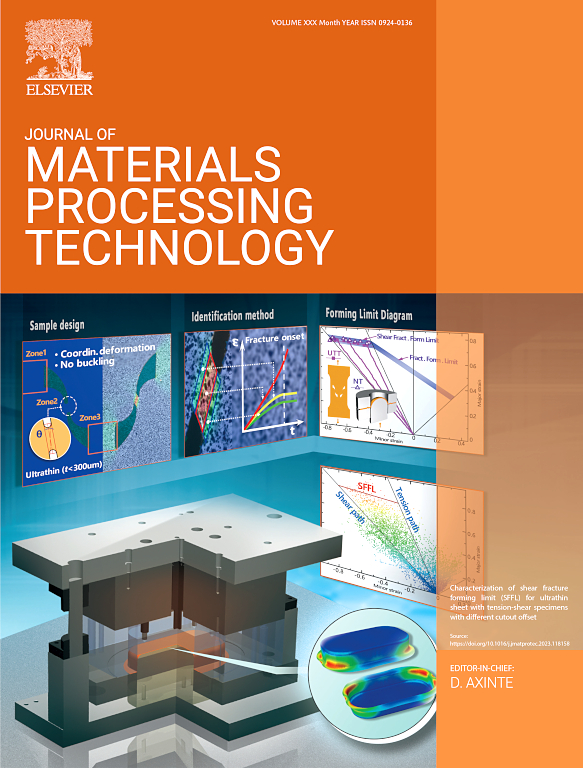
The Journal of Materials Processing Technology covers the processing techniques used in manufacturing components from metals and other materials. The journal aims to publish full research papers of original, significant and rigorous work and so to contribute to increased production efficiency and improved component performance.
Areas of interest to the journal include:
• Casting, forming and machining
• Additive processing and joining technologies
• The evolution of material properties under the specific conditions met in manufacturing processes
• Surface engineering when it relates specifically to a manufacturing process
• Design and behavior of equipment and tools.



 京公网安备 11010802042870号
京ICP备2023020795号-1
京公网安备 11010802042870号
京ICP备2023020795号-1

 分享
分享
 求助内容:
求助内容: 应助结果提醒方式:
 扫码关注我们
