Huanqi He , Linxuan Huo , Solize Oosthuizen-Vosloo , Kelsey J. Pieper , Aron Stubbins , Byungman Yoon , Ameet J. Pinto
{"title":"Building plumbing influences the microdiversity and community assembly of the drinking water microbiome","authors":"Huanqi He , Linxuan Huo , Solize Oosthuizen-Vosloo , Kelsey J. Pieper , Aron Stubbins , Byungman Yoon , Ameet J. Pinto","doi":"10.1016/j.watres.2025.123244","DOIUrl":null,"url":null,"abstract":"<div><div>Building plumbing microbial communities can significantly influence water quality at the point of use, particularly during periods of stagnation. Thus, a fine-scale understanding of factors governing community membership and structure, as well as environmental and ecological factors shaping building plumbing microbial communities is critical. In this study, we utilized full-length 16S ribosomal RNA (rRNA) gene sequencing to investigate the microdiversity and spatial-temporal dynamics of microbial communities in institutional and residential building plumbing systems. Bacterial operational taxonomic units (OTUs) within institutional buildings exhibited much lower microdiversity relative to the same OTUs in residential buildings. Higher microdiversity was associated with higher persistence and relative abundance of OTUs. Interestingly, amplicon sequencing variants within the same OTUs exhibited habitat preferences based on the building type while also demonstrating varying temporal turnover patterns. Dispersal limitation disproportionately governed community assembly in institutional buildings, whereas heterogeneous selection was the dominant ecological mechanism shaping the microbial community in residential buildings. Dispersal limitation in institutional buildings is consistent with larger building sizes and greater periods of water stagnation. Interestingly, the inability to explain the extent of heterogeneous selection-driven community assembly in residential locations using measured water chemistry may suggest a disproportionately large effect of fine-scale variation in plumbing characteristics on community assembly in residential locations.</div></div>","PeriodicalId":443,"journal":{"name":"Water Research","volume":"276 ","pages":"Article 123244"},"PeriodicalIF":12.4000,"publicationDate":"2025-05-15","publicationTypes":"Journal Article","fieldsOfStudy":null,"isOpenAccess":false,"openAccessPdf":"","citationCount":"0","resultStr":null,"platform":"Semanticscholar","paperid":null,"PeriodicalName":"Water Research","FirstCategoryId":"93","ListUrlMain":"https://www.sciencedirect.com/science/article/pii/S0043135425001587","RegionNum":1,"RegionCategory":"环境科学与生态学","ArticlePicture":[],"TitleCN":null,"AbstractTextCN":null,"PMCID":null,"EPubDate":"2025/2/6 0:00:00","PubModel":"Epub","JCR":"Q1","JCRName":"ENGINEERING, ENVIRONMENTAL","Score":null,"Total":0}
引用次数: 0
Abstract
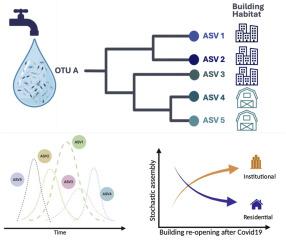
Building plumbing microbial communities can significantly influence water quality at the point of use, particularly during periods of stagnation. Thus, a fine-scale understanding of factors governing community membership and structure, as well as environmental and ecological factors shaping building plumbing microbial communities is critical. In this study, we utilized full-length 16S ribosomal RNA (rRNA) gene sequencing to investigate the microdiversity and spatial-temporal dynamics of microbial communities in institutional and residential building plumbing systems. Bacterial operational taxonomic units (OTUs) within institutional buildings exhibited much lower microdiversity relative to the same OTUs in residential buildings. Higher microdiversity was associated with higher persistence and relative abundance of OTUs. Interestingly, amplicon sequencing variants within the same OTUs exhibited habitat preferences based on the building type while also demonstrating varying temporal turnover patterns. Dispersal limitation disproportionately governed community assembly in institutional buildings, whereas heterogeneous selection was the dominant ecological mechanism shaping the microbial community in residential buildings. Dispersal limitation in institutional buildings is consistent with larger building sizes and greater periods of water stagnation. Interestingly, the inability to explain the extent of heterogeneous selection-driven community assembly in residential locations using measured water chemistry may suggest a disproportionately large effect of fine-scale variation in plumbing characteristics on community assembly in residential locations.
期刊介绍:
Water Research, along with its open access companion journal Water Research X, serves as a platform for publishing original research papers covering various aspects of the science and technology related to the anthropogenic water cycle, water quality, and its management worldwide. The audience targeted by the journal comprises biologists, chemical engineers, chemists, civil engineers, environmental engineers, limnologists, and microbiologists. The scope of the journal include:
•Treatment processes for water and wastewaters (municipal, agricultural, industrial, and on-site treatment), including resource recovery and residuals management;
•Urban hydrology including sewer systems, stormwater management, and green infrastructure;
•Drinking water treatment and distribution;
•Potable and non-potable water reuse;
•Sanitation, public health, and risk assessment;
•Anaerobic digestion, solid and hazardous waste management, including source characterization and the effects and control of leachates and gaseous emissions;
•Contaminants (chemical, microbial, anthropogenic particles such as nanoparticles or microplastics) and related water quality sensing, monitoring, fate, and assessment;
•Anthropogenic impacts on inland, tidal, coastal and urban waters, focusing on surface and ground waters, and point and non-point sources of pollution;
•Environmental restoration, linked to surface water, groundwater and groundwater remediation;
•Analysis of the interfaces between sediments and water, and between water and atmosphere, focusing specifically on anthropogenic impacts;
•Mathematical modelling, systems analysis, machine learning, and beneficial use of big data related to the anthropogenic water cycle;
•Socio-economic, policy, and regulations studies.




 京公网安备 11010802042870号
京ICP备2023020795号-1
京公网安备 11010802042870号
京ICP备2023020795号-1

 分享
分享
 求助内容:
求助内容: 应助结果提醒方式:
 扫码关注我们
