Jiaxin Liu, Shenghong Yang, Rui Jiang, Lu Yu, Shilin Zhou, Xiaoyan Shi, Junling Xu, Lianyi Shao, Zhipeng Sun and Lifeng Hang
{"title":"Two-dimensional self-assembled TiSe2 micro–nanoparticles toward high-performance sodium ion storage†","authors":"Jiaxin Liu, Shenghong Yang, Rui Jiang, Lu Yu, Shilin Zhou, Xiaoyan Shi, Junling Xu, Lianyi Shao, Zhipeng Sun and Lifeng Hang","doi":"10.1039/D4TA08881F","DOIUrl":null,"url":null,"abstract":"<p >Sodium-ion batteries (SIBs) are potential commercial energy storage devices. However, the inadequate long-term cycling stability and rate capability of anode materials have hindered the commercial applications of SIBs. TiSe<small><sub>2</sub></small> is regarded as a potential anode for SIBs owing to its high electrical conductivity and unique layered structure. Herein, a novel TiSe<small><sub>2</sub></small> anode for sodium storage at extraordinary current has been prepared through a simple one-step solid-phase selenization method. The layered micro–nanoparticles can not only ensure rapid ion/electron transport, but also effectively suppress structural collapse over repeated cycles. Benefiting from the design advantages, the layered TiSe<small><sub>2</sub></small> exhibits good structural stability, high pseudocapacitive behavior, and low impedance, thereby retaining a capacity of 76.7 mA h g<small><sup>−1</sup></small> at an ultra-high current density of 40 A g<small><sup>−1</sup></small> and a capacity of 155.6 mA h g<small><sup>−1</sup></small> even after 3000 cycles at 10 A g<small><sup>−1</sup></small>. Moreover, <em>in situ</em> and <em>ex situ</em> technologies clearly reveal the reversible reaction mechanism, also ensuring favourable electrochemical performance.</p>","PeriodicalId":82,"journal":{"name":"Journal of Materials Chemistry A","volume":" 11","pages":" 7758-7765"},"PeriodicalIF":9.5000,"publicationDate":"2025-02-06","publicationTypes":"Journal Article","fieldsOfStudy":null,"isOpenAccess":false,"openAccessPdf":"","citationCount":"0","resultStr":null,"platform":"Semanticscholar","paperid":null,"PeriodicalName":"Journal of Materials Chemistry A","FirstCategoryId":"88","ListUrlMain":"https://pubs.rsc.org/en/content/articlelanding/2025/ta/d4ta08881f","RegionNum":2,"RegionCategory":"材料科学","ArticlePicture":[],"TitleCN":null,"AbstractTextCN":null,"PMCID":null,"EPubDate":"","PubModel":"","JCR":"Q1","JCRName":"CHEMISTRY, PHYSICAL","Score":null,"Total":0}
引用次数: 0
Abstract
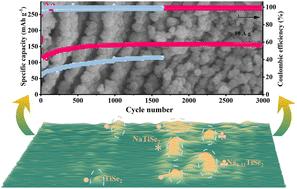
Sodium-ion batteries (SIBs) are potential commercial energy storage devices. However, the inadequate long-term cycling stability and rate capability of anode materials have hindered the commercial applications of SIBs. TiSe2 is regarded as a potential anode for SIBs owing to its high electrical conductivity and unique layered structure. Herein, a novel TiSe2 anode for sodium storage at extraordinary current has been prepared through a simple one-step solid-phase selenization method. The layered micro–nanoparticles can not only ensure rapid ion/electron transport, but also effectively suppress structural collapse over repeated cycles. Benefiting from the design advantages, the layered TiSe2 exhibits good structural stability, high pseudocapacitive behavior, and low impedance, thereby retaining a capacity of 76.7 mA h g−1 at an ultra-high current density of 40 A g−1 and a capacity of 155.6 mA h g−1 even after 3000 cycles at 10 A g−1. Moreover, in situ and ex situ technologies clearly reveal the reversible reaction mechanism, also ensuring favourable electrochemical performance.
钠离子电池(SIBs)是一种潜在的商用储能设备。然而,阳极材料的长期循环稳定性和速率能力不足仍然阻碍着sib的商业应用。由于其高导电性和独特的层状结构,TiSe2被认为是sib的潜在阳极。本文采用简单的一步固相硒化法,制备了一种用于超电流储钠的新型TiSe2阳极。纳米颗粒构成的层状微观结构不仅可以保证离子/电子的快速传递,而且可以有效地抑制结构在重复循环中的崩溃。受益于设计优势,层状TiSe2器件具有良好的结构稳定性、高赝电容性和低阻抗,从而在40 ag−1的超高电流密度下保持76.7 mAh g−1的容量,即使在10 ag−1下循环3000次后仍然保持155.6 mAh g−1的容量。此外,原位和非原位技术清楚地揭示了可逆反应机理,也确保了良好的电化学性能。
期刊介绍:
The Journal of Materials Chemistry A, B & C covers a wide range of high-quality studies in the field of materials chemistry, with each section focusing on specific applications of the materials studied. Journal of Materials Chemistry A emphasizes applications in energy and sustainability, including topics such as artificial photosynthesis, batteries, and fuel cells. Journal of Materials Chemistry B focuses on applications in biology and medicine, while Journal of Materials Chemistry C covers applications in optical, magnetic, and electronic devices. Example topic areas within the scope of Journal of Materials Chemistry A include catalysis, green/sustainable materials, sensors, and water treatment, among others.




 京公网安备 11010802042870号
京ICP备2023020795号-1
京公网安备 11010802042870号
京ICP备2023020795号-1

 分享
分享
 求助内容:
求助内容: 应助结果提醒方式:
 扫码关注我们
