Pembrolizumab with chemoradiotherapy followed by pembrolizumab for stage III–IVa cervical cancer: is the ENGOT-cx11/GOG-3047/KEYNOTE-A18 trial practice changing?
Bart M. F. Penninx MD, Michael J. Samson MD, John-John B. Schnog MD, PhD
{"title":"Pembrolizumab with chemoradiotherapy followed by pembrolizumab for stage III–IVa cervical cancer: is the ENGOT-cx11/GOG-3047/KEYNOTE-A18 trial practice changing?","authors":"Bart M. F. Penninx MD, Michael J. Samson MD, John-John B. Schnog MD, PhD","doi":"10.1002/cncr.35749","DOIUrl":null,"url":null,"abstract":"<p>At the second interim analysis, the ENGOT-cx11/GOG-3047/KEYNOTE-A18 demonstrated an overall survival (OS) benefit after 36 months in stage III–IVa cervical cancer patients treated with chemoradiotherapy and concurrent pembrolizumab followed by 90 weeks of pembrolizumab as compared to placebo (82.6% vs. 74.8%, hazard ratio for death, 0.67 [confidence interval, 0.50–0.90]). Only 51 of 193 progressing patients in the control arm were exposed to immunotherapy after progressing. The reported OS benefit could be explained by suboptimal post-progression treatment in the control group. Even if pembrolizumab as administered in the ENGOT-cx11/GOG-3047/KEYNOTE-A18 was efficacious, the treatment duration is excessively long. The associated costs render it unattainable in the regions where burden of cervical cancer is highest. Based on these concerns, the findings at the interim analysis of the ENGOT-cx11/GOG-3047/KEYNOTE-A18 RCT should not change practice.</p>","PeriodicalId":138,"journal":{"name":"Cancer","volume":"131 4","pages":""},"PeriodicalIF":5.1000,"publicationDate":"2025-02-06","publicationTypes":"Journal Article","fieldsOfStudy":null,"isOpenAccess":false,"openAccessPdf":"","citationCount":"0","resultStr":null,"platform":"Semanticscholar","paperid":null,"PeriodicalName":"Cancer","FirstCategoryId":"3","ListUrlMain":"https://acsjournals.onlinelibrary.wiley.com/doi/10.1002/cncr.35749","RegionNum":2,"RegionCategory":"医学","ArticlePicture":[],"TitleCN":null,"AbstractTextCN":null,"PMCID":null,"EPubDate":"","PubModel":"","JCR":"Q1","JCRName":"ONCOLOGY","Score":null,"Total":0}
引用次数: 0
Abstract
At the second interim analysis, the ENGOT-cx11/GOG-3047/KEYNOTE-A18 demonstrated an overall survival (OS) benefit after 36 months in stage III–IVa cervical cancer patients treated with chemoradiotherapy and concurrent pembrolizumab followed by 90 weeks of pembrolizumab as compared to placebo (82.6% vs. 74.8%, hazard ratio for death, 0.67 [confidence interval, 0.50–0.90]). Only 51 of 193 progressing patients in the control arm were exposed to immunotherapy after progressing. The reported OS benefit could be explained by suboptimal post-progression treatment in the control group. Even if pembrolizumab as administered in the ENGOT-cx11/GOG-3047/KEYNOTE-A18 was efficacious, the treatment duration is excessively long. The associated costs render it unattainable in the regions where burden of cervical cancer is highest. Based on these concerns, the findings at the interim analysis of the ENGOT-cx11/GOG-3047/KEYNOTE-A18 RCT should not change practice.
在第二次中期分析中,ENGOT-cx11/GOG-3047/KEYNOTE-A18显示,与安慰剂相比,接受放化疗和同时使用派姆单抗并服用90周派姆单抗的III-IVa期宫颈癌患者在36个月后的总生存期(OS)获益(82.6% vs. 74.8%,死亡风险比,0.67[置信区间,0.50-0.90])。在对照组的193名进展患者中,只有51人在进展后接受免疫治疗。报告的OS获益可以通过对照组的次优进展后治疗来解释。即使在ENGOT-cx11/GOG-3047/KEYNOTE-A18中使用派姆单抗是有效的,治疗持续时间也过长。相关费用使宫颈癌负担最高的区域无法实现这一目标。基于这些考虑,ENGOT-cx11/GOG-3047/KEYNOTE-A18随机对照试验的中期分析结果不应改变惯例。
期刊介绍:
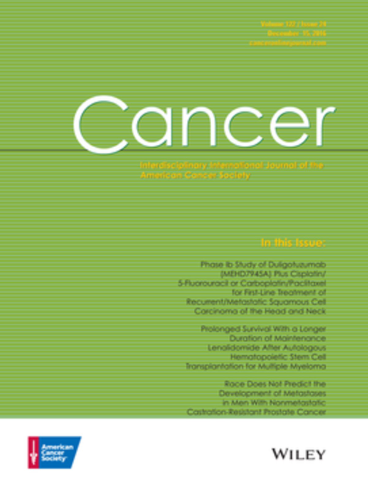
The CANCER site is a full-text, electronic implementation of CANCER, an Interdisciplinary International Journal of the American Cancer Society, and CANCER CYTOPATHOLOGY, a Journal of the American Cancer Society.
CANCER publishes interdisciplinary oncologic information according to, but not limited to, the following disease sites and disciplines: blood/bone marrow; breast disease; endocrine disorders; epidemiology; gastrointestinal tract; genitourinary disease; gynecologic oncology; head and neck disease; hepatobiliary tract; integrated medicine; lung disease; medical oncology; neuro-oncology; pathology radiation oncology; translational research



 京公网安备 11010802042870号
京ICP备2023020795号-1
京公网安备 11010802042870号
京ICP备2023020795号-1

 分享
分享
 求助内容:
求助内容: 应助结果提醒方式:
 扫码关注我们
