{"title":"The effect of baseline versus early glucocorticoid use on immune checkpoint inhibitor efficacy in patients with advanced NSCLC.","authors":"Yifan Wang, Jianying Zhou, Simin Peng, Zhao Cui, Weiqi Wang, Wenqin Zeng, Tingting Qiu, Zhentian Liu","doi":"10.3389/fonc.2025.1533556","DOIUrl":null,"url":null,"abstract":"<p><strong>Purpose: </strong>This study aims to investigate the specific effects of glucocorticoids (GC) on the efficacy of immune checkpoint inhibitors (ICIs), and whether this effect is influenced by the timing and dosage of GC administration. Changes in the neutrophil percentage and the helper/suppressor T lymphocyte ratio [NEUT %/(CD4+/CD8+)] during GC administration were monitored.</p><p><strong>Methods: </strong>The clinical results of 130 patients with advanced non-small cell lung cancer (NSCLC) treated with ICIs were analyzed and compared with those of patients who did not use GC. Cox proportional hazards regression model and Logistic regression analysis were used to analyze the factors affecting ORR and PFS, and t test was used to analyze the changes of NEUT %/(CD4 +/CD8 +) during GC use.</p><p><strong>Results: </strong>Multivariate Logistic analysis showed that GC use was associated with a higher ORR in 130 patients treated with ICIs [HR = 3.07,95% CI (1.31-7.21), P = 0.010]. Univariate Cox analysis showed that GC use was not significantly correlated with PFS [HR = 0.926,95% CI (0.603-1.420), P = 0.710]. Patients who used GC during the baseline period of ICIs treatment had a higher ORR than those who used GC at the early stage of ICIs treatment (65.4% vs 30.8%, p = 0.024). Multivariate Cox analysis showed that GC use had longer PFS [HR = 0.37,95% CI (0.17-0.78), p = 0.009]. The timing of GC use was different, and there was a difference in NEUT %/(CD4 +/CD8 +) levels before and after treatment. There was no significant difference in ORR and PFS between GC duration and dose.</p><p><strong>Conclusion: </strong>The use of GC helps to enhance the efficacy of immunotherapy. In particular, GC use during the baseline period leads to higher ORR and PFS, regardless of the dose or duration of GC use. The levels of NEUT %/(CD4+/CD8+) varied depending on the timing of GC administration.</p>","PeriodicalId":12482,"journal":{"name":"Frontiers in Oncology","volume":"15 ","pages":"1533556"},"PeriodicalIF":3.5000,"publicationDate":"2025-01-23","publicationTypes":"Journal Article","fieldsOfStudy":null,"isOpenAccess":false,"openAccessPdf":"https://www.ncbi.nlm.nih.gov/pmc/articles/PMC11798793/pdf/","citationCount":"0","resultStr":null,"platform":"Semanticscholar","paperid":null,"PeriodicalName":"Frontiers in Oncology","FirstCategoryId":"3","ListUrlMain":"https://doi.org/10.3389/fonc.2025.1533556","RegionNum":3,"RegionCategory":"医学","ArticlePicture":[],"TitleCN":null,"AbstractTextCN":null,"PMCID":null,"EPubDate":"2025/1/1 0:00:00","PubModel":"eCollection","JCR":"Q2","JCRName":"ONCOLOGY","Score":null,"Total":0}
引用次数: 0
Abstract
Purpose: This study aims to investigate the specific effects of glucocorticoids (GC) on the efficacy of immune checkpoint inhibitors (ICIs), and whether this effect is influenced by the timing and dosage of GC administration. Changes in the neutrophil percentage and the helper/suppressor T lymphocyte ratio [NEUT %/(CD4+/CD8+)] during GC administration were monitored.
Methods: The clinical results of 130 patients with advanced non-small cell lung cancer (NSCLC) treated with ICIs were analyzed and compared with those of patients who did not use GC. Cox proportional hazards regression model and Logistic regression analysis were used to analyze the factors affecting ORR and PFS, and t test was used to analyze the changes of NEUT %/(CD4 +/CD8 +) during GC use.
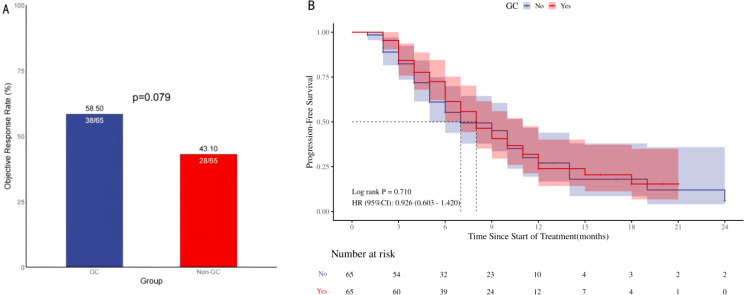
Results: Multivariate Logistic analysis showed that GC use was associated with a higher ORR in 130 patients treated with ICIs [HR = 3.07,95% CI (1.31-7.21), P = 0.010]. Univariate Cox analysis showed that GC use was not significantly correlated with PFS [HR = 0.926,95% CI (0.603-1.420), P = 0.710]. Patients who used GC during the baseline period of ICIs treatment had a higher ORR than those who used GC at the early stage of ICIs treatment (65.4% vs 30.8%, p = 0.024). Multivariate Cox analysis showed that GC use had longer PFS [HR = 0.37,95% CI (0.17-0.78), p = 0.009]. The timing of GC use was different, and there was a difference in NEUT %/(CD4 +/CD8 +) levels before and after treatment. There was no significant difference in ORR and PFS between GC duration and dose.
Conclusion: The use of GC helps to enhance the efficacy of immunotherapy. In particular, GC use during the baseline period leads to higher ORR and PFS, regardless of the dose or duration of GC use. The levels of NEUT %/(CD4+/CD8+) varied depending on the timing of GC administration.
目的:本研究旨在探讨糖皮质激素(GC)对免疫检查点抑制剂(ICIs)疗效的特异性影响,以及这种影响是否受GC给药时间和剂量的影响。监测GC给药期间中性粒细胞百分比和辅助性/抑制性T淋巴细胞比值[NEUT %/(CD4+/CD8+)]的变化。方法:对130例晚期非小细胞肺癌(NSCLC)患者行ICIs治疗的临床结果进行分析,并与未行ICIs治疗的患者进行比较。采用Cox比例风险回归模型和Logistic回归分析影响ORR和PFS的因素,采用t检验分析GC使用期间NEUT %/(CD4 +/CD8 +)的变化。结果:多因素Logistic分析显示,在130例接受ICIs治疗的患者中,GC使用与较高的ORR相关[HR = 3.07,95% CI (1.31-7.21), P = 0.010]。单因素Cox分析显示,GC使用与PFS无显著相关[HR = 0.926,95% CI (0.603-1.420), P = 0.710]。在ICIs治疗基线期使用GC的患者ORR高于在ICIs治疗早期使用GC的患者(65.4% vs 30.8%, p = 0.024)。多因素Cox分析显示,使用GC有更长的PFS [HR = 0.37,95% CI (0.17-0.78), p = 0.009]。使用GC的时间不同,治疗前后NEUT %/(CD4 +/CD8 +)水平也有差异。在GC持续时间和剂量之间,ORR和PFS无显著差异。结论:GC有助于提高免疫治疗的疗效。特别是,在基线期间使用GC导致更高的ORR和PFS,无论使用GC的剂量或持续时间如何。NEUT %/(CD4+/CD8+)水平随给药时间的不同而变化。
期刊介绍:
Cancer Imaging and Diagnosis is dedicated to the publication of results from clinical and research studies applied to cancer diagnosis and treatment. The section aims to publish studies from the entire field of cancer imaging: results from routine use of clinical imaging in both radiology and nuclear medicine, results from clinical trials, experimental molecular imaging in humans and small animals, research on new contrast agents in CT, MRI, ultrasound, publication of new technical applications and processing algorithms to improve the standardization of quantitative imaging and image guided interventions for the diagnosis and treatment of cancer.





 京公网安备 11010802042870号
京ICP备2023020795号-1
京公网安备 11010802042870号
京ICP备2023020795号-1

 分享
分享
 求助内容:
求助内容: 应助结果提醒方式:
 扫码关注我们
