Brittany Shea, Gabriella Y Meltzer, Benjamin B Steiger, Robbie M Parks, Vivian Do, Heather McBrien, Nina Flores, Milo Gordon, Elizabeth M Blake, Joan A Casey
{"title":"Co-occurring climate events and environmental justice in California, 2018-2019.","authors":"Brittany Shea, Gabriella Y Meltzer, Benjamin B Steiger, Robbie M Parks, Vivian Do, Heather McBrien, Nina Flores, Milo Gordon, Elizabeth M Blake, Joan A Casey","doi":"10.1088/2752-5309/ada96f","DOIUrl":null,"url":null,"abstract":"<p><p>Climate change will increase the frequency of extreme weather events. This means climate-driven events like wildfires and power outages will likely co-occur more often, potentially magnifying their health risks. We characterized three types of climate-driven events-anomalously warm temperatures, wildfire burn zone disasters, and long power outages-in 58 California counties during 2018-2019. We defined county-day anomalously warm temperatures when daily average temperatures exceeded 24 °C and the 85th percentile of the long-term county average. We defined county-day wildfire burn zone disasters when an active wildfire burn zone intersected a county, burned 1+ structures, killed a civilian, or received a Federal Emergency Management Agency Fire Management Declaration, and overlapped with a community. For a subset of the 38 counties (66%), long power outage county days were identified using PowerOutage.us data when an outage affected >0.5% of county customers for 8+ h. Co-occurring events were when 2+ of these events occurred on the same county day. Using the CDC/ATSDR Social Vulnerability Index (SVI), we determined whether co-occurring events disproportionately affected vulnerable populations. Nearly every county (97%) experienced at least one day of anomalously warm temperatures, 57% had at least one wildfire burn zone disaster day, and 63% (24/38 counties with available data) had at least one long power outage day. The most common co-occurring events (anomalously warm temperatures and wildfire burn zone disasters) impacted 24 (41%) counties for 144 total county-days. We did not find a clear connection between co-occurring events and social vulnerability. We observed an inverse correlation between co-occurring wildfire burn zone disasters and long power outage days with SVI, and a positive correlation between co-occurring anomalously warm and long power outage days with SVI. This analysis can inform regional resource allocation and other state-wide planning and policy objectives to reduce the adverse effects of climate-driven events.</p>","PeriodicalId":72938,"journal":{"name":"Environmental research, health : ERH","volume":"3 2","pages":"021001"},"PeriodicalIF":0.0000,"publicationDate":"2025-06-01","publicationTypes":"Journal Article","fieldsOfStudy":null,"isOpenAccess":false,"openAccessPdf":"https://www.ncbi.nlm.nih.gov/pmc/articles/PMC11795236/pdf/","citationCount":"0","resultStr":null,"platform":"Semanticscholar","paperid":null,"PeriodicalName":"Environmental research, health : ERH","FirstCategoryId":"1085","ListUrlMain":"https://doi.org/10.1088/2752-5309/ada96f","RegionNum":0,"RegionCategory":null,"ArticlePicture":[],"TitleCN":null,"AbstractTextCN":null,"PMCID":null,"EPubDate":"2025/2/4 0:00:00","PubModel":"Epub","JCR":"","JCRName":"","Score":null,"Total":0}
引用次数: 0
Abstract
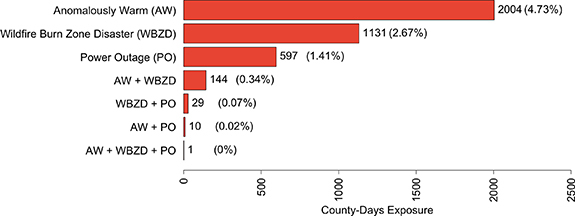
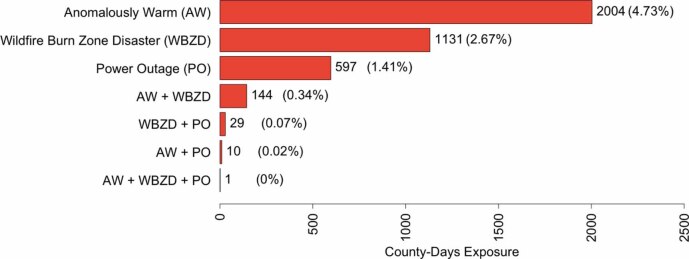
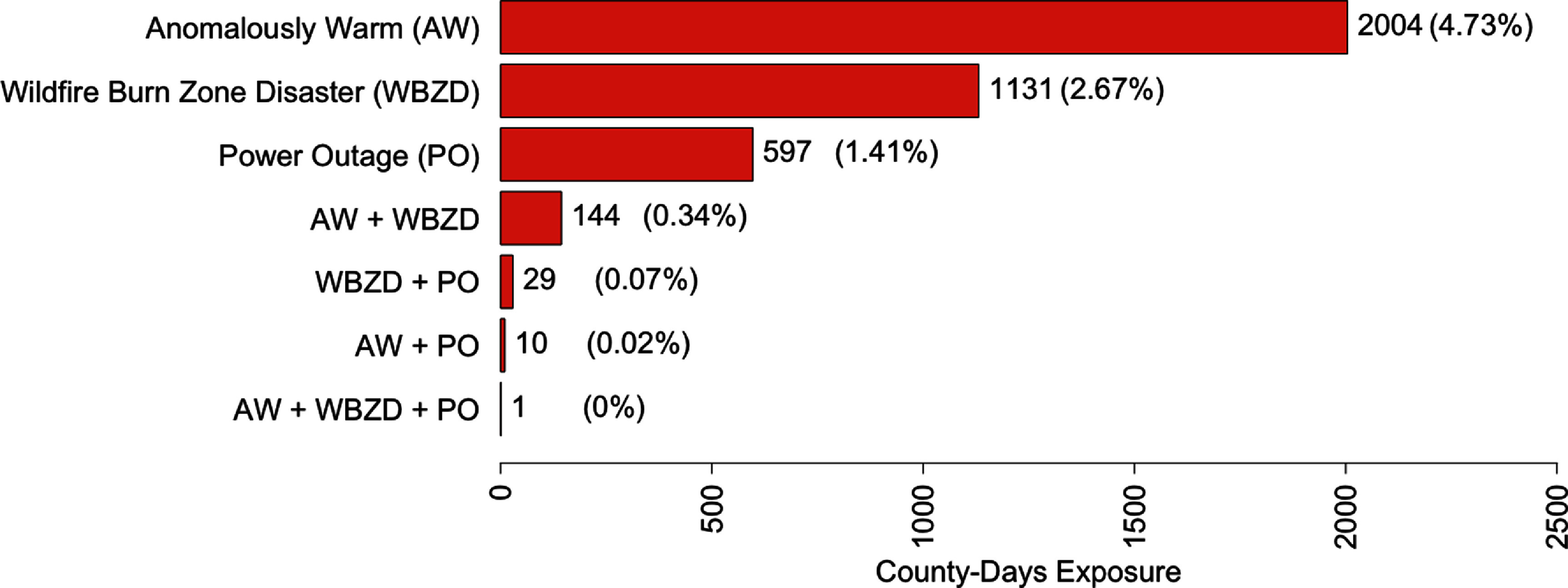
Climate change will increase the frequency of extreme weather events. This means climate-driven events like wildfires and power outages will likely co-occur more often, potentially magnifying their health risks. We characterized three types of climate-driven events-anomalously warm temperatures, wildfire burn zone disasters, and long power outages-in 58 California counties during 2018-2019. We defined county-day anomalously warm temperatures when daily average temperatures exceeded 24 °C and the 85th percentile of the long-term county average. We defined county-day wildfire burn zone disasters when an active wildfire burn zone intersected a county, burned 1+ structures, killed a civilian, or received a Federal Emergency Management Agency Fire Management Declaration, and overlapped with a community. For a subset of the 38 counties (66%), long power outage county days were identified using PowerOutage.us data when an outage affected >0.5% of county customers for 8+ h. Co-occurring events were when 2+ of these events occurred on the same county day. Using the CDC/ATSDR Social Vulnerability Index (SVI), we determined whether co-occurring events disproportionately affected vulnerable populations. Nearly every county (97%) experienced at least one day of anomalously warm temperatures, 57% had at least one wildfire burn zone disaster day, and 63% (24/38 counties with available data) had at least one long power outage day. The most common co-occurring events (anomalously warm temperatures and wildfire burn zone disasters) impacted 24 (41%) counties for 144 total county-days. We did not find a clear connection between co-occurring events and social vulnerability. We observed an inverse correlation between co-occurring wildfire burn zone disasters and long power outage days with SVI, and a positive correlation between co-occurring anomalously warm and long power outage days with SVI. This analysis can inform regional resource allocation and other state-wide planning and policy objectives to reduce the adverse effects of climate-driven events.



 京公网安备 11010802042870号
京ICP备2023020795号-1
京公网安备 11010802042870号
京ICP备2023020795号-1

 分享
分享

 求助内容:
求助内容: 应助结果提醒方式:
 扫码关注我们
