Xiaoyu Gao , Guojie Chen , Wenqing Yao , Yongbiao Mu , Lipeng Hu , Tao Zeng , Wenguang Zhao , Zhongyuan Huang , Maolin Yang , Yuguang Pu , Wenhai Ji , Zhenhong Tan , Ping Miao , Nian Zhang , Litao Yu , Lin Zeng , Rui Wang , Yinguo Xiao
{"title":"Unlocking the ultra-high capacity and cost-effectiveness of cobalt-free lithium-rich cathode materials","authors":"Xiaoyu Gao , Guojie Chen , Wenqing Yao , Yongbiao Mu , Lipeng Hu , Tao Zeng , Wenguang Zhao , Zhongyuan Huang , Maolin Yang , Yuguang Pu , Wenhai Ji , Zhenhong Tan , Ping Miao , Nian Zhang , Litao Yu , Lin Zeng , Rui Wang , Yinguo Xiao","doi":"10.1016/j.ensm.2025.104104","DOIUrl":null,"url":null,"abstract":"<div><div>Cobalt-free Li- and Mn-rich layered (LMR) cathode materials have the merits of being low-cost and environmentally compatible. However, their practical discharge capacities are much lower than the theoretical ones because the lack of cobalt reduces the anion redox activity. Furthermore, the issues related to anionic redox reactions, such as irreversible oxygen loss and phase transitions, hinder their commercialization. In this study, we present a novel method that involves premixing active materials and conductive agents followed by post-processing using spark plasma sintering (SPS). This rapid treatment (10 min) significantly enhances the discharge capacity of Co-free LMR materials. Specifically, the treated materials can achieve 319.4 mAh g⁻¹ at 0.1C, approximately 90 mAh g⁻¹ higher than the untreated LMR. Noticeably, the SPS-treated LMR exhibits excellent capacity retention of 71.8% after 800 cycles at 5C. Multi-angle characterizations demonstrate that SPS treatment induces a reconstructed surface with cationic disordering increasing from the bulk to the surface. This interlayer cationic disordering effectively enhances oxygen redox activity and the reconstructed rock-salt surface protects the interior layered structure. This study develops a new approach to activating the oxygen activity and enhancing the capacity in cathode materials through an innovative SPS technology.</div></div>","PeriodicalId":306,"journal":{"name":"Energy Storage Materials","volume":"76 ","pages":"Article 104104"},"PeriodicalIF":20.2000,"publicationDate":"2025-03-01","publicationTypes":"Journal Article","fieldsOfStudy":null,"isOpenAccess":false,"openAccessPdf":"","citationCount":"0","resultStr":null,"platform":"Semanticscholar","paperid":null,"PeriodicalName":"Energy Storage Materials","FirstCategoryId":"88","ListUrlMain":"https://www.sciencedirect.com/science/article/pii/S2405829725001047","RegionNum":1,"RegionCategory":"材料科学","ArticlePicture":[],"TitleCN":null,"AbstractTextCN":null,"PMCID":null,"EPubDate":"2025/2/8 0:00:00","PubModel":"Epub","JCR":"Q1","JCRName":"CHEMISTRY, PHYSICAL","Score":null,"Total":0}
引用次数: 0
Abstract
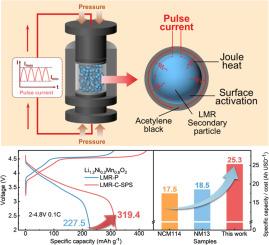
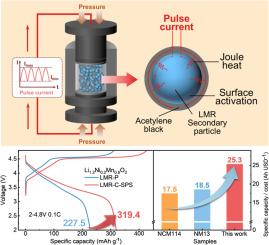
Cobalt-free Li- and Mn-rich layered (LMR) cathode materials have the merits of being low-cost and environmentally compatible. However, their practical discharge capacities are much lower than the theoretical ones because the lack of cobalt reduces the anion redox activity. Furthermore, the issues related to anionic redox reactions, such as irreversible oxygen loss and phase transitions, hinder their commercialization. In this study, we present a novel method that involves premixing active materials and conductive agents followed by post-processing using spark plasma sintering (SPS). This rapid treatment (10 min) significantly enhances the discharge capacity of Co-free LMR materials. Specifically, the treated materials can achieve 319.4 mAh g⁻¹ at 0.1C, approximately 90 mAh g⁻¹ higher than the untreated LMR. Noticeably, the SPS-treated LMR exhibits excellent capacity retention of 71.8% after 800 cycles at 5C. Multi-angle characterizations demonstrate that SPS treatment induces a reconstructed surface with cationic disordering increasing from the bulk to the surface. This interlayer cationic disordering effectively enhances oxygen redox activity and the reconstructed rock-salt surface protects the interior layered structure. This study develops a new approach to activating the oxygen activity and enhancing the capacity in cathode materials through an innovative SPS technology.
无钴富锂富锰层状正极材料具有成本低、环境兼容等优点。但由于钴的缺乏降低了阴离子的氧化还原活性,其实际放电容量远低于理论放电容量。此外,与阴离子氧化还原反应相关的问题,如不可逆的氧损失和相变,阻碍了它们的商业化。在这项研究中,我们提出了一种新的方法,包括预先混合活性材料和导电剂,然后使用火花等离子烧结(SPS)进行后处理。这种快速处理(10分钟)显著提高了无co LMR材料的放电能力。具体来说,经过处理的材料在0.1C时可以达到319.4 mAh g⁻¹,比未经处理的LMR高约90 mAh g⁻¹。值得注意的是,经过sps处理的LMR在5C下循环800次后,其容量保持率为71.8%。多角度表征表明,SPS处理诱导了从体到表面阳离子无序增加的重构表面。这种层间阳离子无序性有效地增强了氧氧化还原活性,重构的岩盐表面保护了内部层状结构。本研究通过一种创新的SPS技术,开发了一种激活正极材料氧活性和提高正极材料容量的新方法。
期刊介绍:
Energy Storage Materials is a global interdisciplinary journal dedicated to sharing scientific and technological advancements in materials and devices for advanced energy storage and related energy conversion, such as in metal-O2 batteries. The journal features comprehensive research articles, including full papers and short communications, as well as authoritative feature articles and reviews by leading experts in the field.
Energy Storage Materials covers a wide range of topics, including the synthesis, fabrication, structure, properties, performance, and technological applications of energy storage materials. Additionally, the journal explores strategies, policies, and developments in the field of energy storage materials and devices for sustainable energy.
Published papers are selected based on their scientific and technological significance, their ability to provide valuable new knowledge, and their relevance to the international research community.



 京公网安备 11010802042870号
京ICP备2023020795号-1
京公网安备 11010802042870号
京ICP备2023020795号-1

 分享
分享
 求助内容:
求助内容: 应助结果提醒方式:
 扫码关注我们
