Sophie A Kitchen, Tara Gomes, Mina Tadrous, Kathleen Pajer, William Gardner, Yona Lunsky, Melanie Penner, David Juurlink, Muhammad Mamdani, Tony Antoniou
{"title":"Association between a publicly funded universal drug program and antipsychotic and antidepressant medication dispensing to children.","authors":"Sophie A Kitchen, Tara Gomes, Mina Tadrous, Kathleen Pajer, William Gardner, Yona Lunsky, Melanie Penner, David Juurlink, Muhammad Mamdani, Tony Antoniou","doi":"10.1186/s12887-024-05345-2","DOIUrl":null,"url":null,"abstract":"<p><strong>Background: </strong>The prescribing of antidepressants and antipsychotics to children has increased worldwide, but little is known about how changes in drug funding policy influence the practice. In 2018, Ontario introduced a universal pharmacare program (OHIP+) for children and youth, amending it in April 2019 to cover only those without private insurance. We examined the association of these policy changes with antipsychotic and antidepressant medication prescribing.</p><p><strong>Methods: </strong>We conducted a population-based study of antidepressant and antipsychotic medication dispensing to children ≤ 18 years old between September 1, 2014, and February 29, 2020. We obtained dispensing data from the IQVIA Geographic Prescription Monitor database, and used interventional autoregressive integrated moving average models to examine whether the implementation of OHIP + and its subsequent revision were associated with changes in dispensing.</p><p><strong>Results: </strong>The implementation of OHIP + was not associated with changes in the rate of antidepressants (-19.3 units per 1,000 population; 95% confidence interval [CI]: -41.7 to 3.1) or antipsychotics (+ 1.0 unit per 1,000 population; 95% CI: -5.4 to 7.5) dispensed. Similarly, subsequent changes to the program restricting coverage to children without private insurance were not associated with antidepressant (0.3 units per 1,000; 95% CI: -7.4 to 7.9) or antipsychotic (1.0 units per 1,000; 95% CI: -0.9 to 2.9) dispensing trends.</p><p><strong>Conclusion: </strong>Implementation of a publicly-funded pharmacare program did not influence trends in antidepressant or antipsychotic medication dispensing among children.</p>","PeriodicalId":9144,"journal":{"name":"BMC Pediatrics","volume":"25 1","pages":"105"},"PeriodicalIF":2.0000,"publicationDate":"2025-02-08","publicationTypes":"Journal Article","fieldsOfStudy":null,"isOpenAccess":false,"openAccessPdf":"https://www.ncbi.nlm.nih.gov/pmc/articles/PMC11806594/pdf/","citationCount":"0","resultStr":null,"platform":"Semanticscholar","paperid":null,"PeriodicalName":"BMC Pediatrics","FirstCategoryId":"3","ListUrlMain":"https://doi.org/10.1186/s12887-024-05345-2","RegionNum":3,"RegionCategory":"医学","ArticlePicture":[],"TitleCN":null,"AbstractTextCN":null,"PMCID":null,"EPubDate":"","PubModel":"","JCR":"Q2","JCRName":"PEDIATRICS","Score":null,"Total":0}
引用次数: 0
Abstract
Background: The prescribing of antidepressants and antipsychotics to children has increased worldwide, but little is known about how changes in drug funding policy influence the practice. In 2018, Ontario introduced a universal pharmacare program (OHIP+) for children and youth, amending it in April 2019 to cover only those without private insurance. We examined the association of these policy changes with antipsychotic and antidepressant medication prescribing.
Methods: We conducted a population-based study of antidepressant and antipsychotic medication dispensing to children ≤ 18 years old between September 1, 2014, and February 29, 2020. We obtained dispensing data from the IQVIA Geographic Prescription Monitor database, and used interventional autoregressive integrated moving average models to examine whether the implementation of OHIP + and its subsequent revision were associated with changes in dispensing.
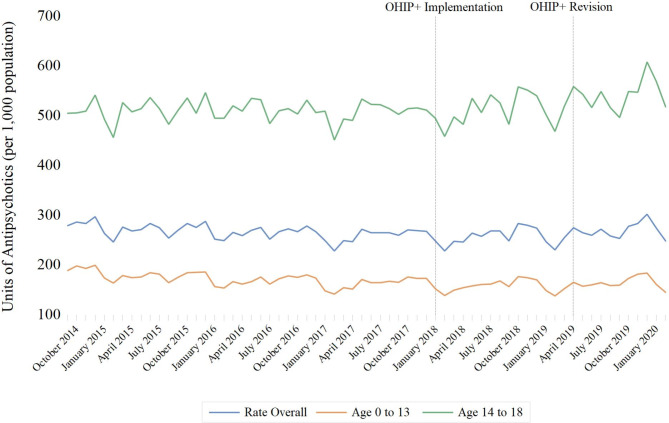
Results: The implementation of OHIP + was not associated with changes in the rate of antidepressants (-19.3 units per 1,000 population; 95% confidence interval [CI]: -41.7 to 3.1) or antipsychotics (+ 1.0 unit per 1,000 population; 95% CI: -5.4 to 7.5) dispensed. Similarly, subsequent changes to the program restricting coverage to children without private insurance were not associated with antidepressant (0.3 units per 1,000; 95% CI: -7.4 to 7.9) or antipsychotic (1.0 units per 1,000; 95% CI: -0.9 to 2.9) dispensing trends.
Conclusion: Implementation of a publicly-funded pharmacare program did not influence trends in antidepressant or antipsychotic medication dispensing among children.
期刊介绍:
BMC Pediatrics is an open access journal publishing peer-reviewed research articles in all aspects of health care in neonates, children and adolescents, as well as related molecular genetics, pathophysiology, and epidemiology.





 京公网安备 11010802042870号
京ICP备2023020795号-1
京公网安备 11010802042870号
京ICP备2023020795号-1

 分享
分享
 求助内容:
求助内容: 应助结果提醒方式:
 扫码关注我们
