{"title":"Responsive Photonic Filaments from Confined Self-Assembly of Cellulose Nanocrystals","authors":"Fusheng Zhang, Jiaqi Yu, Wei Zhong, Zhixiang Wang, Qiongya Li, Guangyan Qing","doi":"10.1021/acsnano.4c15863","DOIUrl":null,"url":null,"abstract":"Cellulose nanocrystals (CNCs) hold transformative potential for sustainable photonics, particularly in applications such as polarization-selective devices and chiroptical sensors. However, conventional CNC derivatives are primarily limited to dense flat films, restricting their functionalization in soft fibers and wearable textiles. Advancing CNCs into infinitely extending cylindrical filaments presents an opportunity to unlock fascinating applications, yet this transformation is often hindered by the Plateau–Rayleigh instability, leading to the breakup of CNC suspensions into droplets. Here, we propose an innovation strategy for the continuous and scalable production of chiral photonic filaments by confining the photo-cross-linking of CNC/poly(ethylene glycol) diacrylate precursors within cylindrical microtubules. The resulting filaments, driven by both shear flow and chiral self-assembly, exhibit a high degree of orientation along their central axis while preserving the nanohierarchical structure of the uniaxial nematic phase. Notably, these filaments achieve an orientation order parameter of 0.91, coupled with exceptional mechanical performances (14 MJ·m<sup>–3</sup>), as well as dynamic interference color-change capabilities in response to variations in hygroscopicity or applied mechanical strain. We present a proof-of-concept for optical fabrics using these photonic filaments, which supports the development of smart textiles and fashionable clothing, thereby significantly enriching the diversity and design possibilities of CNC-based materials.","PeriodicalId":21,"journal":{"name":"ACS Nano","volume":"62 1","pages":""},"PeriodicalIF":16.0000,"publicationDate":"2025-02-09","publicationTypes":"Journal Article","fieldsOfStudy":null,"isOpenAccess":false,"openAccessPdf":"","citationCount":"0","resultStr":null,"platform":"Semanticscholar","paperid":null,"PeriodicalName":"ACS Nano","FirstCategoryId":"88","ListUrlMain":"https://doi.org/10.1021/acsnano.4c15863","RegionNum":1,"RegionCategory":"材料科学","ArticlePicture":[],"TitleCN":null,"AbstractTextCN":null,"PMCID":null,"EPubDate":"","PubModel":"","JCR":"Q1","JCRName":"CHEMISTRY, MULTIDISCIPLINARY","Score":null,"Total":0}
引用次数: 0
Abstract
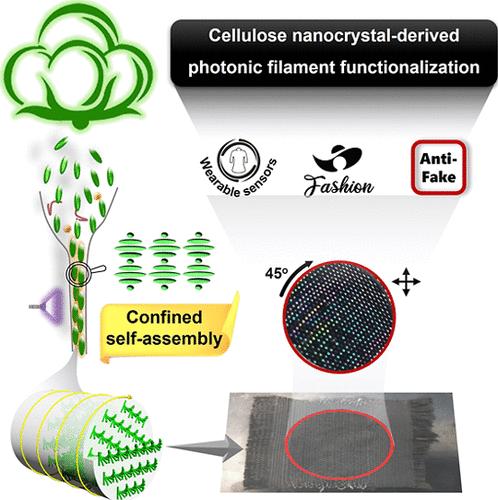
Cellulose nanocrystals (CNCs) hold transformative potential for sustainable photonics, particularly in applications such as polarization-selective devices and chiroptical sensors. However, conventional CNC derivatives are primarily limited to dense flat films, restricting their functionalization in soft fibers and wearable textiles. Advancing CNCs into infinitely extending cylindrical filaments presents an opportunity to unlock fascinating applications, yet this transformation is often hindered by the Plateau–Rayleigh instability, leading to the breakup of CNC suspensions into droplets. Here, we propose an innovation strategy for the continuous and scalable production of chiral photonic filaments by confining the photo-cross-linking of CNC/poly(ethylene glycol) diacrylate precursors within cylindrical microtubules. The resulting filaments, driven by both shear flow and chiral self-assembly, exhibit a high degree of orientation along their central axis while preserving the nanohierarchical structure of the uniaxial nematic phase. Notably, these filaments achieve an orientation order parameter of 0.91, coupled with exceptional mechanical performances (14 MJ·m–3), as well as dynamic interference color-change capabilities in response to variations in hygroscopicity or applied mechanical strain. We present a proof-of-concept for optical fabrics using these photonic filaments, which supports the development of smart textiles and fashionable clothing, thereby significantly enriching the diversity and design possibilities of CNC-based materials.
期刊介绍:
ACS Nano, published monthly, serves as an international forum for comprehensive articles on nanoscience and nanotechnology research at the intersections of chemistry, biology, materials science, physics, and engineering. The journal fosters communication among scientists in these communities, facilitating collaboration, new research opportunities, and advancements through discoveries. ACS Nano covers synthesis, assembly, characterization, theory, and simulation of nanostructures, nanobiotechnology, nanofabrication, methods and tools for nanoscience and nanotechnology, and self- and directed-assembly. Alongside original research articles, it offers thorough reviews, perspectives on cutting-edge research, and discussions envisioning the future of nanoscience and nanotechnology.



 京公网安备 11010802042870号
京ICP备2023020795号-1
京公网安备 11010802042870号
京ICP备2023020795号-1

 分享
分享
 求助内容:
求助内容: 应助结果提醒方式:
 扫码关注我们
