Caroline Williams, Bella R. Carnahan, Stephen N. Hyland, Kristen E. DeMeester, Catherine L. Grimes
{"title":"Bio-orthogonal Labeling of Chitin in Native Pathogenic Candida Species via the Chitin Scavenge Pathway","authors":"Caroline Williams, Bella R. Carnahan, Stephen N. Hyland, Kristen E. DeMeester, Catherine L. Grimes","doi":"10.1021/jacs.4c11554","DOIUrl":null,"url":null,"abstract":"The fungal cell wall is essential for the integrity of the cell, providing strength and shape, as well as protection against environmental stimuli. For pathogenic fungi, the cell wall is also the initial point of contact with the host. Specific cell wall features such as hypha tails and smaller glycan components modulate a wide range of fungal interactions with the immune defenses. Here, a bio-orthogonal labeling method utilizing <i>N</i>-acetyl-glucosamine (NAG) probes is developed to fluorescently label native, pathogenic yeast via the chitin scavenging pathway. A panel of NAG probes was assembled, synthesized, and characterized for the ability to label the chitin in pathogenic yeast. Enzymatic data show that the native scavenging biosynthetic enzyme, Hxk1, is promiscuous, permitting the labeling of the native chitin biopolymer. This chitin labeling method was validated via the development of mass spectrometry protocols. When compared to the current available labeling systems for chitin, the probes do not affect the integrity of the cell wall and do not interrupt cell growth. Furthermore, the NAG probes enabled multiple “click” platforms across pathogenic Candida species including <i>Candida albicans</i> and <i>Candida tropicalis</i>. Budding and filamentous hyphal states were observed. The results indicate the probes’ utility for in vivo study of the morphological, pathogenic switch, and visualization of growth patterns. Thus, the use of these probes in pathogenic Candida strains is ideal for a variety of future applications including strain specific antifungals, diagnostic tools, and immunomodulators.","PeriodicalId":49,"journal":{"name":"Journal of the American Chemical Society","volume":"15 1","pages":""},"PeriodicalIF":15.6000,"publicationDate":"2025-02-09","publicationTypes":"Journal Article","fieldsOfStudy":null,"isOpenAccess":false,"openAccessPdf":"","citationCount":"0","resultStr":null,"platform":"Semanticscholar","paperid":null,"PeriodicalName":"Journal of the American Chemical Society","FirstCategoryId":"92","ListUrlMain":"https://doi.org/10.1021/jacs.4c11554","RegionNum":1,"RegionCategory":"化学","ArticlePicture":[],"TitleCN":null,"AbstractTextCN":null,"PMCID":null,"EPubDate":"","PubModel":"","JCR":"Q1","JCRName":"CHEMISTRY, MULTIDISCIPLINARY","Score":null,"Total":0}
引用次数: 0
Abstract
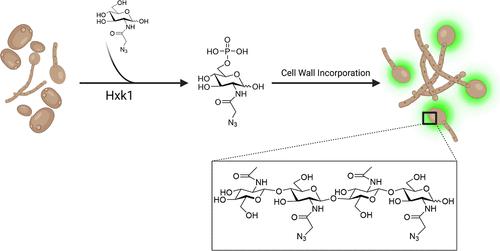
The fungal cell wall is essential for the integrity of the cell, providing strength and shape, as well as protection against environmental stimuli. For pathogenic fungi, the cell wall is also the initial point of contact with the host. Specific cell wall features such as hypha tails and smaller glycan components modulate a wide range of fungal interactions with the immune defenses. Here, a bio-orthogonal labeling method utilizing N-acetyl-glucosamine (NAG) probes is developed to fluorescently label native, pathogenic yeast via the chitin scavenging pathway. A panel of NAG probes was assembled, synthesized, and characterized for the ability to label the chitin in pathogenic yeast. Enzymatic data show that the native scavenging biosynthetic enzyme, Hxk1, is promiscuous, permitting the labeling of the native chitin biopolymer. This chitin labeling method was validated via the development of mass spectrometry protocols. When compared to the current available labeling systems for chitin, the probes do not affect the integrity of the cell wall and do not interrupt cell growth. Furthermore, the NAG probes enabled multiple “click” platforms across pathogenic Candida species including Candida albicans and Candida tropicalis. Budding and filamentous hyphal states were observed. The results indicate the probes’ utility for in vivo study of the morphological, pathogenic switch, and visualization of growth patterns. Thus, the use of these probes in pathogenic Candida strains is ideal for a variety of future applications including strain specific antifungals, diagnostic tools, and immunomodulators.
期刊介绍:
The flagship journal of the American Chemical Society, known as the Journal of the American Chemical Society (JACS), has been a prestigious publication since its establishment in 1879. It holds a preeminent position in the field of chemistry and related interdisciplinary sciences. JACS is committed to disseminating cutting-edge research papers, covering a wide range of topics, and encompasses approximately 19,000 pages of Articles, Communications, and Perspectives annually. With a weekly publication frequency, JACS plays a vital role in advancing the field of chemistry by providing essential research.



 京公网安备 11010802042870号
京ICP备2023020795号-1
京公网安备 11010802042870号
京ICP备2023020795号-1

 分享
分享
 求助内容:
求助内容: 应助结果提醒方式:
 扫码关注我们
