Jessica M. Powers PhD, Lisa R. LaRowe PhD, Dana Rubenstein MHS, Judith A. Paice PhD, RN, Brian Hitsman PhD, Christine M. Rini PhD
{"title":"Relationship between pain and nonopioid substance use in two national samples of cancer survivors","authors":"Jessica M. Powers PhD, Lisa R. LaRowe PhD, Dana Rubenstein MHS, Judith A. Paice PhD, RN, Brian Hitsman PhD, Christine M. Rini PhD","doi":"10.1002/cncr.35701","DOIUrl":null,"url":null,"abstract":"<div>\n \n \n <section>\n \n <h3> Significance</h3>\n \n <p>Pain and nonopioid substance use (tobacco, cannabis, alcohol) frequently co-occur, but have been understudied among cancer survivors. Even less work has examined whether pain and nonopioid substance use is related to other cancer treatment-related side effects, mental health, and health-related quality of life.</p>\n </section>\n \n <section>\n \n <h3> Methods</h3>\n \n <p>Two national datasets were used to assess a range of variables and confirm patterns. Study 1 included 1252 adults (88% White; 55% female; 60% aged ≥65) from Wave 6 (2021) of the Population Assessment of Tobacco and Health Study, and Study 2 included 4130 adults (83% White; 56% female; <i>M</i> age = 66) from the 2020 National Health Interview Survey who reported a lifetime cancer diagnosis. Regression analyses were conducted separately by study.</p>\n </section>\n \n <section>\n \n <h3> Results</h3>\n \n <p>Study 1 results indicated that past-week pain intensity was associated with greater likelihood of using cigarettes, e-cigarettes, and cannabis (<i>p</i>s < .003) and lower likelihood of using alcohol (<i>p</i> < .001). Study 2 results indicated that chronic pain (vs. no chronic pain) was associated with greater likelihood of cigarette smoking (<i>p</i> < .001) and lower likelihood of alcohol use (<i>p</i> < .001). In both studies, cigarette smoking and pain were related to fatigue, sleep difficulties, poorer mental/physical health, and lower health-related quality of life.</p>\n </section>\n \n <section>\n \n <h3> Conclusion</h3>\n \n <p>Pain is associated with greater likelihood of tobacco and cannabis use among cancer survivors. Given that substance use may impact cancer treatment and its side effects and contribute to pain chronification, there is an urgent need to develop tailored interventions for cooccurring pain and substance use in cancer survivors.</p>\n </section>\n </div>","PeriodicalId":138,"journal":{"name":"Cancer","volume":"131 4","pages":""},"PeriodicalIF":5.1000,"publicationDate":"2025-02-10","publicationTypes":"Journal Article","fieldsOfStudy":null,"isOpenAccess":false,"openAccessPdf":"https://onlinelibrary.wiley.com/doi/epdf/10.1002/cncr.35701","citationCount":"0","resultStr":null,"platform":"Semanticscholar","paperid":null,"PeriodicalName":"Cancer","FirstCategoryId":"3","ListUrlMain":"https://acsjournals.onlinelibrary.wiley.com/doi/10.1002/cncr.35701","RegionNum":2,"RegionCategory":"医学","ArticlePicture":[],"TitleCN":null,"AbstractTextCN":null,"PMCID":null,"EPubDate":"","PubModel":"","JCR":"Q1","JCRName":"ONCOLOGY","Score":null,"Total":0}
引用次数: 0
Abstract
Significance
Pain and nonopioid substance use (tobacco, cannabis, alcohol) frequently co-occur, but have been understudied among cancer survivors. Even less work has examined whether pain and nonopioid substance use is related to other cancer treatment-related side effects, mental health, and health-related quality of life.
Methods
Two national datasets were used to assess a range of variables and confirm patterns. Study 1 included 1252 adults (88% White; 55% female; 60% aged ≥65) from Wave 6 (2021) of the Population Assessment of Tobacco and Health Study, and Study 2 included 4130 adults (83% White; 56% female; M age = 66) from the 2020 National Health Interview Survey who reported a lifetime cancer diagnosis. Regression analyses were conducted separately by study.
Results
Study 1 results indicated that past-week pain intensity was associated with greater likelihood of using cigarettes, e-cigarettes, and cannabis (ps < .003) and lower likelihood of using alcohol (p < .001). Study 2 results indicated that chronic pain (vs. no chronic pain) was associated with greater likelihood of cigarette smoking (p < .001) and lower likelihood of alcohol use (p < .001). In both studies, cigarette smoking and pain were related to fatigue, sleep difficulties, poorer mental/physical health, and lower health-related quality of life.
Conclusion
Pain is associated with greater likelihood of tobacco and cannabis use among cancer survivors. Given that substance use may impact cancer treatment and its side effects and contribute to pain chronification, there is an urgent need to develop tailored interventions for cooccurring pain and substance use in cancer survivors.
期刊介绍:
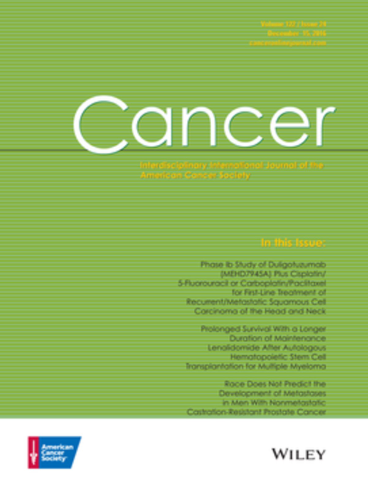
The CANCER site is a full-text, electronic implementation of CANCER, an Interdisciplinary International Journal of the American Cancer Society, and CANCER CYTOPATHOLOGY, a Journal of the American Cancer Society.
CANCER publishes interdisciplinary oncologic information according to, but not limited to, the following disease sites and disciplines: blood/bone marrow; breast disease; endocrine disorders; epidemiology; gastrointestinal tract; genitourinary disease; gynecologic oncology; head and neck disease; hepatobiliary tract; integrated medicine; lung disease; medical oncology; neuro-oncology; pathology radiation oncology; translational research



 京公网安备 11010802042870号
京ICP备2023020795号-1
京公网安备 11010802042870号
京ICP备2023020795号-1

 分享
分享
 求助内容:
求助内容: 应助结果提醒方式:
 扫码关注我们
