Hannah C. Karpel MD, MS, Linda M. Zambrano Guevara MD, B. J. Rimel MD, Kari E. Hacker MD, PhD, Victoria Bae-Jump MD, PhD, Tara Castellano MD, John Curtin MD, MBA, Bhavana Pothuri MD, MS
{"title":"The missing data: A review of gender and sex disparities in research","authors":"Hannah C. Karpel MD, MS, Linda M. Zambrano Guevara MD, B. J. Rimel MD, Kari E. Hacker MD, PhD, Victoria Bae-Jump MD, PhD, Tara Castellano MD, John Curtin MD, MBA, Bhavana Pothuri MD, MS","doi":"10.1002/cncr.35769","DOIUrl":null,"url":null,"abstract":"<p>This article highlights the gender data gaps in clinical trial inclusion and funding, with a particular focus on gynecologic oncology. Female patients have historically been excluded from clinical trials across all medical domains. Despite recent improvements, female patients remain underrepresented in key diseases, including several cancer types, despite experiencing increased burden of disease. Lack of representation is particularly stark for patients in racial, ethnic, and gender minoritized populations, including in gynecologic cancer trials. Furthermore, female health conditions receive disproportionately small amounts of funding relative to their disease burden. Despite their high lethality, gynecologic cancers, including ovarian, cervical, and uterine malignancies, rank among the lowest funded cancer sites from the National Cancer Institute. Likewise, there is significant bias against female investigators with regard to funding, publication, and academic advancement, which affects the prioritization of women’s health. In combination, gender disparities at multiple steps along the research pathway from investigator and disease funding to trial inclusion to publication and dissemination of research perpetuate a significant data gap in the diagnosis, treatment, and prevention of diseases affecting female patients, including gynecologic cancers. Strategies to improve this gender gap and prioritize women’s health funding include increasing female representation in clinical trials with a specific focus on inclusion of patients from historically marginalized backgrounds, considering disease burden–based funding policies, and prioritizing female academic leadership opportunities.</p>","PeriodicalId":138,"journal":{"name":"Cancer","volume":"131 6","pages":""},"PeriodicalIF":5.1000,"publicationDate":"2025-03-11","publicationTypes":"Journal Article","fieldsOfStudy":null,"isOpenAccess":false,"openAccessPdf":"","citationCount":"0","resultStr":null,"platform":"Semanticscholar","paperid":null,"PeriodicalName":"Cancer","FirstCategoryId":"3","ListUrlMain":"https://acsjournals.onlinelibrary.wiley.com/doi/10.1002/cncr.35769","RegionNum":2,"RegionCategory":"医学","ArticlePicture":[],"TitleCN":null,"AbstractTextCN":null,"PMCID":null,"EPubDate":"","PubModel":"","JCR":"Q1","JCRName":"ONCOLOGY","Score":null,"Total":0}
引用次数: 0
Abstract
This article highlights the gender data gaps in clinical trial inclusion and funding, with a particular focus on gynecologic oncology. Female patients have historically been excluded from clinical trials across all medical domains. Despite recent improvements, female patients remain underrepresented in key diseases, including several cancer types, despite experiencing increased burden of disease. Lack of representation is particularly stark for patients in racial, ethnic, and gender minoritized populations, including in gynecologic cancer trials. Furthermore, female health conditions receive disproportionately small amounts of funding relative to their disease burden. Despite their high lethality, gynecologic cancers, including ovarian, cervical, and uterine malignancies, rank among the lowest funded cancer sites from the National Cancer Institute. Likewise, there is significant bias against female investigators with regard to funding, publication, and academic advancement, which affects the prioritization of women’s health. In combination, gender disparities at multiple steps along the research pathway from investigator and disease funding to trial inclusion to publication and dissemination of research perpetuate a significant data gap in the diagnosis, treatment, and prevention of diseases affecting female patients, including gynecologic cancers. Strategies to improve this gender gap and prioritize women’s health funding include increasing female representation in clinical trials with a specific focus on inclusion of patients from historically marginalized backgrounds, considering disease burden–based funding policies, and prioritizing female academic leadership opportunities.
期刊介绍:
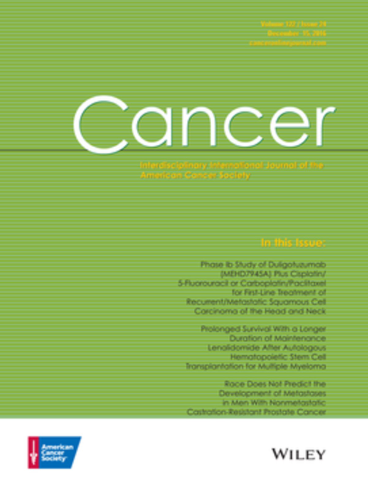
The CANCER site is a full-text, electronic implementation of CANCER, an Interdisciplinary International Journal of the American Cancer Society, and CANCER CYTOPATHOLOGY, a Journal of the American Cancer Society.
CANCER publishes interdisciplinary oncologic information according to, but not limited to, the following disease sites and disciplines: blood/bone marrow; breast disease; endocrine disorders; epidemiology; gastrointestinal tract; genitourinary disease; gynecologic oncology; head and neck disease; hepatobiliary tract; integrated medicine; lung disease; medical oncology; neuro-oncology; pathology radiation oncology; translational research



 京公网安备 11010802042870号
京ICP备2023020795号-1
京公网安备 11010802042870号
京ICP备2023020795号-1

 分享
分享
 求助内容:
求助内容: 应助结果提醒方式:
 扫码关注我们
