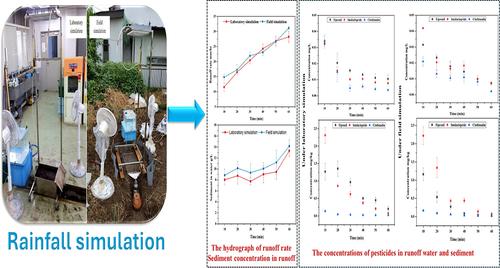
Soil erosion and sedimentation accelerate land degradation, especially in East Asia. Surface runoff is a major pathway for pesticide transport into surface and groundwater, threatening aquatic ecosystems. This study investigated the runoff rate, sediment yield, pesticide transport, and pesticide concentrations across soil layers using a small-scale portable rainfall simulator (0.33 × 0.48 m) under laboratory and field conditions.
Cumulative sediment runoff reached 2.1 and 2.3 ton ha−1 in laboratory and field simulations, respectively. Maximum pesticide concentrations under laboratory conditions were 1.3 mg kg−1 (fipronil), 2.34 mg kg−1 (clothianidin), and 0.17 mg kg−1 (imidacloprid); field results were comparable. Over 2% of applied pesticides dissolved in runoff, while <1.2% adhered to soil particles. Fipronil exhibited the highest losses in runoff, posing acute toxicity risks for aquatic organisms, with toxicity unit values exceeding safe thresholds for bluegill sunfish.
Pesticide losses depend on solubility and soil adsorption. Fipronil, despite limited soil movement, poses significant aquatic toxicity risks compared to imidacloprid and clothianidin. This study highlights the role of portable rainfall simulators in understanding pesticide transport and provides valuable insights for mitigating the environmental risks of pesticide use. © 2025 The Author(s). Pest Management Science published by John Wiley & Sons Ltd on behalf of Society of Chemical Industry.






 京公网安备 11010802042870号
京ICP备2023020795号-1
京公网安备 11010802042870号
京ICP备2023020795号-1

 分享
分享
 求助内容:
求助内容: 应助结果提醒方式:
 扫码关注我们
