Zhijian Qiu , Yongpeng Cui , Li Zhou , Bingyu Li , Xiuli Gao , Xuejin Li , Pengyun Liu , Zifeng Yan , Qingzhong Xue , Wei Xing
{"title":"Non-clusters pseudo-bilayer solvation sheaths for driving low temperature high power lithium ion batteries","authors":"Zhijian Qiu , Yongpeng Cui , Li Zhou , Bingyu Li , Xiuli Gao , Xuejin Li , Pengyun Liu , Zifeng Yan , Qingzhong Xue , Wei Xing","doi":"10.1016/j.ensm.2025.104122","DOIUrl":null,"url":null,"abstract":"<div><div>High concentration electrolytes attract significant attention in low temperature electrolyte systems due to their ability to effectively reduce the desolvation energy barrier of lithium ions. However, the actual low temperature electrochemical performance of LIBs using these high concentration electrolytes remains unsatisfactory. Researchers usually attribute this poor performance to increased viscosity, reduced wettability, and a sharp decline in conductivity at low temperatures. However, these traditional views alone are not enough to reveal the underlying nature of the poor electrochemical performance. Herein, we explore the microscopic mechanisms underlying the poor electrochemical behavior of high concentration electrolytes under low temperature conditions at the molecular level. Using in situ low temperature Raman spectroscopy, we reveal for the first time that the formation of large solvated ion clusters is the fundamental reason for the unsatisfactory electrochemical behavior of high concentration electrolytes at low temperatures. To address this, we propose the “pseudo-bilayer solvation sheath” strategy to suppress the formation of large ionized clusters, thereby enhancing lithium ion transport at low temperatures, especially during the desolvation process from the electrolyte to the electrode surface. As a result, the optimized electrolyte enables an NCM811//graphite full cell to achieve rapid charging within 30 min at -20 °C, with a high capacity retention rate of 55.4%.</div></div>","PeriodicalId":306,"journal":{"name":"Energy Storage Materials","volume":"76 ","pages":"Article 104122"},"PeriodicalIF":20.2000,"publicationDate":"2025-02-11","publicationTypes":"Journal Article","fieldsOfStudy":null,"isOpenAccess":false,"openAccessPdf":"","citationCount":"0","resultStr":null,"platform":"Semanticscholar","paperid":null,"PeriodicalName":"Energy Storage Materials","FirstCategoryId":"88","ListUrlMain":"https://www.sciencedirect.com/science/article/pii/S2405829725001229","RegionNum":1,"RegionCategory":"材料科学","ArticlePicture":[],"TitleCN":null,"AbstractTextCN":null,"PMCID":null,"EPubDate":"","PubModel":"","JCR":"Q1","JCRName":"CHEMISTRY, PHYSICAL","Score":null,"Total":0}
引用次数: 0
Abstract
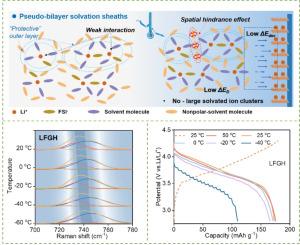
High concentration electrolytes attract significant attention in low temperature electrolyte systems due to their ability to effectively reduce the desolvation energy barrier of lithium ions. However, the actual low temperature electrochemical performance of LIBs using these high concentration electrolytes remains unsatisfactory. Researchers usually attribute this poor performance to increased viscosity, reduced wettability, and a sharp decline in conductivity at low temperatures. However, these traditional views alone are not enough to reveal the underlying nature of the poor electrochemical performance. Herein, we explore the microscopic mechanisms underlying the poor electrochemical behavior of high concentration electrolytes under low temperature conditions at the molecular level. Using in situ low temperature Raman spectroscopy, we reveal for the first time that the formation of large solvated ion clusters is the fundamental reason for the unsatisfactory electrochemical behavior of high concentration electrolytes at low temperatures. To address this, we propose the “pseudo-bilayer solvation sheath” strategy to suppress the formation of large ionized clusters, thereby enhancing lithium ion transport at low temperatures, especially during the desolvation process from the electrolyte to the electrode surface. As a result, the optimized electrolyte enables an NCM811//graphite full cell to achieve rapid charging within 30 min at -20 °C, with a high capacity retention rate of 55.4%.
期刊介绍:
Energy Storage Materials is a global interdisciplinary journal dedicated to sharing scientific and technological advancements in materials and devices for advanced energy storage and related energy conversion, such as in metal-O2 batteries. The journal features comprehensive research articles, including full papers and short communications, as well as authoritative feature articles and reviews by leading experts in the field.
Energy Storage Materials covers a wide range of topics, including the synthesis, fabrication, structure, properties, performance, and technological applications of energy storage materials. Additionally, the journal explores strategies, policies, and developments in the field of energy storage materials and devices for sustainable energy.
Published papers are selected based on their scientific and technological significance, their ability to provide valuable new knowledge, and their relevance to the international research community.




 京公网安备 11010802042870号
京ICP备2023020795号-1
京公网安备 11010802042870号
京ICP备2023020795号-1

 分享
分享
 求助内容:
求助内容: 应助结果提醒方式:
 扫码关注我们
