Yongzheng Zhang , Huiqing Zhou , Jianan Gu , Haifeng Yang , Xiaomin Cheng , Jing Zhang , Jitong Wang , Yanli Wang , Hongzhen Lin , Jian Wang , Liang Zhan , Licheng Ling
{"title":"Homogeneous low-tortuosity membrane with fast ion transfer towards life-durable low-temperature zinc metal batteries","authors":"Yongzheng Zhang , Huiqing Zhou , Jianan Gu , Haifeng Yang , Xiaomin Cheng , Jing Zhang , Jitong Wang , Yanli Wang , Hongzhen Lin , Jian Wang , Liang Zhan , Licheng Ling","doi":"10.1016/j.ensm.2025.104161","DOIUrl":null,"url":null,"abstract":"<div><div>Aqueous zinc metal batteries (AZMBs) have attracted significant attentions in the energy storage field due to their environmental safety. However, sluggish reaction kinetics of Zn(H<sub>2</sub>O)<sub>6</sub><sup>2+</sup> desolvation and corresponding Zn<sup>2+</sup> ion transfer hinder the low-temperature performance of AZMBs. Herein, the boundary inhibition effect of ion-related pathway is initially uncovered, and a homogeneous low-tortuosity separator membrane (LTSM) with enhanced kinetics of ion desolvation and transfer is proposed. This low-tortuosity structure of LTSM significantly enhances the effectiveness of pore sieving effect toward large Zn(H<sub>2</sub>O)<sub>6</sub><sup>2+</sup> clusters, minimizing ion transfer barriers and homogenizing ion flux, as revealed by Raman and sum frequency generation spectroscopies. Encouragingly, the metallic Zn with LTSM exhibits lower nucleation overpotentials of ∼50 mV, showcasing an ultralong lifespan of over 10,000 h at 0 °C. Even under −10 °C, a cycle life up to 5000 h is also achieved. The as-prepared full cells assembled with LTSM display the specific capacity of 200 mAh g<sup>−1</sup> after 4000 cycles at 8 A g<sup>−1</sup> under 0 °C. Increasing to 6.3 mg cm<sup>−2</sup>, the large areal pouch cell stabilizes for 160 cycles with retained capacity of 315 mAh g<sup>−1</sup>, demonstrating feasibility of eliminating the boundary inhibition effect with low-tortuosity separator membrane for practical applications.</div></div>","PeriodicalId":306,"journal":{"name":"Energy Storage Materials","volume":"76 ","pages":"Article 104161"},"PeriodicalIF":20.2000,"publicationDate":"2025-03-01","publicationTypes":"Journal Article","fieldsOfStudy":null,"isOpenAccess":false,"openAccessPdf":"","citationCount":"0","resultStr":null,"platform":"Semanticscholar","paperid":null,"PeriodicalName":"Energy Storage Materials","FirstCategoryId":"88","ListUrlMain":"https://www.sciencedirect.com/science/article/pii/S2405829725001618","RegionNum":1,"RegionCategory":"材料科学","ArticlePicture":[],"TitleCN":null,"AbstractTextCN":null,"PMCID":null,"EPubDate":"2025/3/7 0:00:00","PubModel":"Epub","JCR":"Q1","JCRName":"CHEMISTRY, PHYSICAL","Score":null,"Total":0}
引用次数: 0
Abstract
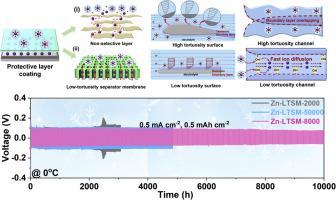
Aqueous zinc metal batteries (AZMBs) have attracted significant attentions in the energy storage field due to their environmental safety. However, sluggish reaction kinetics of Zn(H2O)62+ desolvation and corresponding Zn2+ ion transfer hinder the low-temperature performance of AZMBs. Herein, the boundary inhibition effect of ion-related pathway is initially uncovered, and a homogeneous low-tortuosity separator membrane (LTSM) with enhanced kinetics of ion desolvation and transfer is proposed. This low-tortuosity structure of LTSM significantly enhances the effectiveness of pore sieving effect toward large Zn(H2O)62+ clusters, minimizing ion transfer barriers and homogenizing ion flux, as revealed by Raman and sum frequency generation spectroscopies. Encouragingly, the metallic Zn with LTSM exhibits lower nucleation overpotentials of ∼50 mV, showcasing an ultralong lifespan of over 10,000 h at 0 °C. Even under −10 °C, a cycle life up to 5000 h is also achieved. The as-prepared full cells assembled with LTSM display the specific capacity of 200 mAh g−1 after 4000 cycles at 8 A g−1 under 0 °C. Increasing to 6.3 mg cm−2, the large areal pouch cell stabilizes for 160 cycles with retained capacity of 315 mAh g−1, demonstrating feasibility of eliminating the boundary inhibition effect with low-tortuosity separator membrane for practical applications.
水锌金属电池因其环境安全性而在储能领域受到广泛关注。然而,Zn(H2O)62+的脱溶反应动力学迟缓以及相应的Zn2+离子转移阻碍了azmb的低温性能。本文初步揭示了离子相关途径的边界抑制作用,并提出了一种具有增强离子脱溶和转移动力学的均匀低扭曲分离膜(LTSM)。拉曼光谱和和频产生谱显示,LTSM的低扭曲结构显著增强了对大Zn(H2O)62+簇的孔筛效应,最大限度地减少了离子转移障碍,使离子通量均匀化。令人鼓舞的是,具有LTSM的金属Zn具有较低的成核过电位(~ 50 mV),在0°C下具有超过10000小时的超长寿命。即使在−10°C下,循环寿命也可达5000小时。用LTSM组装的完整电池在0°C下,在8 A g−1条件下,经过4000次循环后显示出200 mAh g−1的物质容量。增加到6.3 mg cm - 2时,大面积袋状电池可稳定运行160次,保留容量为315 mAh g - 1,证明了在实际应用中消除低扭曲分离膜边界抑制效应的可行性。
期刊介绍:
Energy Storage Materials is a global interdisciplinary journal dedicated to sharing scientific and technological advancements in materials and devices for advanced energy storage and related energy conversion, such as in metal-O2 batteries. The journal features comprehensive research articles, including full papers and short communications, as well as authoritative feature articles and reviews by leading experts in the field.
Energy Storage Materials covers a wide range of topics, including the synthesis, fabrication, structure, properties, performance, and technological applications of energy storage materials. Additionally, the journal explores strategies, policies, and developments in the field of energy storage materials and devices for sustainable energy.
Published papers are selected based on their scientific and technological significance, their ability to provide valuable new knowledge, and their relevance to the international research community.




 京公网安备 11010802042870号
京ICP备2023020795号-1
京公网安备 11010802042870号
京ICP备2023020795号-1

 分享
分享
 求助内容:
求助内容: 应助结果提醒方式:
 扫码关注我们
