{"title":"Copper nanocubes as low-cost enzyme mimics in a sarcosine-sensing reaction cascade†","authors":"Anuja Tripathi and Mark P. Styczynski","doi":"10.1039/D4AN01242A","DOIUrl":null,"url":null,"abstract":"<p >The development of simple, inexpensive, deployable clinical diagnostics could have a global impact on public health by making measurements of patient health status more widely accessible to patients regardless of socioeconomic status. Here, we report a novel biosensor for sarcosine using a colorimetric readout created by a hybrid catalyst system using copper nanocubes and the enzyme sarcosine oxidase. The enzyme catalyzes the reaction of sarcosine to generate H<small><sub>2</sub></small>O<small><sub>2</sub></small>, which the copper nanocubes then use as a substrate to create free radicals that convert colorless 3,3′,5,5′-tetramethylbenzidine (TMB) to its blue, oxidized form. The sensor showed good substrate affinity for Cu nanocubes and yielded a wide linear response range (0–140 μM) for sarcosine detection, with high selectivity against various interfering species. The limit of detection and limit of quantification were found to be 1.43 μM and 4.7 μM, respectively. We showed that the biosensor maintains function in a complex serum sample matrix, suggesting potential utility in clinical applications. Finally, we demonstrated a prototype based on light emitting diodes (LEDs) and a light-dependent resistor (LDR) for unambiguous visual interpretation using an inexpensive microcontroller potentially suitable for use outside of traditional clinical or analytical laboratories.</p>","PeriodicalId":63,"journal":{"name":"Analyst","volume":" 7","pages":" 1248-1260"},"PeriodicalIF":3.3000,"publicationDate":"2025-02-11","publicationTypes":"Journal Article","fieldsOfStudy":null,"isOpenAccess":false,"openAccessPdf":"https://pubs.rsc.org/en/content/articlepdf/2025/an/d4an01242a?page=search","citationCount":"0","resultStr":null,"platform":"Semanticscholar","paperid":null,"PeriodicalName":"Analyst","FirstCategoryId":"92","ListUrlMain":"https://pubs.rsc.org/en/content/articlelanding/2025/an/d4an01242a","RegionNum":3,"RegionCategory":"化学","ArticlePicture":[],"TitleCN":null,"AbstractTextCN":null,"PMCID":null,"EPubDate":"","PubModel":"","JCR":"Q2","JCRName":"CHEMISTRY, ANALYTICAL","Score":null,"Total":0}
引用次数: 0
Abstract
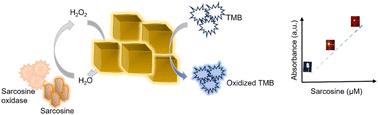
The development of simple, inexpensive, deployable clinical diagnostics could have a global impact on public health by making measurements of patient health status more widely accessible to patients regardless of socioeconomic status. Here, we report a novel biosensor for sarcosine using a colorimetric readout created by a hybrid catalyst system using copper nanocubes and the enzyme sarcosine oxidase. The enzyme catalyzes the reaction of sarcosine to generate H2O2, which the copper nanocubes then use as a substrate to create free radicals that convert colorless 3,3′,5,5′-tetramethylbenzidine (TMB) to its blue, oxidized form. The sensor showed good substrate affinity for Cu nanocubes and yielded a wide linear response range (0–140 μM) for sarcosine detection, with high selectivity against various interfering species. The limit of detection and limit of quantification were found to be 1.43 μM and 4.7 μM, respectively. We showed that the biosensor maintains function in a complex serum sample matrix, suggesting potential utility in clinical applications. Finally, we demonstrated a prototype based on light emitting diodes (LEDs) and a light-dependent resistor (LDR) for unambiguous visual interpretation using an inexpensive microcontroller potentially suitable for use outside of traditional clinical or analytical laboratories.



 京公网安备 11010802042870号
京ICP备2023020795号-1
京公网安备 11010802042870号
京ICP备2023020795号-1

 分享
分享
 求助内容:
求助内容: 应助结果提醒方式:
 扫码关注我们
