{"title":"Molecularly Functionalized Biomass Hydrogels for Sustainable Atmospheric Water Harvesting","authors":"Weixin Guan, Yaxuan Zhao, Chuxin Lei, Yuyang Wang, Kai Wu, Guihua Yu","doi":"10.1002/adma.202420319","DOIUrl":null,"url":null,"abstract":"<p>Atmospheric water harvesting (AWH) offers a promising pathway to alleviate global water scarcity, highlighting the need for environmentally responsible sorbent materials. In this context, this research introduces a universal strategy for transforming natural polysaccharides into effective hydrogel sorbents, demonstrated with cellulose, starch, and chitosan. The methodology unites alkylation to graft thermoresponsive groups, thereby enhancing water processability and enabling energy-efficient water release at lower temperatures, with the integration of zwitterionic groups to ensure stable and effective water sorption. The molecularly functionalized cellulose hydrogel, exemplifying our approach, shows favorable water uptake of 0.86–1.32 g g<sup>−1</sup> at 15–30% relative humidity (RH), along with efficient desorption, releasing 95% of captured water at 60 °C. Outdoor tests highlight the water production rate of up to 14.19 kg kg<sup>−1</sup> day<sup>−1</sup> by electrical heating. The proposed molecular engineering methodology, which expands the range of raw materials by leveraging abundant biomass feedstock, has the potential to advance sorbent production and scalable AWH technologies, contributing to sustainable solutions.</p>","PeriodicalId":114,"journal":{"name":"Advanced Materials","volume":"37 22","pages":""},"PeriodicalIF":29.1000,"publicationDate":"2025-02-13","publicationTypes":"Journal Article","fieldsOfStudy":null,"isOpenAccess":false,"openAccessPdf":"","citationCount":"0","resultStr":null,"platform":"Semanticscholar","paperid":null,"PeriodicalName":"Advanced Materials","FirstCategoryId":"88","ListUrlMain":"https://advanced.onlinelibrary.wiley.com/doi/10.1002/adma.202420319","RegionNum":1,"RegionCategory":"材料科学","ArticlePicture":[],"TitleCN":null,"AbstractTextCN":null,"PMCID":null,"EPubDate":"","PubModel":"","JCR":"Q1","JCRName":"CHEMISTRY, MULTIDISCIPLINARY","Score":null,"Total":0}
引用次数: 0
Abstract
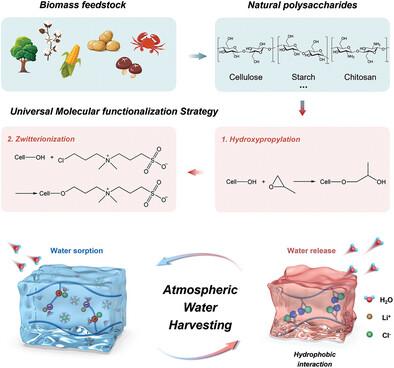
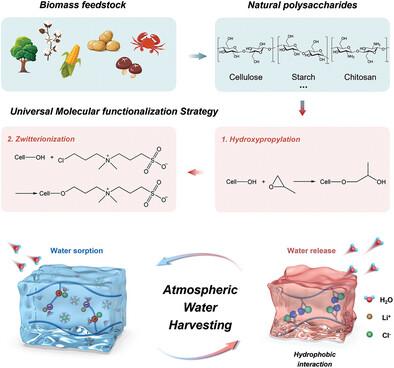
Atmospheric water harvesting (AWH) offers a promising pathway to alleviate global water scarcity, highlighting the need for environmentally responsible sorbent materials. In this context, this research introduces a universal strategy for transforming natural polysaccharides into effective hydrogel sorbents, demonstrated with cellulose, starch, and chitosan. The methodology unites alkylation to graft thermoresponsive groups, thereby enhancing water processability and enabling energy-efficient water release at lower temperatures, with the integration of zwitterionic groups to ensure stable and effective water sorption. The molecularly functionalized cellulose hydrogel, exemplifying our approach, shows favorable water uptake of 0.86–1.32 g g−1 at 15–30% relative humidity (RH), along with efficient desorption, releasing 95% of captured water at 60 °C. Outdoor tests highlight the water production rate of up to 14.19 kg kg−1 day−1 by electrical heating. The proposed molecular engineering methodology, which expands the range of raw materials by leveraging abundant biomass feedstock, has the potential to advance sorbent production and scalable AWH technologies, contributing to sustainable solutions.
大气集水(AWH)为缓解全球水资源短缺提供了一条有前途的途径,强调了对环境负责任的吸附材料的需求。在此背景下,本研究介绍了一种将天然多糖转化为有效水凝胶吸附剂的通用策略,用纤维素、淀粉和壳聚糖证明了这一点。该方法结合烷基化和接枝热敏基团,从而提高水的可加工性,并在较低温度下实现节能的水释放,同时结合两性离子基团,确保稳定有效的吸水。分子功能化的纤维素水凝胶在15-30%的相对湿度(RH)下具有0.86-1.32 g g−1的吸水率,并且在60°C下具有高效的解吸能力,释放95%的捕获水。室外测试表明,通过电加热,产水量高达14.19 kg kg - 1 day - 1。所提出的分子工程方法通过利用丰富的生物质原料扩大了原材料的范围,有可能推进吸附剂生产和可扩展的AWH技术,为可持续解决方案做出贡献。
期刊介绍:
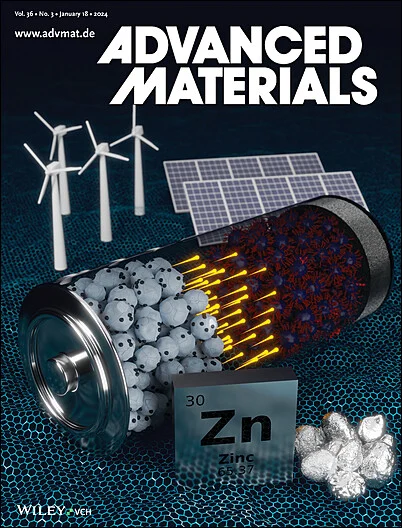
Advanced Materials, one of the world's most prestigious journals and the foundation of the Advanced portfolio, is the home of choice for best-in-class materials science for more than 30 years. Following this fast-growing and interdisciplinary field, we are considering and publishing the most important discoveries on any and all materials from materials scientists, chemists, physicists, engineers as well as health and life scientists and bringing you the latest results and trends in modern materials-related research every week.







 京公网安备 11010802042870号
京ICP备2023020795号-1
京公网安备 11010802042870号
京ICP备2023020795号-1

 分享
分享
 求助内容:
求助内容: 应助结果提醒方式:
 扫码关注我们
