Tofayet Sultan, Mohammad Sayem Chowdhury, Nusrat Jahan, M F Mridha, Sultan Alfarhood, Mejdl Safran, Dunren Che
{"title":"LeafDNet: Transforming Leaf Disease Diagnosis Through Deep Transfer Learning.","authors":"Tofayet Sultan, Mohammad Sayem Chowdhury, Nusrat Jahan, M F Mridha, Sultan Alfarhood, Mejdl Safran, Dunren Che","doi":"10.1002/pld3.70047","DOIUrl":null,"url":null,"abstract":"<p><p>The health and productivity of plants, particularly those in agricultural and horticultural industries, are significantly affected by timely and accurate disease detection. Traditional manual inspection methods are labor-intensive, subjective, and often inaccurate, failing to meet the precision required by modern agricultural practices. This research introduces an innovative deep transfer learning method utilizing an advanced version of the Xception architecture, specifically designed for identifying plant diseases in roses, mangoes, and tomatoes. The proposed model introduces additional convolutional layers following the base Xception architecture, combined with multiple trainable dense layers, incorporating advanced regularization and dropout techniques to optimize feature extraction and classification. This architectural enhancement enables the model to capture complex, subtle patterns within plant leaf images, contributing to more robust disease identification. A comprehensive dataset comprising 5491 images across four distinct disease categories was employed for the training, validation, and testing of the model. The experimental results showcased outstanding performance, achieving 98% accuracy, 99% precision, 98% recall, and a 98% F1-score. The model outperformed traditional techniques as well as other deep learning-based methods. These results emphasize the potential of this advanced deep learning framework as a scalable, efficient, and highly accurate solution for early plant disease detection, providing substantial benefits for plant health management and supporting sustainable agricultural practices.</p>","PeriodicalId":20230,"journal":{"name":"Plant Direct","volume":"9 2","pages":"e70047"},"PeriodicalIF":2.3000,"publicationDate":"2025-02-12","publicationTypes":"Journal Article","fieldsOfStudy":null,"isOpenAccess":false,"openAccessPdf":"https://www.ncbi.nlm.nih.gov/pmc/articles/PMC11815709/pdf/","citationCount":"0","resultStr":null,"platform":"Semanticscholar","paperid":null,"PeriodicalName":"Plant Direct","FirstCategoryId":"99","ListUrlMain":"https://doi.org/10.1002/pld3.70047","RegionNum":3,"RegionCategory":"生物学","ArticlePicture":[],"TitleCN":null,"AbstractTextCN":null,"PMCID":null,"EPubDate":"2025/2/1 0:00:00","PubModel":"eCollection","JCR":"Q2","JCRName":"PLANT SCIENCES","Score":null,"Total":0}
引用次数: 0
Abstract
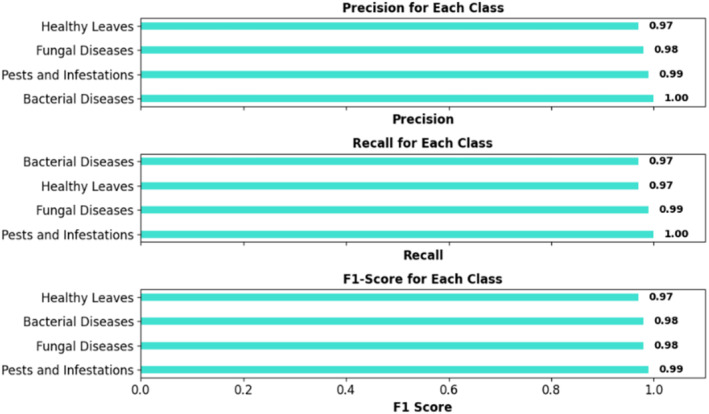
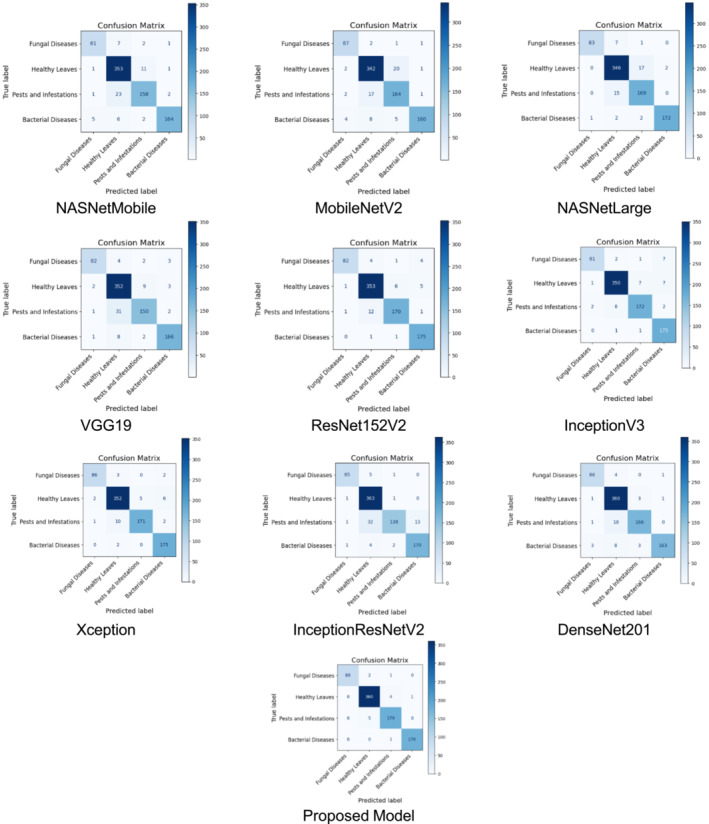
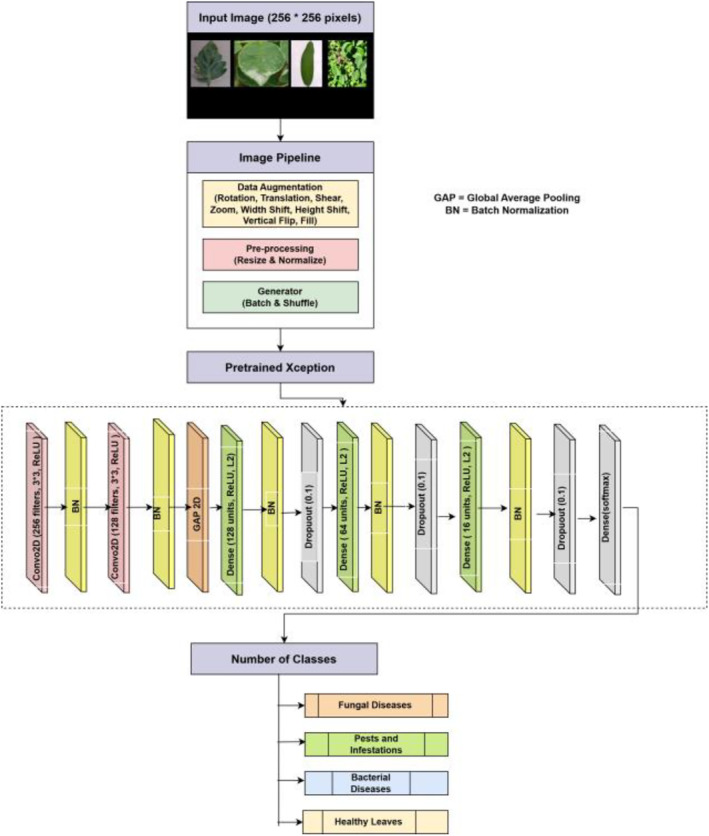
The health and productivity of plants, particularly those in agricultural and horticultural industries, are significantly affected by timely and accurate disease detection. Traditional manual inspection methods are labor-intensive, subjective, and often inaccurate, failing to meet the precision required by modern agricultural practices. This research introduces an innovative deep transfer learning method utilizing an advanced version of the Xception architecture, specifically designed for identifying plant diseases in roses, mangoes, and tomatoes. The proposed model introduces additional convolutional layers following the base Xception architecture, combined with multiple trainable dense layers, incorporating advanced regularization and dropout techniques to optimize feature extraction and classification. This architectural enhancement enables the model to capture complex, subtle patterns within plant leaf images, contributing to more robust disease identification. A comprehensive dataset comprising 5491 images across four distinct disease categories was employed for the training, validation, and testing of the model. The experimental results showcased outstanding performance, achieving 98% accuracy, 99% precision, 98% recall, and a 98% F1-score. The model outperformed traditional techniques as well as other deep learning-based methods. These results emphasize the potential of this advanced deep learning framework as a scalable, efficient, and highly accurate solution for early plant disease detection, providing substantial benefits for plant health management and supporting sustainable agricultural practices.
期刊介绍:
Plant Direct is a monthly, sound science journal for the plant sciences that gives prompt and equal consideration to papers reporting work dealing with a variety of subjects. Topics include but are not limited to genetics, biochemistry, development, cell biology, biotic stress, abiotic stress, genomics, phenomics, bioinformatics, physiology, molecular biology, and evolution. A collaborative journal launched by the American Society of Plant Biologists, the Society for Experimental Biology and Wiley, Plant Direct publishes papers submitted directly to the journal as well as those referred from a select group of the societies’ journals.




 京公网安备 11010802042870号
京ICP备2023020795号-1
京公网安备 11010802042870号
京ICP备2023020795号-1

 分享
分享
 求助内容:
求助内容: 应助结果提醒方式:
 扫码关注我们
