Ashley Gresh, Astrid Van Damme, Deborah L Billings, Sharon Schindler Rising, Shaimaa Ibrahim, Abiola Ajibola, Ellen Chirwa, Jennyfer Don-Aki, Nastassia Donoho, Manodj Hindori, Nafisa Jiddawi, Emeka Kanebi, Esnath Kapito, Catherine Kay, Tara Kinra, Vlorian Molliqaj, Bolanle Oyeledun, Marlies E B Rijnders, Octavia Wiseman, Ghutai Sadeq Yaqubi, Crystal L Patil
{"title":"Integrating postnatal care into the redesign of group care beyond birth.","authors":"Ashley Gresh, Astrid Van Damme, Deborah L Billings, Sharon Schindler Rising, Shaimaa Ibrahim, Abiola Ajibola, Ellen Chirwa, Jennyfer Don-Aki, Nastassia Donoho, Manodj Hindori, Nafisa Jiddawi, Emeka Kanebi, Esnath Kapito, Catherine Kay, Tara Kinra, Vlorian Molliqaj, Bolanle Oyeledun, Marlies E B Rijnders, Octavia Wiseman, Ghutai Sadeq Yaqubi, Crystal L Patil","doi":"10.1186/s13690-025-01508-4","DOIUrl":null,"url":null,"abstract":"<p><strong>Background: </strong>Globally, alarmingly high rates of maternal and infant mortality and morbidity persist. A constellation of health system and social factors contribute to this, including poor quality and barriers to accessing health care, including preventive services. As such, there have been calls for a redesign of maternal and child health (MCH) services. Although group care has primarily been tested in antenatal settings, it offers a promising redesign that optimizes maternal and child health care, survival, and well-being. The purpose of this study was to produce a blueprint of an adapted group care model that integrates postnatal maternal care, well-child care, and family engagement to be adapted to realities of different settings.</p><p><strong>Methods: </strong>Using a human-centered design approach and the Framework for Reporting Adaptations and Modifications to Evidence-based interventions (FRAME), we employed qualitative methods to adapt CenteringParenting<sup>®</sup> (retaining its three core pillars of health assessment, interactive learning, and community building), and co-create the blueprint for group care beyond birth that can be used across settings. We initiated the process through face-to-face workshops during a global meeting on group care, followed by six online incubator sessions with key stakeholders from 13 countries during which we used qualitative methods of free listing, pile sorting, and ranking. We conducted a rapid qualitative analysis to produce a blueprint.</p><p><strong>Results: </strong>Participants collaboratively modified the content, format, and evaluation of CenteringParenting<sup>®</sup> with the goal of creating a blueprint that integrates postnatal and pediatric care into group care that can be further adapted and implemented across diverse settings and contexts. The blueprint consists of suggested timing of visits over two years after birth, suggested visit content, and evaluation metrics for research and practice.</p><p><strong>Conclusions: </strong>The resulting group care beyond birth blueprint offers a strategy to redesign maternal and infant/child health services that can positively transform postnatal care and provide essential services to postpartum people. Adaptation of the blueprint to local realities is expected. Future research is recommended to test the model's acceptability, feasibility, and effectiveness across settings. Using this blueprint, we can build the evidence base to support this model aiming to improve maternal and infant/child health outcomes.</p>","PeriodicalId":48578,"journal":{"name":"Archives of Public Health","volume":"83 1","pages":"34"},"PeriodicalIF":3.2000,"publicationDate":"2025-02-13","publicationTypes":"Journal Article","fieldsOfStudy":null,"isOpenAccess":false,"openAccessPdf":"https://www.ncbi.nlm.nih.gov/pmc/articles/PMC11823241/pdf/","citationCount":"0","resultStr":null,"platform":"Semanticscholar","paperid":null,"PeriodicalName":"Archives of Public Health","FirstCategoryId":"3","ListUrlMain":"https://doi.org/10.1186/s13690-025-01508-4","RegionNum":3,"RegionCategory":"医学","ArticlePicture":[],"TitleCN":null,"AbstractTextCN":null,"PMCID":null,"EPubDate":"","PubModel":"","JCR":"Q2","JCRName":"PUBLIC, ENVIRONMENTAL & OCCUPATIONAL HEALTH","Score":null,"Total":0}
引用次数: 0
Abstract
Background: Globally, alarmingly high rates of maternal and infant mortality and morbidity persist. A constellation of health system and social factors contribute to this, including poor quality and barriers to accessing health care, including preventive services. As such, there have been calls for a redesign of maternal and child health (MCH) services. Although group care has primarily been tested in antenatal settings, it offers a promising redesign that optimizes maternal and child health care, survival, and well-being. The purpose of this study was to produce a blueprint of an adapted group care model that integrates postnatal maternal care, well-child care, and family engagement to be adapted to realities of different settings.
Methods: Using a human-centered design approach and the Framework for Reporting Adaptations and Modifications to Evidence-based interventions (FRAME), we employed qualitative methods to adapt CenteringParenting® (retaining its three core pillars of health assessment, interactive learning, and community building), and co-create the blueprint for group care beyond birth that can be used across settings. We initiated the process through face-to-face workshops during a global meeting on group care, followed by six online incubator sessions with key stakeholders from 13 countries during which we used qualitative methods of free listing, pile sorting, and ranking. We conducted a rapid qualitative analysis to produce a blueprint.
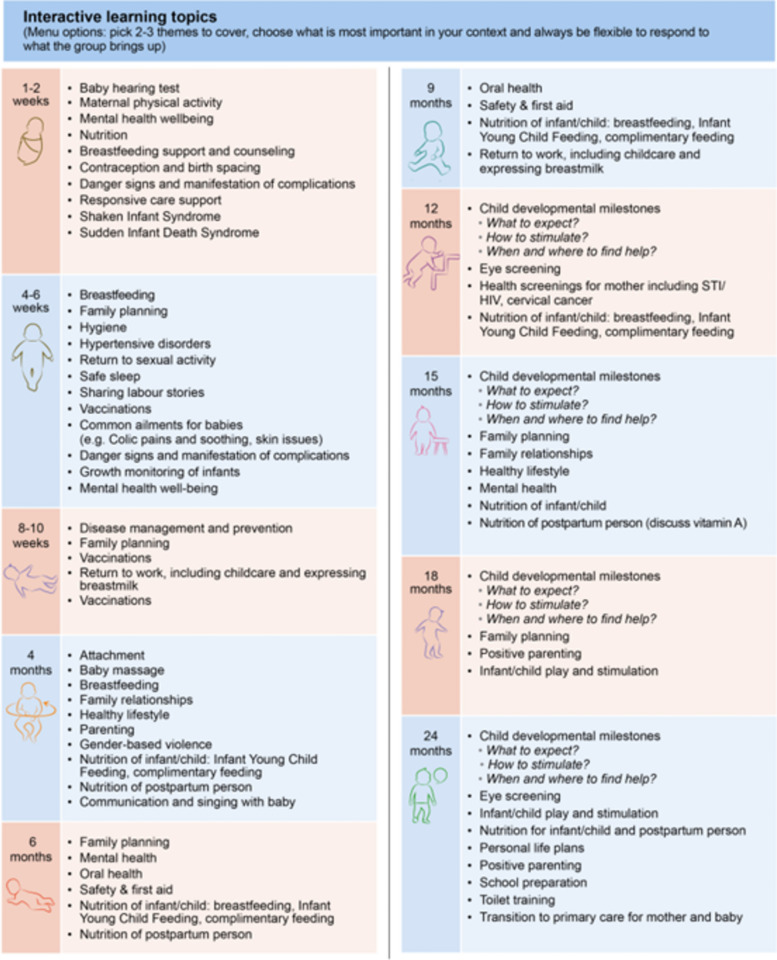
Results: Participants collaboratively modified the content, format, and evaluation of CenteringParenting® with the goal of creating a blueprint that integrates postnatal and pediatric care into group care that can be further adapted and implemented across diverse settings and contexts. The blueprint consists of suggested timing of visits over two years after birth, suggested visit content, and evaluation metrics for research and practice.
Conclusions: The resulting group care beyond birth blueprint offers a strategy to redesign maternal and infant/child health services that can positively transform postnatal care and provide essential services to postpartum people. Adaptation of the blueprint to local realities is expected. Future research is recommended to test the model's acceptability, feasibility, and effectiveness across settings. Using this blueprint, we can build the evidence base to support this model aiming to improve maternal and infant/child health outcomes.
期刊介绍:
rchives of Public Health is a broad scope public health journal, dedicated to publishing all sound science in the field of public health. The journal aims to better the understanding of the health of populations. The journal contributes to public health knowledge, enhances the interaction between research, policy and practice and stimulates public health monitoring and indicator development. The journal considers submissions on health outcomes and their determinants, with clear statements about the public health and policy implications. Archives of Public Health welcomes methodological papers (e.g., on study design and bias), papers on health services research, health economics, community interventions, and epidemiological studies dealing with international comparisons, the determinants of inequality in health, and the environmental, behavioural, social, demographic and occupational correlates of health and diseases.





 京公网安备 11010802042870号
京ICP备2023020795号-1
京公网安备 11010802042870号
京ICP备2023020795号-1

 分享
分享
 求助内容:
求助内容: 应助结果提醒方式:
 扫码关注我们
