Dawei Cheng, Xinyu Huang, Ben Shao, Caihong Zhang, Xueling Li, Meiqing Li
{"title":"Preventive efficacy of sprouting black soybean peptides on high-salt diet-induced hypertension in mice","authors":"Dawei Cheng, Xinyu Huang, Ben Shao, Caihong Zhang, Xueling Li, Meiqing Li","doi":"10.1111/1750-3841.70014","DOIUrl":null,"url":null,"abstract":"<p>This study examined possible mechanisms of action as well as the preventive and interventional effects of sprouting black soybean peptides (SBSPs) and black soybean peptides (BSPs) on hypertension in C57BL/6j mice that was brought on by a high-salt diet. BSP and SBSP were administered to mice in the black soybean peptide prevention (BSP-P) group and sprouting black soybean peptide prevention (SBSP-P) group starting 4 weeks prior to the high-salt diet, respectively. Mice in the black soybean peptide intervention (BSP-I) group and the sprouting black soybean peptide intervention (SBSP-I) group received oral doses of BSP and SBSP, respectively, together with a high-salt diet. The findings demonstrated that BSP-I, BSP-P, SBSP-I, and SBSP-P prevented the activation of localized angiotensin converting enzyme (ACE)/angiotensin II (Ang II) pathways in the kidneys and circulation, delayed the rise in blood pressure in mice, and preserved the functional nitric oxide/endothelin-1 (NO/ET-1) balance of endothelium. The inflammatory factors tumor necrosis factor-α (TNF-α), interferon-γ (IFN-γ), and interleukin-6 (IL-6) had decreased plasma levels. Additionally, it improved fibrosis, renal edema phenomena, and cardiomegaly. Furthermore, the expression of genes related to the renin–angiotensin system and endothelial function is regulated by SBSP and BSP. On the other hand, compared to intervention effects, SBSP and BSP showed more noticeable preventive benefits on hypertension brought on by a high-salt diet. When all else was equal, SBSP was more effective than BSP at avoiding hypertension. As a result, this study offers theoretical backing for SBSP as a dietary supplement source for the prevention of high-salt diet-induced hypertension.</p>","PeriodicalId":193,"journal":{"name":"Journal of Food Science","volume":"90 2","pages":""},"PeriodicalIF":3.4000,"publicationDate":"2025-02-17","publicationTypes":"Journal Article","fieldsOfStudy":null,"isOpenAccess":false,"openAccessPdf":"","citationCount":"0","resultStr":null,"platform":"Semanticscholar","paperid":null,"PeriodicalName":"Journal of Food Science","FirstCategoryId":"97","ListUrlMain":"https://ift.onlinelibrary.wiley.com/doi/10.1111/1750-3841.70014","RegionNum":2,"RegionCategory":"农林科学","ArticlePicture":[],"TitleCN":null,"AbstractTextCN":null,"PMCID":null,"EPubDate":"","PubModel":"","JCR":"Q2","JCRName":"FOOD SCIENCE & TECHNOLOGY","Score":null,"Total":0}
引用次数: 0
Abstract
This study examined possible mechanisms of action as well as the preventive and interventional effects of sprouting black soybean peptides (SBSPs) and black soybean peptides (BSPs) on hypertension in C57BL/6j mice that was brought on by a high-salt diet. BSP and SBSP were administered to mice in the black soybean peptide prevention (BSP-P) group and sprouting black soybean peptide prevention (SBSP-P) group starting 4 weeks prior to the high-salt diet, respectively. Mice in the black soybean peptide intervention (BSP-I) group and the sprouting black soybean peptide intervention (SBSP-I) group received oral doses of BSP and SBSP, respectively, together with a high-salt diet. The findings demonstrated that BSP-I, BSP-P, SBSP-I, and SBSP-P prevented the activation of localized angiotensin converting enzyme (ACE)/angiotensin II (Ang II) pathways in the kidneys and circulation, delayed the rise in blood pressure in mice, and preserved the functional nitric oxide/endothelin-1 (NO/ET-1) balance of endothelium. The inflammatory factors tumor necrosis factor-α (TNF-α), interferon-γ (IFN-γ), and interleukin-6 (IL-6) had decreased plasma levels. Additionally, it improved fibrosis, renal edema phenomena, and cardiomegaly. Furthermore, the expression of genes related to the renin–angiotensin system and endothelial function is regulated by SBSP and BSP. On the other hand, compared to intervention effects, SBSP and BSP showed more noticeable preventive benefits on hypertension brought on by a high-salt diet. When all else was equal, SBSP was more effective than BSP at avoiding hypertension. As a result, this study offers theoretical backing for SBSP as a dietary supplement source for the prevention of high-salt diet-induced hypertension.
期刊介绍:
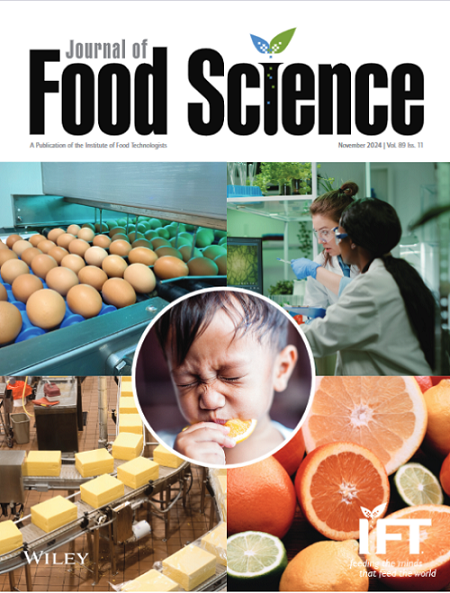
The goal of the Journal of Food Science is to offer scientists, researchers, and other food professionals the opportunity to share knowledge of scientific advancements in the myriad disciplines affecting their work, through a respected peer-reviewed publication. The Journal of Food Science serves as an international forum for vital research and developments in food science.
The range of topics covered in the journal include:
-Concise Reviews and Hypotheses in Food Science
-New Horizons in Food Research
-Integrated Food Science
-Food Chemistry
-Food Engineering, Materials Science, and Nanotechnology
-Food Microbiology and Safety
-Sensory and Consumer Sciences
-Health, Nutrition, and Food
-Toxicology and Chemical Food Safety
The Journal of Food Science publishes peer-reviewed articles that cover all aspects of food science, including safety and nutrition. Reviews should be 15 to 50 typewritten pages (including tables, figures, and references), should provide in-depth coverage of a narrowly defined topic, and should embody careful evaluation (weaknesses, strengths, explanation of discrepancies in results among similar studies) of all pertinent studies, so that insightful interpretations and conclusions can be presented. Hypothesis papers are especially appropriate in pioneering areas of research or important areas that are afflicted by scientific controversy.



 京公网安备 11010802042870号
京ICP备2023020795号-1
京公网安备 11010802042870号
京ICP备2023020795号-1

 分享
分享
 求助内容:
求助内容: 应助结果提醒方式:
 扫码关注我们
