{"title":"Type 3 diabetes and metabolic reprogramming of brain neurons: causes and therapeutic strategies.","authors":"Xiangyuan Meng, Hui Zhang, Zhenhu Zhao, Siyao Li, Xin Zhang, Ruihan Guo, Huimin Liu, Yiling Yuan, Wanrui Li, Qi Song, Jinyu Liu","doi":"10.1186/s10020-025-01101-z","DOIUrl":null,"url":null,"abstract":"<p><p>Abnormal glucose metabolism inevitably disrupts normal neuronal function, a phenomenon widely observed in Alzheimer's disease (AD). Investigating the mechanisms of metabolic adaptation during disease progression has become a central focus of research. Considering that impaired glucose metabolism is closely related to decreased insulin signaling and insulin resistance, a new concept \"type 3 diabetes mellitus (T3DM)\" has been coined. T3DM specifically refers to the brain's neurons becoming unresponsive to insulin, underscoring the strong link between diabetes and AD. Recent studies reveal that during brain insulin resistance, neurons exhibit mitochondrial dysfunction, reduced glucose metabolism, and elevated lactate levels. These findings suggest that impaired insulin signaling caused by T3DM may lead to a compensatory metabolic shift in neurons toward glycolysis. Consequently, this review aims to explore the underlying causes of T3DM and elucidate how insulin resistance drives metabolic reprogramming in neurons during AD progression. Additionally, it highlights therapeutic strategies targeting insulin sensitivity and mitochondrial function as promising avenues for the successful development of AD treatments.</p>","PeriodicalId":18813,"journal":{"name":"Molecular Medicine","volume":"31 1","pages":"61"},"PeriodicalIF":6.4000,"publicationDate":"2025-02-18","publicationTypes":"Journal Article","fieldsOfStudy":null,"isOpenAccess":false,"openAccessPdf":"https://www.ncbi.nlm.nih.gov/pmc/articles/PMC11834690/pdf/","citationCount":"0","resultStr":null,"platform":"Semanticscholar","paperid":null,"PeriodicalName":"Molecular Medicine","FirstCategoryId":"3","ListUrlMain":"https://doi.org/10.1186/s10020-025-01101-z","RegionNum":2,"RegionCategory":"医学","ArticlePicture":[],"TitleCN":null,"AbstractTextCN":null,"PMCID":null,"EPubDate":"","PubModel":"","JCR":"Q1","JCRName":"BIOCHEMISTRY & MOLECULAR BIOLOGY","Score":null,"Total":0}
引用次数: 0
Abstract
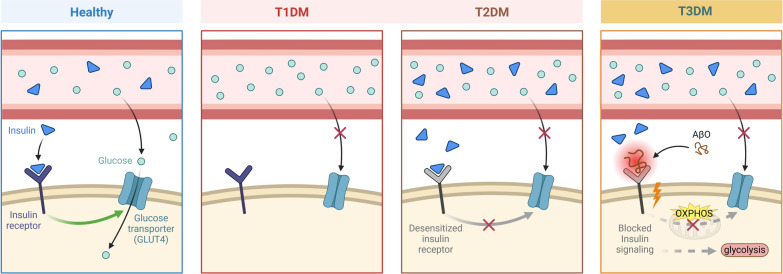
Abnormal glucose metabolism inevitably disrupts normal neuronal function, a phenomenon widely observed in Alzheimer's disease (AD). Investigating the mechanisms of metabolic adaptation during disease progression has become a central focus of research. Considering that impaired glucose metabolism is closely related to decreased insulin signaling and insulin resistance, a new concept "type 3 diabetes mellitus (T3DM)" has been coined. T3DM specifically refers to the brain's neurons becoming unresponsive to insulin, underscoring the strong link between diabetes and AD. Recent studies reveal that during brain insulin resistance, neurons exhibit mitochondrial dysfunction, reduced glucose metabolism, and elevated lactate levels. These findings suggest that impaired insulin signaling caused by T3DM may lead to a compensatory metabolic shift in neurons toward glycolysis. Consequently, this review aims to explore the underlying causes of T3DM and elucidate how insulin resistance drives metabolic reprogramming in neurons during AD progression. Additionally, it highlights therapeutic strategies targeting insulin sensitivity and mitochondrial function as promising avenues for the successful development of AD treatments.
期刊介绍:
Molecular Medicine is an open access journal that focuses on publishing recent findings related to disease pathogenesis at the molecular or physiological level. These insights can potentially contribute to the development of specific tools for disease diagnosis, treatment, or prevention. The journal considers manuscripts that present material pertinent to the genetic, molecular, or cellular underpinnings of critical physiological or disease processes. Submissions to Molecular Medicine are expected to elucidate the broader implications of the research findings for human disease and medicine in a manner that is accessible to a wide audience.





 京公网安备 11010802042870号
京ICP备2023020795号-1
京公网安备 11010802042870号
京ICP备2023020795号-1

 分享
分享
 求助内容:
求助内容: 应助结果提醒方式:
 扫码关注我们
