Mengchen Guo, Junkun Jiang, Anke Zhang, Wenjing Yu, Xin Huang
{"title":"Cholesterol promotes hair growth through activating sympathetic nerves and enhancing the proliferation of hair follicle stem cells.","authors":"Mengchen Guo, Junkun Jiang, Anke Zhang, Wenjing Yu, Xin Huang","doi":"10.1186/s10020-025-01139-z","DOIUrl":null,"url":null,"abstract":"<p><p>The regulatory mechanisms by which cholesterol influences hair regeneration remain incompletely understood. This study investigates the effects of cholesterol on hair follicle stem cells (HFSCs) proliferation and hair regeneration, with a focus on the underlying molecular mechanisms. Subcutaneous cholesterol injections in C57BL/6 mice significantly enhanced hair regeneration by promoting HFSCs proliferation. Hematoxylin and eosin (HE) staining revealed a greater number of hair follicles in the anagen phase in the cholesterol-treated group compared to controls. Immunofluorescence (IF) and BrdU labeling further confirmed that cholesterol significantly stimulated HFSCs proliferation. Mechanistically, cholesterol activated the PKA signaling pathway, leading to the phosphorylation of tyrosine hydroxylase (TH) at the serine 40 residue, which subsequently stimulated the sympathetic nervous system (SNS). SNS activation enhanced HFSCs proliferation and increased the proportion of hair follicles in the anagen phase. Furthermore, sympathetic nerve ablation significantly attenuated the hair regeneration-promoting effects of cholesterol, highlighting the critical regulatory role of SNS in this process. These findings provide key insights into the molecular mechanisms by which cholesterol regulates hair regeneration via the PKA-tyrosine hydroxylase-SNS pathway. Moreover, they suggest potential therapeutic applications targeting cholesterol-mediated signaling pathways to promote hair regeneration.</p>","PeriodicalId":18813,"journal":{"name":"Molecular Medicine","volume":"31 1","pages":"86"},"PeriodicalIF":6.4000,"publicationDate":"2025-03-05","publicationTypes":"Journal Article","fieldsOfStudy":null,"isOpenAccess":false,"openAccessPdf":"https://www.ncbi.nlm.nih.gov/pmc/articles/PMC11883958/pdf/","citationCount":"0","resultStr":null,"platform":"Semanticscholar","paperid":null,"PeriodicalName":"Molecular Medicine","FirstCategoryId":"3","ListUrlMain":"https://doi.org/10.1186/s10020-025-01139-z","RegionNum":2,"RegionCategory":"医学","ArticlePicture":[],"TitleCN":null,"AbstractTextCN":null,"PMCID":null,"EPubDate":"","PubModel":"","JCR":"Q1","JCRName":"BIOCHEMISTRY & MOLECULAR BIOLOGY","Score":null,"Total":0}
引用次数: 0
Abstract
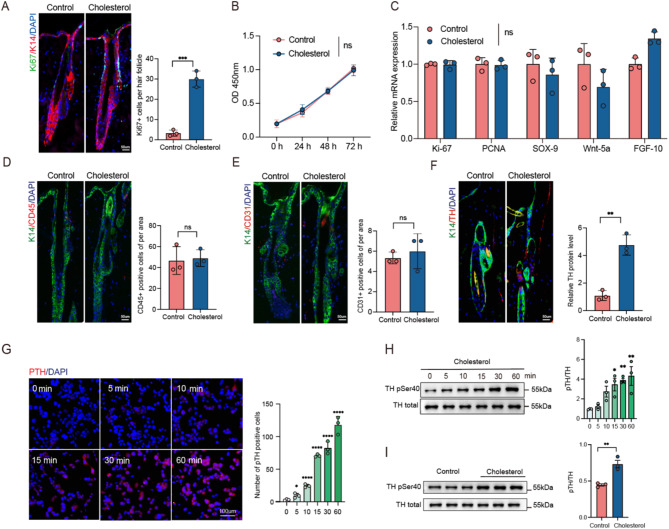
The regulatory mechanisms by which cholesterol influences hair regeneration remain incompletely understood. This study investigates the effects of cholesterol on hair follicle stem cells (HFSCs) proliferation and hair regeneration, with a focus on the underlying molecular mechanisms. Subcutaneous cholesterol injections in C57BL/6 mice significantly enhanced hair regeneration by promoting HFSCs proliferation. Hematoxylin and eosin (HE) staining revealed a greater number of hair follicles in the anagen phase in the cholesterol-treated group compared to controls. Immunofluorescence (IF) and BrdU labeling further confirmed that cholesterol significantly stimulated HFSCs proliferation. Mechanistically, cholesterol activated the PKA signaling pathway, leading to the phosphorylation of tyrosine hydroxylase (TH) at the serine 40 residue, which subsequently stimulated the sympathetic nervous system (SNS). SNS activation enhanced HFSCs proliferation and increased the proportion of hair follicles in the anagen phase. Furthermore, sympathetic nerve ablation significantly attenuated the hair regeneration-promoting effects of cholesterol, highlighting the critical regulatory role of SNS in this process. These findings provide key insights into the molecular mechanisms by which cholesterol regulates hair regeneration via the PKA-tyrosine hydroxylase-SNS pathway. Moreover, they suggest potential therapeutic applications targeting cholesterol-mediated signaling pathways to promote hair regeneration.
期刊介绍:
Molecular Medicine is an open access journal that focuses on publishing recent findings related to disease pathogenesis at the molecular or physiological level. These insights can potentially contribute to the development of specific tools for disease diagnosis, treatment, or prevention. The journal considers manuscripts that present material pertinent to the genetic, molecular, or cellular underpinnings of critical physiological or disease processes. Submissions to Molecular Medicine are expected to elucidate the broader implications of the research findings for human disease and medicine in a manner that is accessible to a wide audience.





 京公网安备 11010802042870号
京ICP备2023020795号-1
京公网安备 11010802042870号
京ICP备2023020795号-1

 分享
分享
 求助内容:
求助内容: 应助结果提醒方式:
 扫码关注我们
