{"title":"Photonic NP-Complete Problem Solver Enabled by Local Spatial Frequency Encoding","authors":"Xueyi Jiang, Shiji Zhang, Bo Wu, Hailong Zhou, Zhichao Ruan, Jianji Dong, Xinliang Zhang","doi":"10.1021/acsphotonics.4c01795","DOIUrl":null,"url":null,"abstract":"Due to the absence of known polynomial-time algorithms, NP-complete (NPC) problems, such as the subset sum problem (SSP), pose a significant challenge for electronic computers. Optical approaches, known for their inherent parallelism, low latency, and reduced power consumption, present a promising alternative. However, existing diffractive networks (DNNs) are limited to achieving only polynomial-level parallelism. In this work, we introduce an SSP solver that achieves exponential parallelism, allowing the SSP problem to be solved within polynomial time (volume). By using beam splitting in a synthetic polarization dimension to maintain a single localized optical spot and encoding spatial frequencies onto this spot, the solutions can be successfully searched in parallel. Moreover, unlike other spatial optical computing systems that require substantial thickness due to overlapping nonlocality (ONL), our system can remain remarkably thin. This thinness enables the addition of more layers without increasing the overall size, facilitating efficient 3D stacking. We have conducted a proof-of-principle experimental demonstration and discussed the advantages of our method over other state-of-the-art solutions. This work lays a strong foundation for the exploration of novel paradigms to fully utilize the parallelism of optical computing.","PeriodicalId":23,"journal":{"name":"ACS Photonics","volume":"25 1","pages":""},"PeriodicalIF":6.7000,"publicationDate":"2025-02-20","publicationTypes":"Journal Article","fieldsOfStudy":null,"isOpenAccess":false,"openAccessPdf":"","citationCount":"0","resultStr":null,"platform":"Semanticscholar","paperid":null,"PeriodicalName":"ACS Photonics","FirstCategoryId":"101","ListUrlMain":"https://doi.org/10.1021/acsphotonics.4c01795","RegionNum":1,"RegionCategory":"物理与天体物理","ArticlePicture":[],"TitleCN":null,"AbstractTextCN":null,"PMCID":null,"EPubDate":"","PubModel":"","JCR":"Q1","JCRName":"MATERIALS SCIENCE, MULTIDISCIPLINARY","Score":null,"Total":0}
引用次数: 0
Abstract
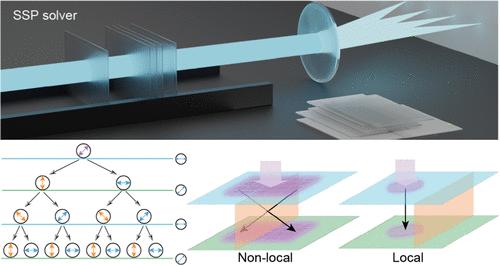
Due to the absence of known polynomial-time algorithms, NP-complete (NPC) problems, such as the subset sum problem (SSP), pose a significant challenge for electronic computers. Optical approaches, known for their inherent parallelism, low latency, and reduced power consumption, present a promising alternative. However, existing diffractive networks (DNNs) are limited to achieving only polynomial-level parallelism. In this work, we introduce an SSP solver that achieves exponential parallelism, allowing the SSP problem to be solved within polynomial time (volume). By using beam splitting in a synthetic polarization dimension to maintain a single localized optical spot and encoding spatial frequencies onto this spot, the solutions can be successfully searched in parallel. Moreover, unlike other spatial optical computing systems that require substantial thickness due to overlapping nonlocality (ONL), our system can remain remarkably thin. This thinness enables the addition of more layers without increasing the overall size, facilitating efficient 3D stacking. We have conducted a proof-of-principle experimental demonstration and discussed the advantages of our method over other state-of-the-art solutions. This work lays a strong foundation for the exploration of novel paradigms to fully utilize the parallelism of optical computing.
期刊介绍:
Published as soon as accepted and summarized in monthly issues, ACS Photonics will publish Research Articles, Letters, Perspectives, and Reviews, to encompass the full scope of published research in this field.




 京公网安备 11010802042870号
京ICP备2023020795号-1
京公网安备 11010802042870号
京ICP备2023020795号-1

 分享
分享
 求助内容:
求助内容: 应助结果提醒方式:
 扫码关注我们
