{"title":"Ecological benefits of tourism management and the challenges of habitat classification","authors":"Andrew Torsney , Yvonne M. Buckley","doi":"10.1016/j.gecco.2025.e03477","DOIUrl":null,"url":null,"abstract":"<div><div>Nature-based tourism is increasingly popular, with destination competitiveness tied to natural assets or protection status. While tourism often poses conservation challenges, limited research explores its potential ecological benefits when management aligns ecological and visitor experience goals. We examine how management practices intended to enhance tourism offerings affect plant diversity in a Natura 2000 Special Area of Conservation. We also investigate how habitat classification influences conservation outcomes in two distinct habitat types: the more sensitive Machair Grassland and the less sensitive Fixed Dunes. Habitat classification criteria may affect biodiversity protection, site vulnerability, and the impact of tourism. Using a grazing exclosure experiment, we assess how grazing management influences plant diversity, measured by Simpson’s index. We compare the effects of grazing on biodiversity under the current Fixed Dune classification and an alternative classification as Machair, highlighting the impact of classification on conservation management outcomes. We demonstrate that appropriate grazing management significantly enhances plant diversity, providing evidence for the ecological benefits of managing for both tourism and conservation goals. Furthermore, the study demonstrates that habitat classification criteria can directly affect conservation management outcomes for protected habitats. This study challenges the prevailing 'war-on-tourism' narrative, supporting a synergistic management approach where tourism and conservation are jointly aligned, essential as nature-based tourism continues to grow. Emphasising the imperative of understanding habitat classification and ecological benefits for effective alignment of tourism and conservation.</div></div>","PeriodicalId":54264,"journal":{"name":"Global Ecology and Conservation","volume":"58 ","pages":"Article e03477"},"PeriodicalIF":3.4000,"publicationDate":"2025-04-01","publicationTypes":"Journal Article","fieldsOfStudy":null,"isOpenAccess":false,"openAccessPdf":"","citationCount":"0","resultStr":null,"platform":"Semanticscholar","paperid":null,"PeriodicalName":"Global Ecology and Conservation","FirstCategoryId":"93","ListUrlMain":"https://www.sciencedirect.com/science/article/pii/S2351989425000782","RegionNum":2,"RegionCategory":"环境科学与生态学","ArticlePicture":[],"TitleCN":null,"AbstractTextCN":null,"PMCID":null,"EPubDate":"2025/2/19 0:00:00","PubModel":"Epub","JCR":"Q1","JCRName":"BIODIVERSITY CONSERVATION","Score":null,"Total":0}
引用次数: 0
Abstract
Nature-based tourism is increasingly popular, with destination competitiveness tied to natural assets or protection status. While tourism often poses conservation challenges, limited research explores its potential ecological benefits when management aligns ecological and visitor experience goals. We examine how management practices intended to enhance tourism offerings affect plant diversity in a Natura 2000 Special Area of Conservation. We also investigate how habitat classification influences conservation outcomes in two distinct habitat types: the more sensitive Machair Grassland and the less sensitive Fixed Dunes. Habitat classification criteria may affect biodiversity protection, site vulnerability, and the impact of tourism. Using a grazing exclosure experiment, we assess how grazing management influences plant diversity, measured by Simpson’s index. We compare the effects of grazing on biodiversity under the current Fixed Dune classification and an alternative classification as Machair, highlighting the impact of classification on conservation management outcomes. We demonstrate that appropriate grazing management significantly enhances plant diversity, providing evidence for the ecological benefits of managing for both tourism and conservation goals. Furthermore, the study demonstrates that habitat classification criteria can directly affect conservation management outcomes for protected habitats. This study challenges the prevailing 'war-on-tourism' narrative, supporting a synergistic management approach where tourism and conservation are jointly aligned, essential as nature-based tourism continues to grow. Emphasising the imperative of understanding habitat classification and ecological benefits for effective alignment of tourism and conservation.
期刊介绍:
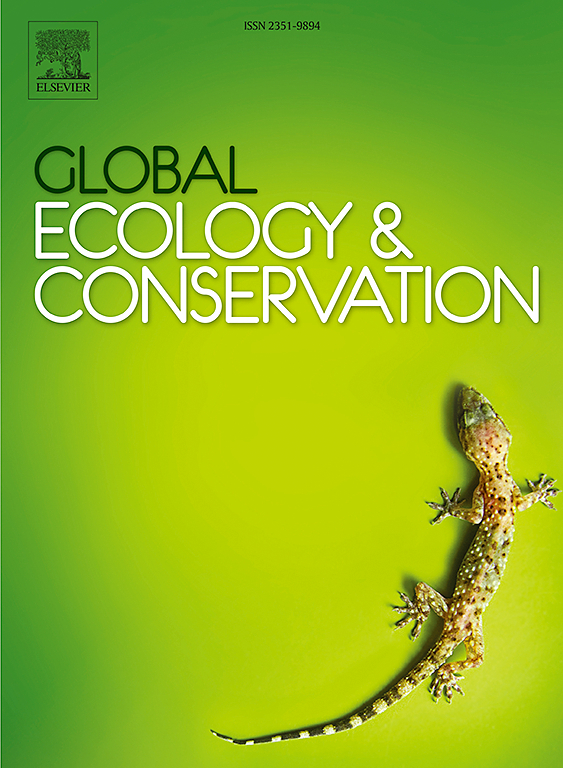
Global Ecology and Conservation is a peer-reviewed, open-access journal covering all sub-disciplines of ecological and conservation science: from theory to practice, from molecules to ecosystems, from regional to global. The fields covered include: organismal, population, community, and ecosystem ecology; physiological, evolutionary, and behavioral ecology; and conservation science.




 京公网安备 11010802042870号
京ICP备2023020795号-1
京公网安备 11010802042870号
京ICP备2023020795号-1

 分享
分享
 求助内容:
求助内容: 应助结果提醒方式:
 扫码关注我们
