{"title":"Deep learning in gonarthrosis classification: a comparative study of model architectures and single vs. multi-model methods.","authors":"Sahika Betul Yayli, Kutay Kılıç, Salih Beyaz","doi":"10.3389/frai.2025.1413820","DOIUrl":null,"url":null,"abstract":"<p><strong>Purpose: </strong>This study aims to classify Kellgren-Lawrence (KL) osteoarthritis stages using knee anteroposterior X-ray images by comparing two deep learning (DL) methodologies: a traditional single-model approach and a proposed multi-model approach. We addressed three core research questions in this study: (1) How effective are single-model and multi-model deep learning approaches in classifying KL stages? (2) How do seven convolutional neural network (CNN) architectures perform across four distinct deep learning tasks? (3) What is the impact of CLAHE (Contrast Limited Adaptive Histogram Equalization) on classification performance?</p><p><strong>Approach: </strong>We created a dataset of 14,607 annotated knee AP X-rays from three hospitals. The knee joint region was isolated using a YOLOv5 object detection model. The multi-model approach utilized three DL models: one for osteophyte detection, another for joint space narrowing analysis, and a third to combine these outputs with demographic and image data for KL classification. The single-model approach directly classified KL stages as a benchmark. Seven CNN architectures (NfNet-F0/F1, EfficientNet-B0/B3, Inception-ResNet-v2, VGG16) were trained with and without CLAHE augmentation.</p><p><strong>Results: </strong>The single-model approach achieved an F1-score of 0.763 and accuracy of 0.767, outperforming the multi-model strategy, which scored 0.736 and 0.740. Different models performed best across tasks, underscoring the need for task-specific architecture selection. CLAHE negatively impacted most models, with only one showing a marginal improvement of 0.3%.</p><p><strong>Conclusion: </strong>The single-model approach was more effective for KL grading, surpassing metrics in existing literature. These findings emphasize the importance of task-specific architectures and preprocessing. Future studies should explore ensemble modeling, advanced augmentations, and clinical validation to enhance applicability.</p>","PeriodicalId":33315,"journal":{"name":"Frontiers in Artificial Intelligence","volume":"8 ","pages":"1413820"},"PeriodicalIF":4.7000,"publicationDate":"2025-02-05","publicationTypes":"Journal Article","fieldsOfStudy":null,"isOpenAccess":false,"openAccessPdf":"https://www.ncbi.nlm.nih.gov/pmc/articles/PMC11835854/pdf/","citationCount":"0","resultStr":null,"platform":"Semanticscholar","paperid":null,"PeriodicalName":"Frontiers in Artificial Intelligence","FirstCategoryId":"1085","ListUrlMain":"https://doi.org/10.3389/frai.2025.1413820","RegionNum":0,"RegionCategory":null,"ArticlePicture":[],"TitleCN":null,"AbstractTextCN":null,"PMCID":null,"EPubDate":"2025/1/1 0:00:00","PubModel":"eCollection","JCR":"Q2","JCRName":"COMPUTER SCIENCE, ARTIFICIAL INTELLIGENCE","Score":null,"Total":0}
引用次数: 0
Abstract
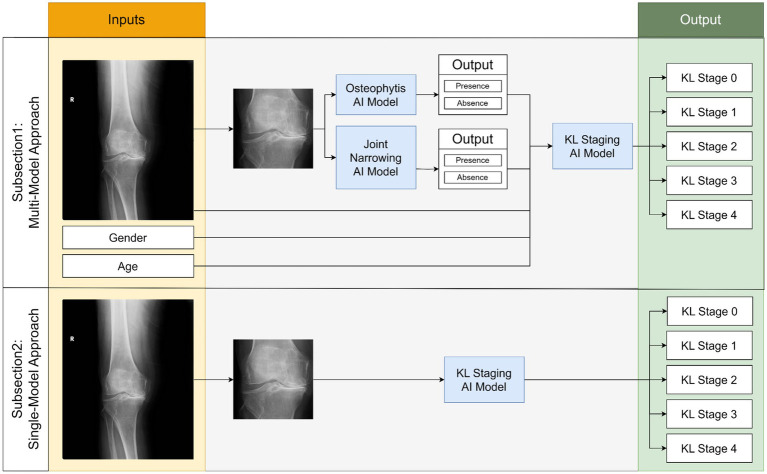
Purpose: This study aims to classify Kellgren-Lawrence (KL) osteoarthritis stages using knee anteroposterior X-ray images by comparing two deep learning (DL) methodologies: a traditional single-model approach and a proposed multi-model approach. We addressed three core research questions in this study: (1) How effective are single-model and multi-model deep learning approaches in classifying KL stages? (2) How do seven convolutional neural network (CNN) architectures perform across four distinct deep learning tasks? (3) What is the impact of CLAHE (Contrast Limited Adaptive Histogram Equalization) on classification performance?
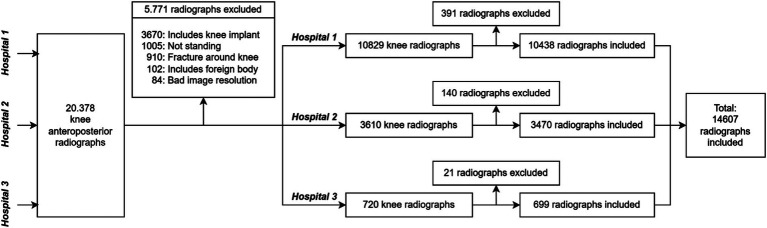
Approach: We created a dataset of 14,607 annotated knee AP X-rays from three hospitals. The knee joint region was isolated using a YOLOv5 object detection model. The multi-model approach utilized three DL models: one for osteophyte detection, another for joint space narrowing analysis, and a third to combine these outputs with demographic and image data for KL classification. The single-model approach directly classified KL stages as a benchmark. Seven CNN architectures (NfNet-F0/F1, EfficientNet-B0/B3, Inception-ResNet-v2, VGG16) were trained with and without CLAHE augmentation.
Results: The single-model approach achieved an F1-score of 0.763 and accuracy of 0.767, outperforming the multi-model strategy, which scored 0.736 and 0.740. Different models performed best across tasks, underscoring the need for task-specific architecture selection. CLAHE negatively impacted most models, with only one showing a marginal improvement of 0.3%.
Conclusion: The single-model approach was more effective for KL grading, surpassing metrics in existing literature. These findings emphasize the importance of task-specific architectures and preprocessing. Future studies should explore ensemble modeling, advanced augmentations, and clinical validation to enhance applicability.





 京公网安备 11010802042870号
京ICP备2023020795号-1
京公网安备 11010802042870号
京ICP备2023020795号-1

 分享
分享
 求助内容:
求助内容: 应助结果提醒方式:
 扫码关注我们
